Mexican Papel Picado: The Meaning Behind Day of the Dead’s Colorful Paper Art


One of the first things I notice when Día de Muertos approaches in Mexico is that colorful papel picado starts appearing everywhere.
You’ll see these delicate sheets of cut paper hanging across streets, decorating restaurants, covering market stalls, and adding color to traditional ofrendas.
The designs are often intricate, with flowers, skeletons, skulls, and other images cut into the paper.
Although papel picado looks beautiful, and its movement in the breeze is part of what makes it so recognizable, it isn’t simply a decoration.
This of course begs the question: “So what’s the papel picado meaning then?“
Let’s dive in and find out the true meaning of papel picado, why is it used for Day of the Dead, and why it has a symbolic place in Mexican celebrations.
Disclosure: This article may contain affiliate links, meaning when you make a purchase, I earn a small commission. Affiliate links cost you nothing to use, and help keep my content free. It’s a win-win for us both. For more info, see the Disclosure Policy.
What Is Papel Picado?

Papel picado translates roughly as “perforated paper” or “punched paper.”
It is a traditional Mexican craft made by cutting elaborate designs into thin sheets of paper.
Traditionally, artisans stack several sheets and cut through them using specialized tools, allowing them to create repeated patterns — much like how kids make snowflake art ❄️
The finished sheets are often strung together to make colorful banners.
Although papel picado is especially associated with Día de Muertos, it is also used for Mexican Independence Day, weddings, birthdays, religious celebrations, and other festivities.
For Día de Muertos, the designs frequently include skeletons, skulls, marigold flowers, candles, and other images associated with the holiday.
I love how something as simple as paper can transform a space, with a few strings of papel picado making a home, street, or altar feel festive immediately.
What Does Papel Picado Symbolize on Day of the Dead?

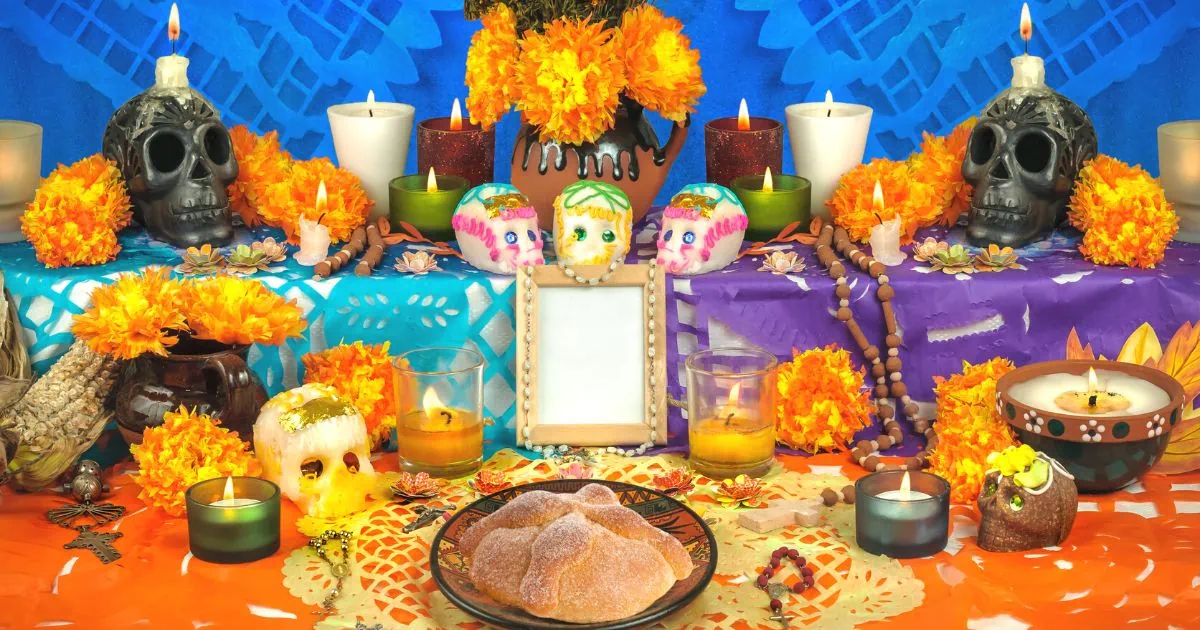
The most widely recognized interpretation of papel picado on a Day of the Dead altar is that 🌬️ it represents the elements of wind and air.
Air is one of the natural elements commonly represented on an ofrenda, alongside water, earth, and fire.
The paper moves gently whenever a breeze passes through, making the element of air visible.
The movement also adds a sense of life to the altar.
Mexico’s National Institute of Anthropology and History (INAH) includes papel picado among the familiar elements of an ofrenda, explaining that it adds color to the celebration and represents the wind.
Papel picado also has a practical decorative purpose; its bright colors and intricate designs bring together the different elements of an ofrenda.
Why Is Papel Picado Used on Day of the Dead Altars?

An ofrenda is a space prepared to honor deceased loved ones.
Families may include photographs, candles, cempasúchil flowers, water, favorite foods, pan de muerto, and personal belongings.
Papel picado adds another layer of meaning to this arrangement.
Its movement represents air, while its colors and patterns create a visual connection between the different offerings.
You may see it draped along the front of an altar, hung above photographs, or arranged as a backdrop behind the offerings.
Some families use just a few sheets, while others decorate an entire room with paper banners.
There isn’t one required way to arrange it. The design of an ofrenda often reflects family customs, available space, and personal preferences.
If you’re interested in what the other items represent, check out my guide to the meaning of every item on a Day of the Dead altar.
What Do the Designs on Papel Picado Mean?

The designs cut into papel picado can be just as interesting as the colors.
💀 Skulls and Skeletons
Skulls and skeletons are among the most familiar designs and symbols representing Day of the Dead.
They connect the paper decoration with the central theme of Día de Muertos: remembering our loved ones who have passed.
In Mexican traditions, skeleton imagery isn’t necessarily intended to be frightening the way it is in European traditions.
It can be playful, artistic, and celebratory, and in fact, is the subject of many traditional Mexican tattoo designs.
🌼 Flowers
Flowers are another common design, especially marigolds and roses, incorporated with other decorative patterns to complement the flowers.
Cempasúchil, the bright orange marigold flower most associated with Día de Muertos, is particularly recognizable during the season.
If you’d like to learn more about this special flower, I wrote this separate article about why marigolds are used for Day of the Dead.
🕯️ Candles and Other Symbols
Some designs include candles, crosses, hearts, or other religious and decorative imagery.
These designs can reflect the different cultural influences found in Día de Muertos traditions.
The symbolism isn’t identical for every family or community, so I wouldn’t assume that every cutout has one universally accepted meaning.
What Do the Colors of Papel Picado Mean?

Papel picado comes in many colors, including purple, orange, yellow, pink, blue, green, white, and black.
You may hear explanations assigning a specific meaning to every color.
For example, purple is sometimes associated with mourning, while orange is connected with cempasúchil and the broader visual language of Día de Muertos.
White may be associated with hope or purity in some interpretations.
However, color symbolism can vary, and there isn’t one universal color code followed by every family in Mexico.
The colors are also chosen for their visual impact, as bright paper banners stand out against dark backgrounds, candlelight, flowers, and photographs.
When I see papel picado hanging above a traditional altar, I think the overall effect is just as important as the meaning assigned to any individual color.
Is Papel Picado a Pre-Hispanic Tradition?

The history of papel picado is more complicated than simply describing it as an ancient Indigenous decoration.
Paper has a long history in Mexico, including the use of amate, a material made from tree bark that was used by Indigenous communities for various purposes.
However, the familiar colorful banners made from thin tissue paper are associated with a later craft tradition.
The technique of cutting decorative paper has influences beyond Mexico, and Mexican artisans developed their own distinctive designs and methods.
It is useful to distinguish the broader history of paper in Mexico from the specific craft of modern papel picado.
Día de Muertos itself has also developed over time, incorporating Indigenous traditions and Catholic practices introduced during the colonial period.
I discuss this cultural development in my article on the origins and fascinating history of Día de Muertos.
Rather than assuming that every decoration has remained unchanged for centuries, I find it more helpful to understand Día de Muertos as a living tradition.
Papel Picado in Mexico

Though associated with Day of the Dead, papel picado isn’t exclusive to the holiday.
In many restaurants and towns like Sayulita, Mexico (seen above), as well as other Mexican cities, papel picado hangs year-round.
However, it is definitely one of the most recognizable Day of the Dead symbols.
One of the things I appreciate about experiencing Día de Muertos in different parts of Mexico is seeing how the celebration changes from one place to another.
I’ve attended Day of the Dead celebrations in Mexico City, Oaxaca City, and Mérida, and I find that the setting can influence the overall atmosphere.
In Mexico City, papel picado can be part of large public displays as well as home altars and market decorations.
In Oaxaca City, you’ll find it among the flowers, foods, crafts, and other visual elements associated with the season for sale at local mercados (markets).
In Mérida, it can also be part of seasonal Hanal Pixan decorations in homes, businesses, and public spaces.
Do note that these examples shouldn’t be taken to mean that every community decorates in the same way. They don’t!
Local traditions and individual families make their own choices about how to prepare for Día de Muertos.
That variation is one of the things that makes experiencing the holiday across Mexico so interesting.
How Is Papel Picado Made?

As its name does literally mean “perforated paper” or “punched paper,” traditional papel picado is made by cutting designs into thin paper.
Artisans may use chisels, hammers, and patterns to create intricate details.
To save time, several sheets can be stacked together so that the same design is repeated across multiple pieces.
The cutouts allow light to pass through the paper and make the patterns visible.
The finished sheets are often attached to string or ribbon, creating long banners that can be hung across a room, an outdoor space, or an ofrenda (altar).
The process requires patience and precision, particularly when the designs include small details.
Although mass-produced versions are widely available, handmade papel picado remains an important example of Mexican decorative craft.
Can You Use Papel Picado at Home?

Absolutely. If you’re preparing your own Day of the Dead ofrenda, papel picado is an easy way to introduce color and movement.
You can hang it above the altar, attach it to the front of a table, or string it across a wall behind the photographs.
If you are making a small altar, a few sheets may be enough because you don’t need to recreate an elaborate public display to make the decoration meaningful!
Choose colors and designs that complement the other elements of your ofrenda, and make sure the paper is kept safely away from candles and other open flames.
Is Papel Picado Only Used for Day of the Dead?

No. Papel picado is used for many important holiday celebrations throughout Mexico.
You’ll see it at weddings, religious festivals, birthdays, baptisms, national holidays, and other events, as well as in restaurants year-round.
The patterns and colors often change according to the occasion.
- For Día de Muertos, skulls, skeletons, and flowers are common papel picado motifs.
- For other celebrations, the designs might feature doves, hearts, flags, or different decorative patterns.
- In restaurants, they often have their own papel picado made with the restaurant’s name.
- Some towns keep papel picado with generic designs up year round, especially in tourist or high-traffic areas, to add a festive touch.
This versatility is part of what makes papel picado such a recognizable Mexican craft.
Why Papel Picado Is an Important Day of the Dead Symbol

Papel picado is more than a colorful banner.
On a Day of the Dead altar, it is commonly understood to represent air and wind, while its movement adds a lively quality to the display.
Its designs connect it visually with the flowers, candles, skulls, and other elements associated with the holiday.
After living in Mexico since 2018, I’ve come to appreciate how these details contribute to the atmosphere of Día de Muertos in Mexico.
The celebration is full of meaningful objects, but they don’t all have to be solemn, as color, craft, food, and decoration are part of the experience, too.
This is exactly why papel picado is such an appealing symbol of Día de Muertos: it combines artistry, movement, and meaning in a simple piece of paper.