
Celebrating Day of the Dead in Mexico: Everything You Need to Know to Do it Right


dia de los muertos in mexico on your bucket list?
Smart choice! I live in Mexico and have attended Mexican Day of the Dead celebrations in several cities, so this article contains all my pro tips and a lot of info about the holiday itself. Here’s why Mexicans celebrate Day of the Dead.
Even though the Dia de Muertos holiday revolves around death, it’s anything but a somber affair.
In fact, many celebrations of Day of the Dead in Mexico are huge parties that last for days, complete with food, music, drinking, dancing and decorations.
Though it may seem little more than a party at first glance, Day of the Dead is a cultural celebration. It has deep roots and centuries-old traditions that trace back to the ancient Aztecs.
In 2008, UNESCO proclaimed Day of the Dead an Intangible Cultural Heritage of Humanity.
Taking this in simpler terms, it means the holiday represents one of the defining aspects of Mexican culture.
In this article, you’ll discover everything you need to know about Day of the Dead in Mexico — from its ancient origins and symbols, to how to celebrate Day of the Dead in Mexico today, and the best places to celebrate it. Let’s dive in!
What is Day of the Dead?
The first thing you need to know about Dia de los Muertos — it is not Mexican Halloween. Day of the Dead is, however, one of the most important and best Mexican holidays, with traditions that date back thousands of years.

Unlike many present-day rituals around death, Day of the Dead is not a somber funerary event. On the contrary, Dia de Muertos is a celebration, one so grand even the deceased return to attend the party held in their honor.
🤔 What does dia de muertos mean?
In case you didn’t know, both día de muertos and día de los muertos mean Day of the Dead in Spanish.
The Day of the Dead celebration holds great significance in the life of Mexico’s indigenous communities. The fusion of pre-Hispanic religious rites and Catholic feasts brings together two universes…
Source: UNESCO
The most correct way to say it is día de muertos; without “los” before the word “muertos.” However, you will see it written as both día de muertos and día de los muertos.
History of Day of the Dead in Mexico

The holiday’s origins date back to the Aztec celebration of the goddess Mictecacihuatl, the Aztec Queen of the Underworld.
Much like the current incarnation of Day of the Dead, the Aztec festival was a celebratory affair.
After Mexican colonization by the Spanish, who brought with them Christianity, the Spanish forcibly moved the festival’s dates.
The Aztec holiday originally took place in early-summer, but was moved to the fall season by the Spanish.
These new fall dates coincided with what Christians called Allhallowtide. This is another multi-day holiday commemorating the deceased, but from the Christian pantheon.
Allhallowtide took place on October 31 to November 2. The first day, October 31, was known as All Saints Eve; November 1 was All Saints Day; and November 2 was All Souls Day. Day of the Dead uses these same dates.
💀 A Journey to Míctlan: The Underworld
As mentioned, Day of the Dead is by no means a gloomy festival. In fact, for pre-Columbian Mexicans, death was simply a trip to Mictlán, which is the Underworld in Aztec mythology.
You can get an idea of what Mictlán is said to look like by watching the movie Coco.
For the Aztecs, this was a blessing, not a curse. They viewed death as little more than a transition, and their Underworld was actually a place to party.
If the notion that death is a paradise sounds strange, it’s something you find in most religions and ancient cultures.
In Christianity, it’s called heaven; for the Vikings, it was Valhalla; for Muslims, it’s called Jannah; and for ancient Greeks, it was Elysium.
When is the Day of the Dead in Mexico?
It depends, as different places have different celebrations. Officially, Day of the Dead is November 2nd, but in some places, it’s a is a two-day holiday that takes place November 1st and 2nd.

Day of the Dead is celebrated on November 1 and 2 every year.
In 2026, it falls on Sunday, November 1 and Monday, November 2.
However, in the cities that have the most elaborate Day of the Dead Celebrations in Mexico, preparations can begin 7-10 days prior.
In some places, Día de los Muertos takes over entirely. Bright orange marigold flowers blanket the streets, colorful papel picado (craft paper) gets hung across streets, and comparsas (parades or processions) take over the streets.
October 31: All Saints Eve

Wondering, When does Day of the Dead start?
The first day is November 1 at midnight, which is why many say Day of the Dead begins on October 31. At midnight, the spirits of the departed children are said to return.
Though technically the “eve” of Dia de Muertos, much like Christmas Eve, many consider it a festival day.
You may see people putting the final touches on their ofrendas (altars), or at the cemetery decorating the gravestone of their deceased loved one.
November 1st: Day of the Little Angels

What was formerly known as All Saints Day, is present-day Día de los Angelitos, or the Day of the Little Angels. This day honors the children who have passed.
You may also see this day called the Día de los Inocentes, or Day of the Innocents. However, make sure not to confuse it with Day of Holy Innocents, which is on December 28th.
November 2nd: Day of the Dead

Formerly known as All Souls Day, November 2nd is the actual Day of the Dead day. On this day, family members and loved ones celebrate the adults in their life who no longer walk the Earth.
The spirits of all adults returned the night before, at midnight, but parties will continue all day.
Of the three days of Day of the Dead, this is usually the most tranquil, as celebrations begin to wrap up in most places.
What are the differences between Day of the Dead and Halloween?
At first glance, the spooky iconography both holidays share might make them look identical. However, calling Day of the Dead simply “Mexico Halloween” denies its unique connection to the pre-Hispanic and Aztec people.

While present-day Halloween is mostly about costumes and trick or treating, Day of the Dead is explicitly about the afterlife and remembrance of your departed loved ones. Here’s how Day of the Dead and Halloween really differ.
However, Halloween was very much a holiday about the deceased.
The tradition of Halloween costumes arose because the Europeans considered the spirits that returned to Earth to be evil. (Note: Halloween comes from the European Pagan holiday called Samhain.)
They dressed their children in costumes so these malevolent spirits wouldn’t recognize them. They feared the spirits would capture the kids, or worse, kill them.
Within Day of the Dead traditions, the dead are peaceful, joyful and welcomed guests.
In fact, all the parties during Day of the Dead are held in their honor, and the elaborate ofrendas (altars) contain their favorite foods and beverages.
What are the similarities between the Day of the Dead and Halloween?
That being said, the holidays do share quite a few similarities, like these:
- They both stem from ancient traditions — Halloween from European Paganism, and Day of the Dead from the Aztecs.
- They were both morphed with Christianity into the holidays we know today.
- They are both based on the idea that spirits return to Earth once a year.
As the United States and Mexico share thousands of miles of a land border, a mixing of cultures and customs continues to occur.
In Mexico today, Halloween is just as popular in some cities as Day of the Dead.
Let’s face it: Everyone loves dressing up. Halloween parties in Mexico with American-style costumes are becoming the norm.
Young children dress up in costumes for Calaverita, the equivalent of trick-or-treating.
Day of the Dead in Spain vs Mexico
Spain doesn’t celebrate Day of the Dead the way Mexico does.
Instead, Spaniards mark Día de Todos los Santos (All Saints’ Day) on November 1, a national holiday.
Families visit cemeteries to clean graves and leave flowers, and bakeries sell sweets like huesos de santo and buñuelos.
It’s a quieter, more solemn day, without Mexico’s ofrendas, marigolds, parades and face paint.
5 Best Places to Celebrate Day of the Dead in Mexico
Whether you want to experience a traditional Mexico Day of the Dead festival, or just party like you never have before, there’s a perfect place for you.
Below, you’ll find the five best places to attend Day of the Dead in Mexico. 🌺💀🌺 For a more complete list, check out these 17 Best Day of the Dead Celebrations in Mexico.
1. Oaxaca City, Oaxaca


Oaxaca Day of the Dead Tours
This 7 Day Oaxaca Day of the Dead Tour has an amazing itinerary where you’ll venture off the beaten path to experience this Mexico holiday like a local.
As far as parties and bustling celebrations go, Oaxaca City is THE place to visit for Day of the Dead in Mexico. In fact, the Oaxaca Day of the Dead festivities helped put this holiday on many travelers’ Mexico bucket list.
Constantly dubbed the capital of Mexican folklore, Day of Dead in Oaxaca City is as lively as it can get. What makes it this way? The local people.
Oaxacans love a good party. Their cultural roots run deep, and they seem to find an excuse to party many days of the year. Besides Day of the Dead, there are festivals in Oaxaca nearly every month.
During Day of the Dead Oaxaca, you’ll see ofrendas (altars), marigold flowers and decorations all over the city’s colorful streets.
Most events take place outdoors, with Oaxacan food, music and parades in every corner of downtown Oaxaca City.
Though it’s called “Day” of the Dead, in Oaxaca, the holiday lasts a week — sometimes more.
If you’re attending, get ready for the experience of a lifetime, where the music is played loud, the Oaxaca mezcal flows and even the dead come to party.
🌺💀🌺 Want to attend Day of the Dead in Oaxaca Mexico? Check out this Ultimate Guide to Día de Muertos in Oaxaca City which includes everything you need to know to attend the festival like a pro.
How to get to Oaxaca City
When traveling to Oaxaca City, you’ll want to fly into Oaxaca International Airport (code: OAX). It is located just 20-30 minutes from Downtown Oaxaca.
You can also fly to Mexico City Airport (code: MEX), then rent a car in the Mexico City Airport and drive to Oaxaca City.
If you don’t want to drive, take the six-hour Mexico City to Oaxaca bus ride via the ADO bus.
2. Mexico City

day of the Dead in Mexico City: What to expect
Mexico City wasn’t always a go-to destination for Day of the Dead.
That changed after the opening scene of the 2015 James Bond film Spectre put it in the spotlight.
The film opens with an epic Day of the Dead parade in Mexico City, which never actually existed.
The story goes that so many people showed up for the parade the year after Spectre came out that the government had to make the scene a reality.
In 2016, life imitated art, and Mexico City held its first Gran Desfile de Día de Muertos (Day of the Dead Parade).
🤔 Wondering, What is an alebrije? They are colorful chimera creatures, or hybrid animals, which some say serve as spirit guides.
Mexico City Day of the Dead Parade
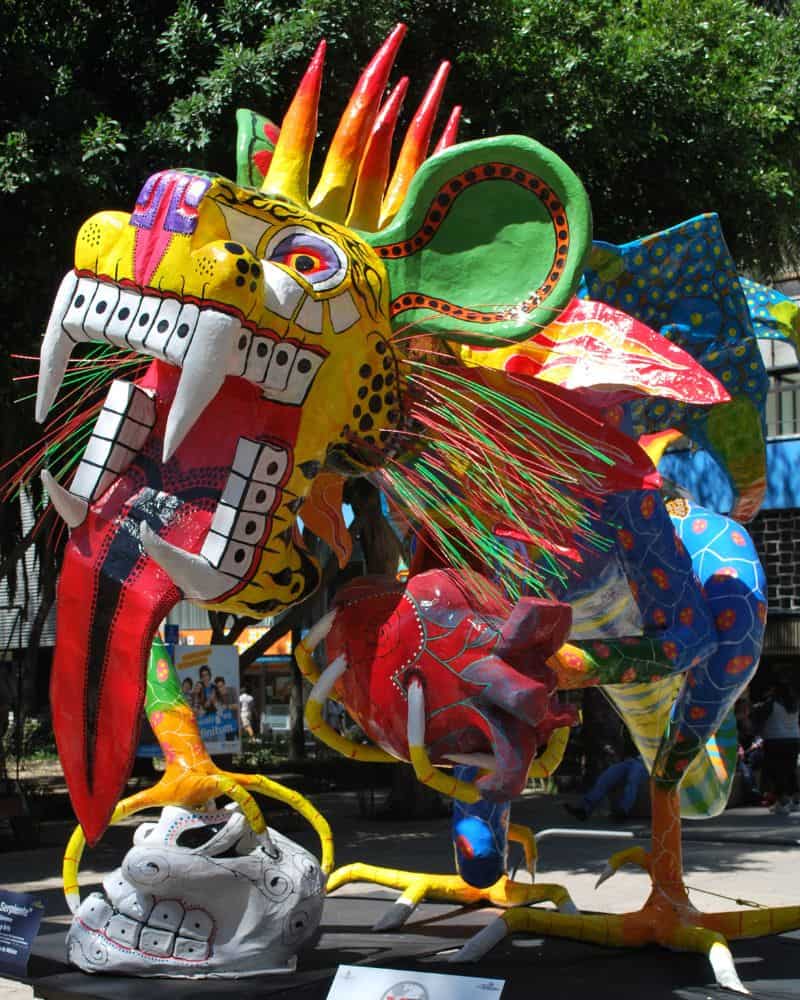
Each year, an army of volunteers take over many of the main streets in Mexico City, shutting them down for the parade.
Performers march with giant floats and skeletons, wearing colorful costumes of traditional Day of the Dead characters.
The 2026 parade travels along Paseo de la Reforma and Avenida Juárez toward the Zócalo (Main Square).
A separate Alebrijes Parade, on Saturday, October 17, 2026, ends with giant alebrijes displayed along Paseo de la Reforma.
You can see them from about October 18 into early November.
WHEN IS THE MEXICO CITY DAY OF THE DEAD PARADE?
The Dia de los Muertos Mexico City parade dates vary, but the parade is usually the Saturday before the actual Day of the Dead holiday.

In 2026, the Mexico City Day of the Dead Parade is on Saturday, October 31, the day before Day of the Dead.
It officially starts at 2pm, but it often runs late. For a front-row spot, arrive a few hours early
Get the route map and my best viewing tips in my Mexico City Day of the Dead Parade 2026 guide.
Is Day of the Dead in Mexico City safe?
For the most part — Yes. It is a lively time to visit, but also perfectly safe as long as you follow the same general travel safety measures you would anywhere else.
Still, as one of the largest cities on Earth, you will need to stay aware of yourself, your belongings and your surroundings at all times.
How to get to Mexico City
This is probably the easiest Day of the Dead to get to, as you’ll just fly into Mexico City International Airport (code: MEX).
From there, the easiest and safest way to get to your accommodation is with this private shuttle service.
3. Merida, Yucatan (Hanal Pixan)

Merida may not be the first place you think of for Day of the Dead in Mexico, but Yucatan’s most colorful city observes a version of it.
Hanal Pixan (pronounced ha-nal pick-shaw) is similar to Day of the Dead, but with a Mayan twist. In fact, some people call it the Mayan Day of the Dead celebration.
In Merida, you’ll find large ofrendas (altars) throughout the town. Many of the best ones are in Plaza Grande (Main Plaza in Downtown Merida) and other public spaces along the Paseo de Montejo.
You can also sample some traditional Yucatan foods during Hanal Pixan that aren’t made other times of the year.
One of the locals’ favorite foods is called pib (AKA mucbipollo or pibipollo), a type of crispy, baked tamale.
Paseo de las Animas (Merida Day of the Dead Parade)
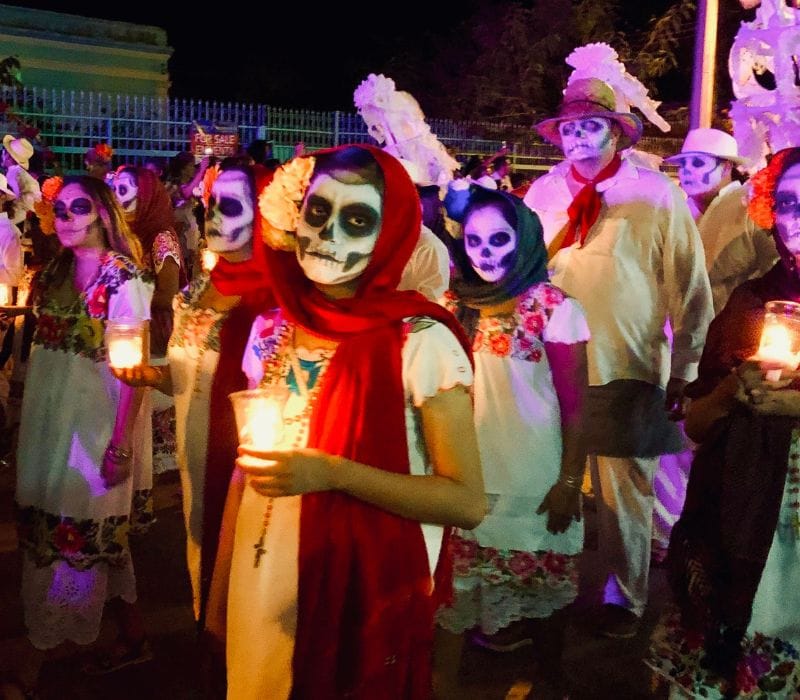
Paseo de las Animas is one of the most popular events in Merida. In 2026, it’s on Friday, October 30, starting at 6pm at the Cementerio General de Mérida (Main Merida Cemetery).
During the parade, you’ll hear music and see thousands of people dressed up in traditional attire, with their faces painted as skulls.
Unlike in most parts of Mexico, most people don’t paint their faces with bright colors; just black and white. However, you can also find colorful painted faces; it’s just not typical of this region in Mexico.
If you’re interested in participating, this is a wonderful way to do so. Face painters will be set up before the parade so you can easily get your face painted and join in.
The parade ends at Parque San Juan Park, where the festivities continue.
How to get to Merida
You’ll fly into Merida International Airport (code: MID), located about 20-30 minutes from downtown.
From there, the easiest and safest way to get to your accommodation is with this private shuttle service.
There are plenty of great Merida hotels in downtown and also chic boutique hotels in Merida — but make sure to reserve yours at least 1-2 months before the actual holiday because things do sell out.
4. Patzcuaro & Janitzio Island, Michoacán

Isla Janitzio Island is one of the quintessential places for an authentic Day of the Dead celebration in Mexico.
It is also a must-visit for culture travelers, as the main part of Mexico to get to experience the Purépecha people and their unique culture.
Isla Janitzio is a small island on Lake Pátzcuaro. It is one of the towns in the Patzcuaro pueblo magico (magic town), located in Michoacán state.
There are several Patzcuaro Day of the Dead celebrations, but the one in Janitzio Island is considered among the best in town.
The main celebrations in Janitzio and Patzcuaro go from October 31 to November 2nd.
In 2026, Michoacán’s main Noche de Muertos week runs from October 28 to November 2.
🎥 Day of the Dead Fun Fact: The cemetery in Patzcuaro, Mexico, inspired the cemetery seen in the Pixar movie Coco, a beloved film about El Día de los Muertos.
Day of the Dead in Janitzio Island

The main date to party and celebrate Day of the Dead in Janitzio Island is November 2. However, you’ll want to arrive by October 30 if you want to experience the more traditional festivities.
On October 31, the Day of the Dead celebration begins with traditional boats heading into the waters off-shore to hunt ducks with spears.
They are later cooked and placed on ofrendas (altars) as a way to welcome the deceased back to the living world.
On November 1, women and children visit the town’s graveyards and begin decorating the graves. The locals in Patzcuaro and Janitzio go all out, as there is a contest to select the best altars and grave decorations in town.
Once the sun begins to go down on October 31, festive celebrations in Patzcuaro and Janitzio officially start.
Through dance performances, music and food, locals and visitors alike celebrate the lives of their departed loved ones. This massive party goes on until November 2, and sometimes even longer.
How to get to Janitzio Island
You’ll first fly into either Mexico City International Airport (code MEX), or Morelia International Airport (code: MLM).
Then, make your way by rental car or bus to the Pátzcuaro Embarcadero (dock), then take the boat to Janitzio Island.
There’s plenty of parking at the dock, and in a few parking lots just nearby.
5. Guanajuato City, Guanajuato

Guanajuato City, the capital of Guanajuato state, attracts thousands of visitors each year to see the monumental altar at the University of Guanajuato.
Students of the university build and create this dazzling altar to honor illustrious academic figures.
The rest of the town is also festively-decorated, and you’ll see (and smell) marigold flowers all over, as well as ofrendas (altars).
There’s also a Dia de los Muertos parade, outdoor shows, and large sculptures outside the Teatro Juarez Theater.
How to get to Guanajuato
You’ll want to fly into Bajío International Airport AKA Guanajuato International Airport (code: BJX). From there, the easiest and safest way to get to your accommodation is with this private shuttle service.
It’s only about one hour from Guanajuato to San Miguel de Allende, which also has a fun celebration for Day of the Dead in Mexico.
Consider renting a car and visiting both towns to attend both the Guanajuato Dia de los Muertos events and San Miguel de Allende Day of the Dead events.
10 Tips for Celebrating Day of the Dead in Mexico

🟢 Do: Book your air travel and hotel as far in advance as possible.
This is especially true if you plan on visiting extremely popular places for Day of the Dead like Oaxaca City or Janitzio Island in Patzcuaro, Michoacan. (You’ve been warned 💀)
🟢 Do: Participate! This holiday is about remembering the departed, so many Oaxacan families love when you ask about their deceased loved ones honored on the altars.
When you see a parade going by, jump in and start dancing with the locals.
🟢 Do: Have a day where your only plan is to walk the city. During Day of the Dead, whole towns are transformed for this giant party, so explore as much as you can while the decorations are up.
🟢 Do: Ask for permission to take photos. To err on the side of caution, get permission from families in the cemeteries and at their ofrendas (altars), and when photographing people.
🟢 Do: Carry cash on you at all times. In Mexico, cash is still king — and in small towns, many places don’t take cards. This is especially true with taxis, in local mercados (markets), and street vendors, which will all be cash only.
🟢 Do: Pack noise canceling earbuds or noise canceling earplugs to get a good night’s sleep during this festive holiday. Day of the Dead is basically a multi-day party with music and celebrations city-wide.
🛑 Don’t: Treat this as a tourist attraction.
The Day of the Dead Festival is a centuries-old cultural tradition, so have fun — but know this is not the same thing as getting wasted on Bourbon Street during Mardi Gras in New Orleans.
🛑 Don’t: Touch or disturb anything, including altars, cemetery decorations, sawdust carpets and sand art on the ground, as it’s not respectful.
🛑 Don’t: Use flash photography anywhere. To be safe you’ll want to just turn your flash from auto to off so your camera doesn’t accidentally go flash at the wrong moment.
🛑 Don’t: Don’t wear American-style costumes; especially not the “sexy” variety that end up on Buzzfeed lists.
This is not Mexico’s Halloween, and it has a different vibe than Halloween in the United States. 💃 For an idea of what to wear, head here.
Day of the Dead Symbols & Customs
1. Day of the Dead Cemeteries

Decorating the gravestones in cemeteries is one of the most beautiful Day of the Dead customs.
In some places, like Patzcuaro and Janitzio Island in Michoacán state, they even have contests for the best decorations.
The decorations are a way to honor the dead, and spruce up their final resting place a bit. Also, the strong scent of the cempasuchil flowers (marigolds) is said to call them back.
In many places, family members spend all day decorating on October 31st, or a few days earlier.
If you’re celebrating Day of the Dead in Mexico, try to arrive by October 30th so you can see the town being decorated for this elaborate holiday.
2. Day of the Dead Sugar Skulls

One of the icons of this holiday is the Day of the Dead sugar skull. Ironically enough, these confectionery treats don’t really have Mexican (or even pre-Hispanic) roots, and come from Europe.
Italian Catholic missionaries brought sugar art to Mexico in the 1600s. Unlike Europe, Mexico is abundant in sugar and sugarcane, so it became a natural place for these molded sugar figures to take root and form their own traditions.
💀 Small sugar skulls vs large sugar skulls

During Día de Muertos México, sugar skulls will be made in two sizes: Large and small.
The larger ones are often placed on a gravestone in honor and remembrance of the departed children.
These bite-sized ones can also be eaten, used for in-home ofrenda (altar) decoration, and can be taken home as souvenirs.
The larger ones represent a departed person, and that person’s name is written on the forehead of the skull.
You’ll usually see these more elaborate, larger sugar skulls placed on an ofrenda or gravestone for that person’s returning spirit. These larger sugar skulls are not meant to be eaten.
3. Marigolds: Day of the Dead Flowers

Marigold flowers, or cempasuchil (pronounced sem-pa-souch-ill), have been a part of this celebration dating back to its Aztec origins.
According to Aztecs beliefs, the flower’s bright color and strong scent served a sensory guide for the spirits. They believed the marigold flowers let our departed know exactly where they should return to meet us.
Nowadays, no Day of the Dead ofrenda (altar) is complete without some cempasuchil flowers on it.
You’ll also see marigolds and terciopelo rojo (cockscomb flowers) decorating cities and cemeteries all over Mexico.
🌼💀🌼 Day of the Dead Fun Fact: Throughout Mexico, marigolds are often called flor de los muertos (flower of the dead) because of their close associations with Day of the Dead.
4. La Catrina: Day of the Dead Skeleton Woman

Besides Frida Kahlo, La Catrina might be the woman most commonly associated with Mexico.
This elegant skeletal lady, who everyone paints their faces to look like, was born in 1910 when Mexican illustrator José Guadalupe Posada first drew her.
He named this figure La Calavera Garbancera (The Elegant Skull, which is sometimes called La Calavera Catrina) — and she was drawn as satirical social commentary.
Posada’s dapper woman with her fancy feathered-hat was a critique of Mexican society at the time. According to him, many Mexicans were starting to dress more European.
Posada saw this change as a snub to the more humble, and traditional style of Mexican dress. This is exactly why La Calavera Garbancera is dressed as she is, in European-style attire.
He created his Calavera Garbancera character as a skeleton who served as a reminder that we all eventually die one day — whether we’re wearing fancy clothing or not.
History of La Catrina: Day of the Dead Icon

La Catrina’s transition into the official grand dame of Day of the Dead came after Mexican artist Diego Rivera (Frida’s husband) painted her with a full-body and Victorian dress.
Using a similar face, he took Posada’s La Calavera Garbancera and created who would become known as La Catrina.
Rivera’s 50-foot-long (15 m) painting, Sueño de una tarde dominical en la Alameda Central (Dream of a Sunday Afternoon in Alameda Central Park), made La Catrina’s full-body form famous.
In the painting, La Catrina is placed in the dead center (pun very much intended). Diego Rivera, who’s depicted as a young boy, stands by her side, and just behind them, you’ll see Frida Kahlo.
🎨 Want to see the painting in real life? You’ll need to head to Downtown Mexico City, to the Diego Rivera Mural Museum, one of the best museums in Mexico City.
5. Comparsas: Day of the Dead Parades
You’ll hear a comparsa or muerteada (both words mean parade) long before you see it coming.
This is great because it gives you time to find it, and then join in with the procession as it passes through the streets.
During a comparsa, multi-instrument groups of costumed musicians join together to play festive music in the streets.
Anyone can join in at any part along the parade route, as this is one of the most festive Day of the Dead traditions. You can join to just walk, or start dancing as the parade moves along.
6. Ofrendas: Day of the Dead Altars

Just walking the streets and alleyways of many towns in Mexico, you’ll see a plethora of ofrendas (altars).
They are usually decorated with a combo of marigold flowers, candles, sugar skulls, copal incense and/or colorful paper flags called papel picado.
You’ll also see photos of the departed in a frame, and whatever food and drink they would want to consume on their arrival.
They say when the dead return they will be hungry and thirsty from the journey — so we have to prepare accordingly.
7. Day of the Dead Sand Tapestries

On streets and in front of some ofrendas, you’ll find colorful and intricate tapetes de arena (sand tapestries). If you’re very lucky, you’ll even see an artist making one.
The tradition of sand art plays into the deeper meaning of Day of the Dead, that all things eventually blow away in the wind, or die.
For this reason, you’ll also see ground art made of other natural materials the wind can carry away, like marigold flower petals and even beans.
8. Day of the Dead Sawdust Carpets

Tapetes de aserrín (sawdust carpets) are made throughout Mexico for Day of the Dead, and also for other holidays like Semana Santa (Holy Week).
In some places, entire streets get shut down to cars so the carpets can be made.
The tapetes de aserrín sawdust carpets take days to make, with entire families or even whole towns pitching in.
Much like the Day of the Dead sand tapestries, the carpets eventually blow away in the wind.

Alebrijes were first made by Mexican artist Pedro Linares in Mexico City. At age 30, he suffered a terrible illness, and even had fever dreams at night.
One night, he saw a chimera (hybrid animal) screaming the word “alebrije,” a word that has no real meaning.
From this vision, he made an artistic representation of this colorful chimera, and the first alebrije was born.
10. Mojigangas: Giant Puppets

Mojigangas (pronounced moe-he-gawn-gahs) come from Spain, but were brought to Mexico in the 1600s.
They stand about 15-feet-tall (4.5 m), and are a part of many celebrations in Central Mexico.
You can see mojigangas everywhere from festivals in Oaxaca to weddings in San Miguel de Allende. You’ll also see mojiganga puppets during Mexico Day of the Dead in several cities.
Day of the Dead Food
Pan de Muerto (Day of the Dead Bread)

Pan de muerto, or “Dead Bread,” is a type of bread roll or pastry that’s traditionally only made from about mid-September to mid-November.
It is the food most associated with Day of the Dead.
In Oaxaca, unlike the rest of Mexico, there is a small candy face placed in the center to represent a departed soul. The bread is topped with sesame seeds, and isn’t very sweet.
However, in many other parts of Mexico, pan de muerto has a cross shape on the top of the roll, and is topped with sugar.
They also have orange zest or orange blossom water added, so they taste similar to a morning bun.
Tamales

You’ll find tamales on the dinner table during most Mexican holidays — from Christmas in Mexico to Día de la Candelaria on February 2nd.
This is an ancient, pre-hispanic food made from one of the most important Mexican staple ingredients, maiz (corn).
A tamal (tamale in English), is a traditional Mexican dish made from masa, or corn dough.
To the masa, you can add other ingredients like rajas (roasted poblano peppers), chicken and mole, or even fruits for tamales dulces (sweet tamales).
The mixture is then wrapped in a corn husk or banana leaf, and steamed.
In Central Mexico, you’ll find most tamales made with a corn husk. However, in southern Mexico, especially Oaxaca and the Yucatan Peninsula, it’s made with banana leaves.
Pib (Mucbipollo)
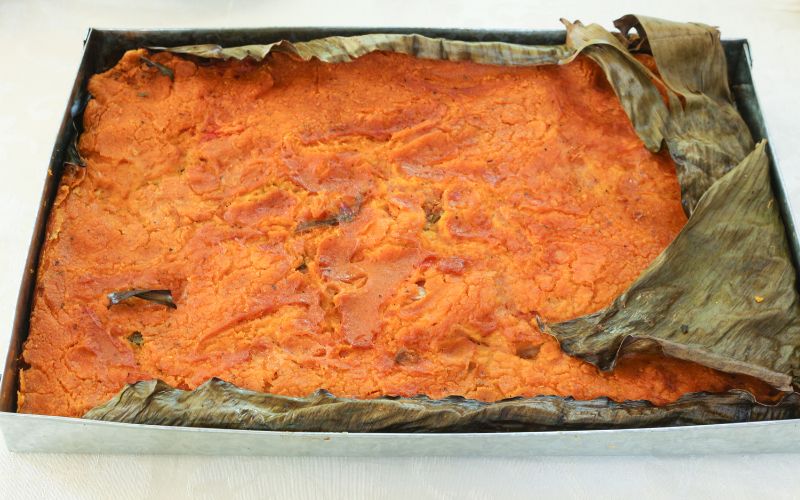
If you’re traveling to Yucatan during Hanal Pixan, the Mayan Day of the Dead holiday, make sure to try pib (AKA mucbipollo or pibipollo).
Pib is a crispy, baked tamale that looks more like a casserole than a tamal, as it gets cooked in large sheets.
For Yucatan visitors, you’ll probably just want a single pib tamal, not a whole pan of it. Be on the lookout for chachacuahs or tamales enterrados, meaning “buried tamales,” for a single serving of pib tamale.
Yucatecan pib is a locals’ favorite — and something you’ll rarely (if ever) see outside of Yucatan Peninsula.
It is only made and sold from about mid-October to early-November, to coincide with the Hanal Pixan holiday.
Alfeñique Candy

Alfeñique (pronounced al-fen-yeek) is a confectionary treat that originated in Spain, though it has Islamic roots.
Known as “Al-Fanid” in Islamic Spain, this was a warmed sweet candy used to treat coughs — basically an ancient cough drop!
Of the most famous alfeñique candies in Mexico, there’s the sugar skulls. However, these aren’t the only ones. Nowadays, you can find many shapes of alfeñique, and in very elaborate designs.
Champurrado: Hot Chocolate

Champurrado (pronounced champ-pour-ah-doe) is a type of Mexican hot chocolate.
It is a bit richer than regular Mexican hot chocolate because it’s prepared with masa de maíz (corn flour), piloncillo (raw cane sugar) and cinnamon.
Champurrado has been around since the Aztec times, and really useful to keep people warm on a cooler winter night during Day of the Dead.
One of the best Mexico drinks still made today, champurrado’s thick texture is perfect for dipping churros in.
Atole: Vanilla Drink

Atole (pronounced ah-toe-lay) is nearly the same drink as champurrado, but with vanilla instead of chocolate.
For those who prefer vanilla to chocolate, atole is one of the must-try drinks in Mexico during Day of the Dead.
Day of the Dead in Mexico: FAQ
How long does Day of the Dead last?
Though it’s called “Day” of the Dead, the holiday runs November 1-2.

It officially begins at midnight on November 1, which is why some say the holiday starts October 31st; though it technically begins at midnight on November 1st.
What is the official Day of the Dead in Mexico?
The actual Day of the Dead day is November 2nd each year. The date never changes.

November 1st is called the Día de los Angelitos (Day of the Little Angels) to honor the children who have passed; November 2 is the Day of the Dead for the adults.
What does Day of the Dead represent?
During the Day of the Dead, the doors of the underworld are believed to open up, and the veil between the living and the dead thins enough for the spirits to pass through it.
This allows families to reunite with their departed loved ones, if only for a brief moment.
While many think it’s just a holiday about death, it’s also a celebration of life.
For those who get into the spirit of Día de Muertos, the holiday gives you a chance to reconnect with your departed loved ones in a festive way.
How do they celebrate Day of the Dead in Mexico?
It depends — Some cities and towns in Mexico take things to the next level by hosting city-wide street parties that last a few days, or a few weeks.
These are the towns you see in Instagram photos, but know this isn’t necessarily the norm.
In the majority of Mexican cities, you wouldn’t even know there’s a holiday going on.
For a list of the most fun places to visit, check out the 17 Best Day of the Dead Celebrations in Mexico.
Some people simply enjoy a low-key celebration at home with traditional Day of the Dead foods.
Others build elaborate, colorful ofrendas (altars) with pictures of the deceased as well as their favorite treats, food and personal items.
Why is Day of the Dead important to Mexico?
It’s an ancient tradition, and a party — So what’s not to love?!

In Mexico, family is one of the most important aspects of the culture.
Día de Muertos allows us to reconnect with our lost loved ones, even if just for a day, so it’s a special time in Mexico.
Is Day of the Dead Mexico’s most important holiday?
That depends on who you ask, but know there are a lot of holidays in Mexico — usually one per month.
During the Mexico Christmas Season, which runs from mid-December to early-January, there are about five major winter holidays in Mexico alone.
It would be impossible to say if Day of the Dead is the most important holiday in Mexico for everyone, because that would depend on who you’re asking.
Still, it’s definitely among the most important Mexican holidays celebrated all year — and the one that attracts the world’s attention.
What do I wear for Day of the Dead in Mexico?
Wondering how to dress for Day of the Dead in Mexico? In general, Mexicans tend to dress on the conservative side, even during holidays like Day of the Dead.

As mentioned, this is not a time for the “sexy costumes” that are popular in the United States.
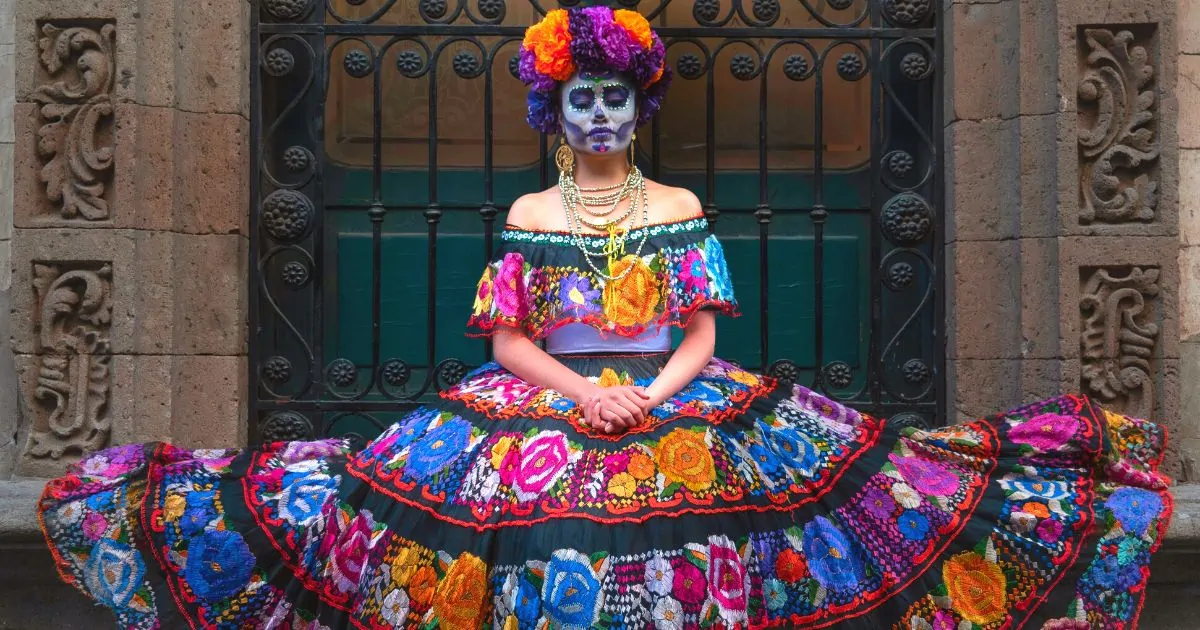
However, since it’s Dia de Muertos, many will don a special dress to enjoy the nighttime festivities — like these.
You can also visit a local Mexican mercado (market) wherever you’re headed and pick up a dress there.
Costumes are the norm for locals, and many do go all out — but with traditional Mexican garments, not wild costumes.
💄 La Catrina Face Painting

Want to get your face painted like La Catrina, the famous Day of the Dead Woman?
You don’t need to bring all your makeup, as street vendors will do it for about $50 pesos ($3 USD).
You will definitely want to bring a good makeup remover to get it off at the end of the night though.
🌸 Day of the Dead Flower Crowns
You’ll find street vendors selling inexpensive flower crowns to complete the look.
In some places, vendors make fresh flower crowns in the local mercados (markets) — or you can also go all out with one of these elaborate flower crown headbands.
My Final Thoughts on Celebrating Day of the Dead in Mexico
Day of the Dead is not a gloomy festival, and it never was.
For pre-Columbian Mexicans, death was simply a free trip to Mictlán — the Underworld in Aztec mythology.
For them, death was always viewed as a transformation; never a mournful event.
During the Mexico festival of the dead, the veil between the living and the dead is thinned so the dead may cross back over.
If death itself was never a sad event for the Aztecs, then the return of the deceased is also not a sad event; it’s a call for celebration.
On a personal note — I live in Mexico, have traveled to 23 out of 32 states, and lived in five.
I feel I know the country pretty well, and always say that Day of the Dead is the best time to visit, especially Day of the Dead in Oaxaca.
Additional Day of the Dead Blogs

Need more information on the Mexico Day of the dead holiday? Here’s some blogs you’ll want to read next:
