20 Powerful Day of the Dead Symbols and Their Meanings (Colors, Decorations & Characters)

What do marigolds, sugar skulls and La Catrina actually mean? Why are all the flowers orange?
As someone who has lived in Mexico since 2018 and has celebrated Día de los Muertos in several cities, I’m here to explain these Day of the Dead symbols and their meanings to you.
While every city in Mexico celebrates the holiday a little differently, the same symbols show up everywhere: on family altars, in cemeteries, in parades and on every bakery shelf in late October.
Below are the Top 20 Day of the Dead symbols (Día de los Muertos symbols) and what they mean.

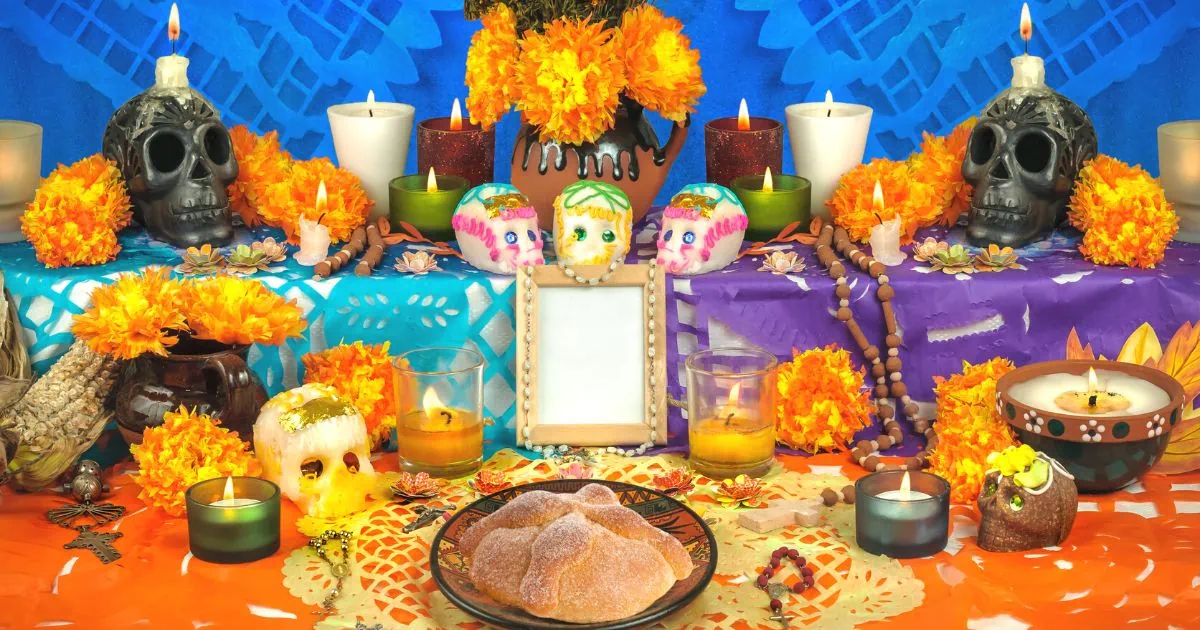
1. Ofrendas (Day of the Dead Altars)

The ofrenda is the heart of the holiday, and most Day of the Dead symbols live on it.
Families build them at home, in businesses and on graves, and towns build big public ones in plazas.
An ofrenda (offering) is an altar built to welcome the dead home.
The souls of loved ones are said to return for a visit each year. They arrive hungry and thirsty, so the family sets out everything they’ll need.
Ofrendas often have two or three levels, and once I learned what each symbol meant, every altar started to tell a story.
A common explanation is that two levels stand for heaven and earth, and three add the underworld (or purgatory), though families arrange them however feels right.
In late October, you’ll see them all over Mexican cities. Look in homes with the door left open, hotel lobbies, shops and the main plaza.
In Oaxaca City, it felt like every doorway in Centro had an altar.
Some families even leave their front doors open so people walking by can see the ofrenda inside.
🕯️ What goes on a Day of the Dead altar? Most of the next seven symbols on the list, ie. flowers, candles, incense, photos, and more.
Families also add whatever the person loved: their favorite food, a cold beer, cigarettes, a deck of cards, a toy for a child.
2. Marigold Flowers (Cempasúchil)

The marigold, or cempasúchil (sem-pah-SOO-cheel), has been part of this celebration since Aztec times.
The name comes from Nahuatl and means “20 flowers,” for its many petals.
According to the old beliefs, the flower’s bright color and strong scent guide the spirits home.
That’s why families scatter a path of petals from the street (or the cemetery) to the altar, so the souls can find their way.
Throughout Mexico, marigolds are also called flor de muerto (flower of the dead).
You’ll see them on every ofrenda, in archways over doorways, and in piles at the markets in the last week of October.
Magenta cockscomb (terciopelo rojo, or mano de león) is usually right beside them.
3. Candles (Velas)
Candles light the way for the dead.
Many families place one candle for each soul they’re welcoming, and cemetery vigils on the night of November 1 can be lit almost entirely by candlelight.
Some altars use four candles in the shape of a cross to mark the four cardinal directions, so the soul can find its way from anywhere.
4. Papel Picado

Papel picado (“punched paper”) is the colorful tissue-paper banner cut with intricate designs: skulls, Catrinas, flowers and crosses for this holiday.
It hangs over altars, across streets and outside restaurants.
Because it’s so delicate, papel picado is often said to represent the fragility of life.
It’s also said to represent wind, one of the four elements on a traditional ofrenda (with water, earth in the form of food, and fire in the candles).
Much of Mexico’s papel picado is still made by hand in San Salvador Huixcolotla, Puebla, where artisans cut through stacks of paper with hammers and chisels.
Day of the Dead decorations tip: Papel picado, small sugar skulls and Catrina figurines are the easiest Day of the Dead decorations to bring home.
Markets sell them year-round, but especially during the holidays.
5. Water and Salt
A glass of water is set out for souls who arrive thirsty after their long journey. Salt purifies, and some families arrange it in the shape of a cross.
In some traditions it also keeps the soul’s body from “spoiling” on the trip there and back.
6. Copal Incense

Copal is a tree resin that’s been burned in Mexico since before the Spanish arrived.
On an ofrenda, its smoke purifies the space, keeps away bad spirits and carries prayers.
The smell of copal mixed with marigolds is the scent of Día de Muertos.
7. Photos and Personal Items

A photo of each person being honored is placed on the altar so their soul knows which ofrenda is theirs.
Families add the things the person loved: their favorite drink (tequila, mezcal, beer or a Coke), a favorite dish, a hat, tools from their trade, or toys for a child.
This is why every altar is different; the most meaningful Day of the Dead symbols are often the ones that only mean something to that family.
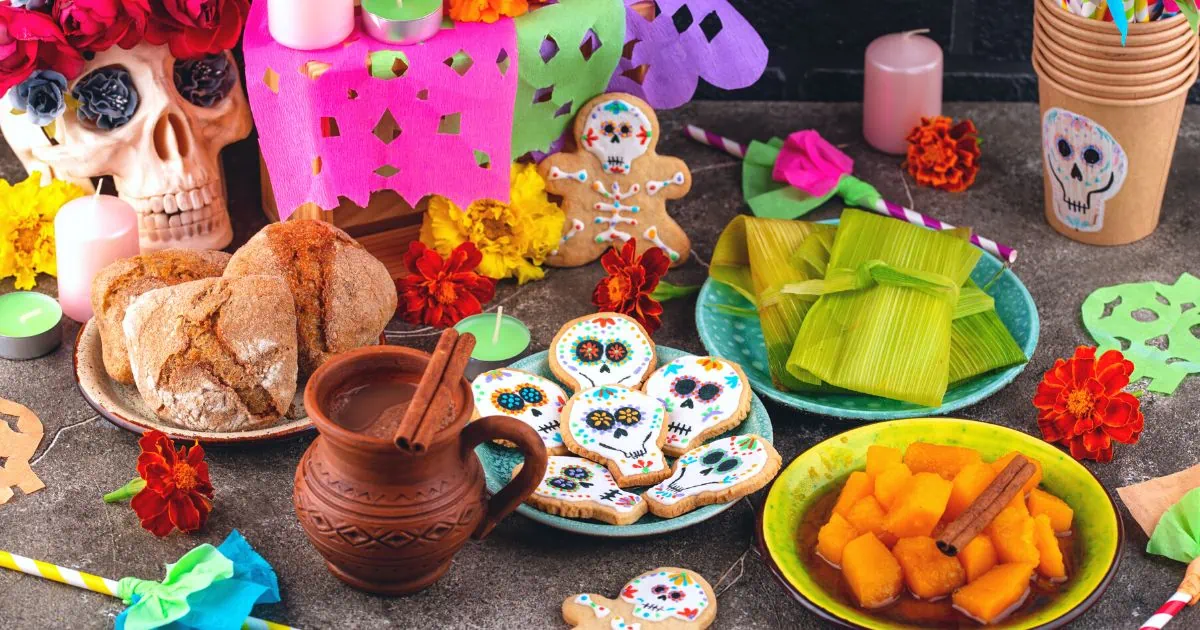
8. Pan de Muerto (Day of the Dead Bread)

Pan de muerto (bread of the dead) is a soft, sweet roll made only from about mid-September to mid-November.
The most common style is round, flavored with orange blossom, and topped with sugar.
The strips of dough on top represent bones, often in a cross, and the little ball in the center is said to be a skull or a teardrop.
It’s put on the ofrenda for the dead, but the living eat plenty of it too, usually dunked in hot chocolate.
Different Types of pan de muerto in Mexico

Traditional Mexican pan de muerto bread changes from region to region.
In Oaxaca, pan de yema is decorated with a small painted face (carita) that represents a departed soul, and some versions are topped with sesame seeds.
In Mexico City, you’ll find the classic sugar-topped version everywhere, plus filled versions in fancier bakeries.
In Mérida, you’ll find pan de muerto in the bakeries too. But during Hanal Pixán, the food everyone talks about is mucbipollo (more on that below).
🍞 More Day of the Dead foods: 30 Best Day of the Dead Foods & Drinks
9. Sugar Skulls (Calaveras de Azúcar)

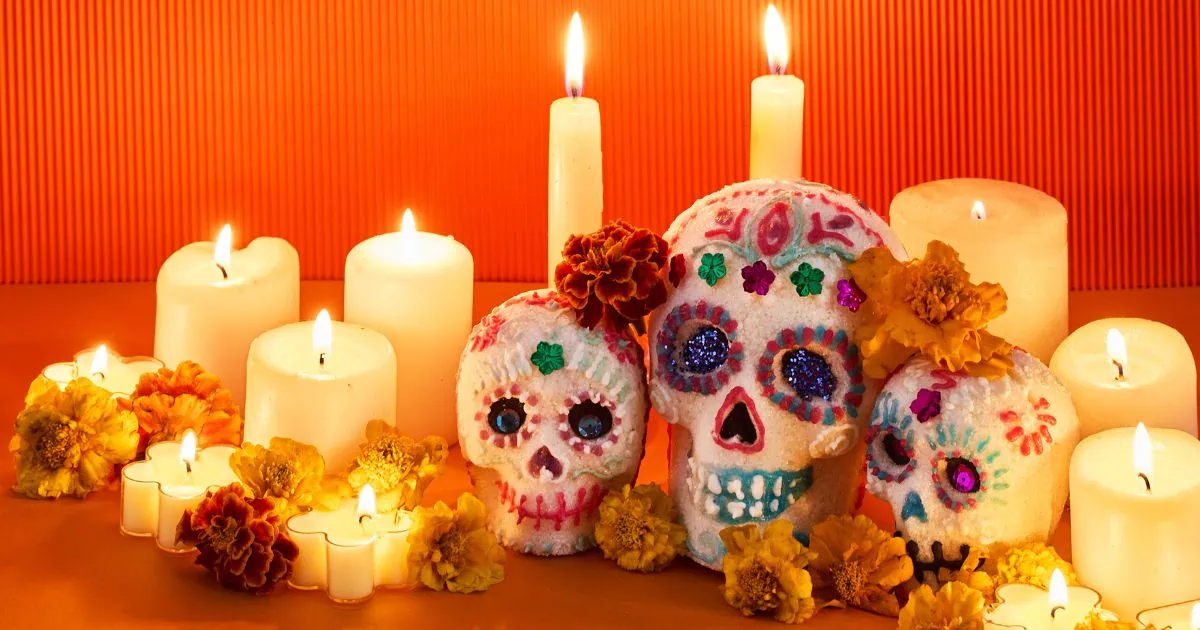
Sugar skulls are one of the most famous Day of the Dead symbols, and their meaning is literal: each one represents a specific person who has died.
The name of the departed is often written on the forehead in colored icing, and the skull goes on their altar or grave.
Unlike the somber skulls of other cultures, these are bright and cheerful, because the point of the holiday is to celebrate the dead, not fear them.
Small vs. large sugar skulls

Small, bite-size sugar skulls are given as gifts (often with a friend’s name on them), eaten, or used to decorate home altars.
They make a great souvenir.
Large sugar skulls, with names on the forehead and elaborate icing, go on the ofrenda or gravestone for the returning soul.
Keep in mind that those aren’t meant to be eaten.
How are sugar skulls made?
Traditional sugar skulls are made from alfeñique, a sugar paste of sugar, water and a little lemon juice (some recipes add egg white).
The paste is pressed into clay molds, dried, and decorated by hand with icing, foil and sequins.
Sugar molding arrived with Europeans during the colonial era, and it took root in Mexico, where sugar was plentiful.
Today, Toluca’s Feria del Alfeñique is one of the biggest places to see the craft.
Decorating your own sugar skull is a fun activity during the holiday; many cooking schools and hotels offer workshops in late October.
Chocolate and amaranth skulls

You’ll also see skulls made of chocolate and of amaranth seeds (alegría).
Amaranth was sacred to the Aztecs, who shaped it into figures of their gods, so the amaranth skull is a nice nod to the holiday’s older roots.
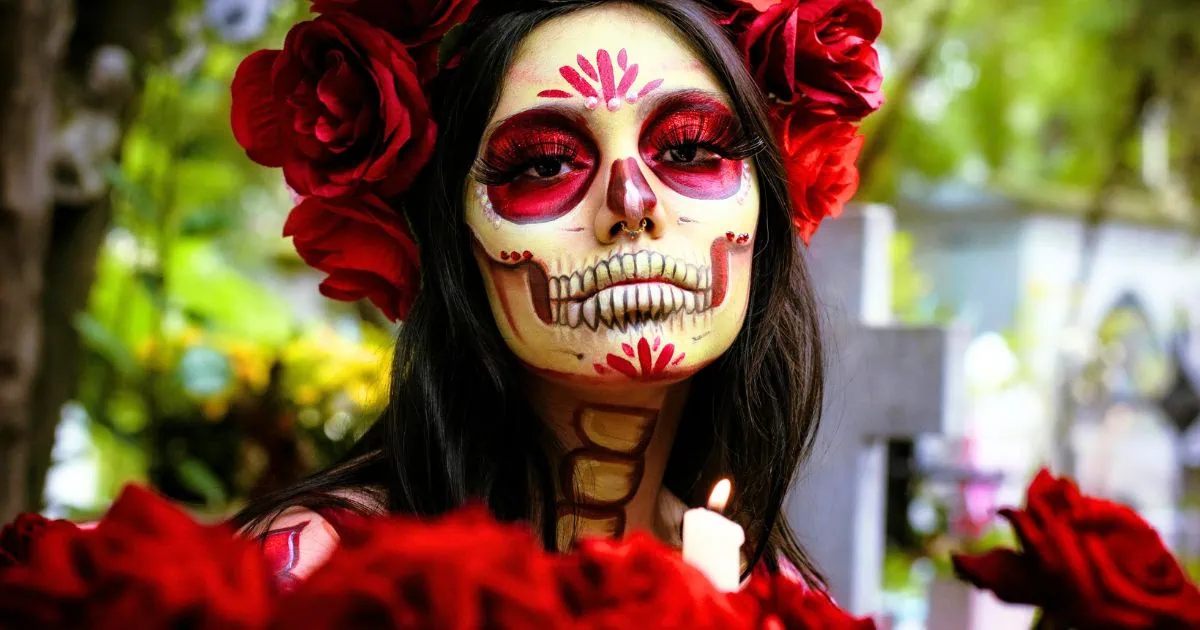
10. La Catrina (Skeletal Day of the Dead Woman)

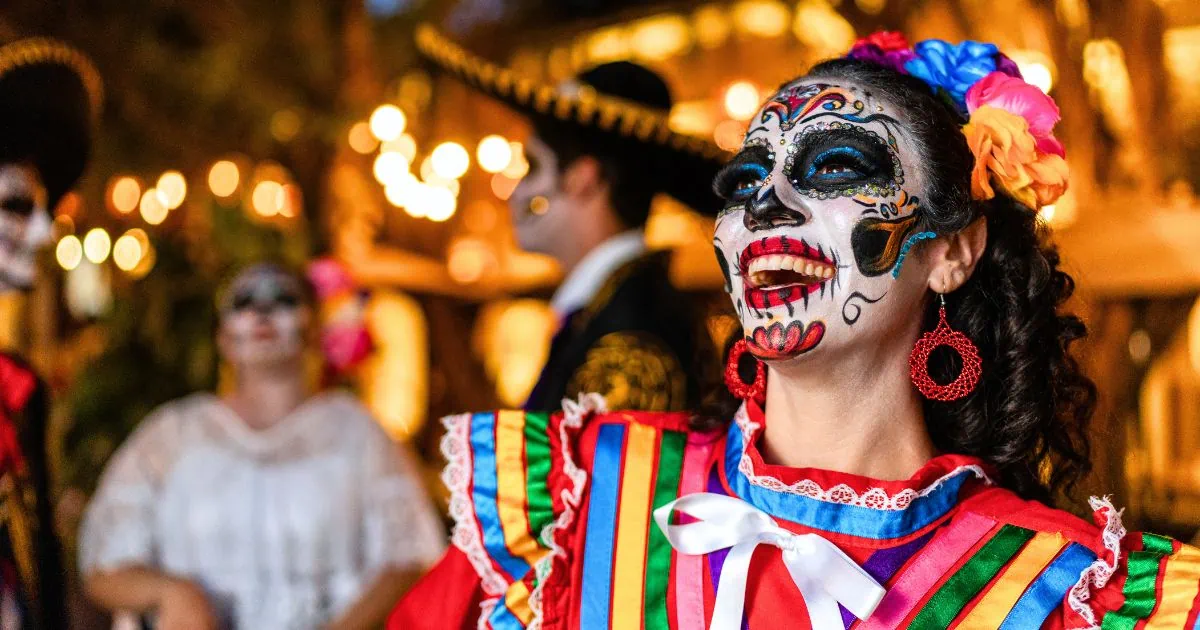
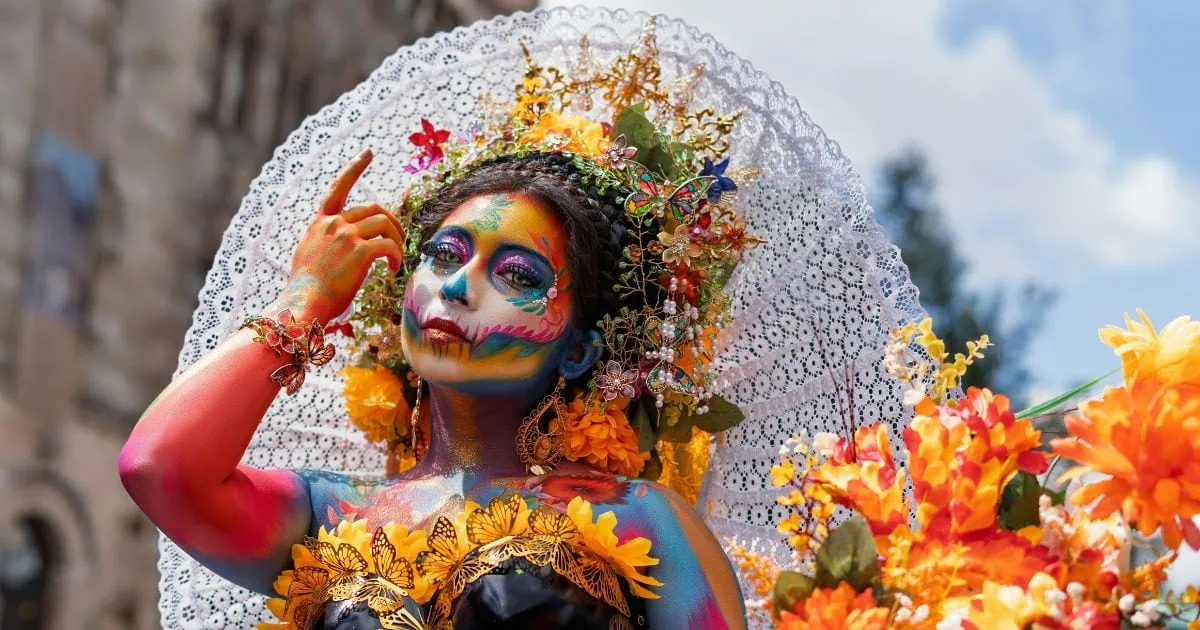
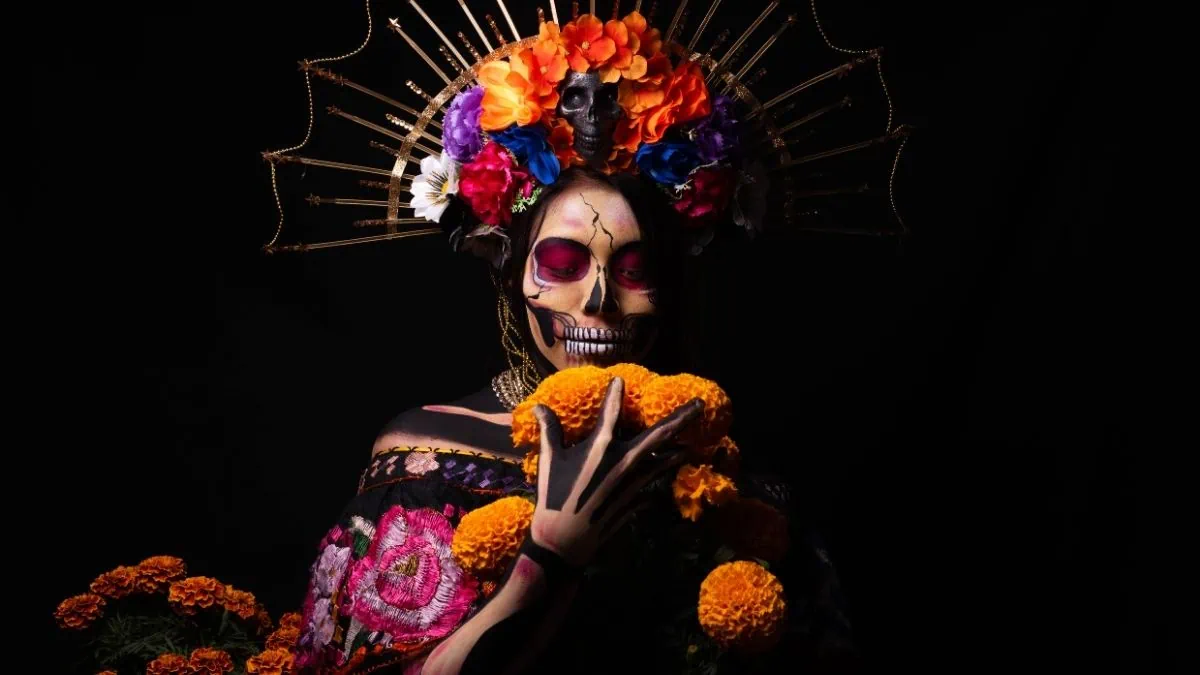
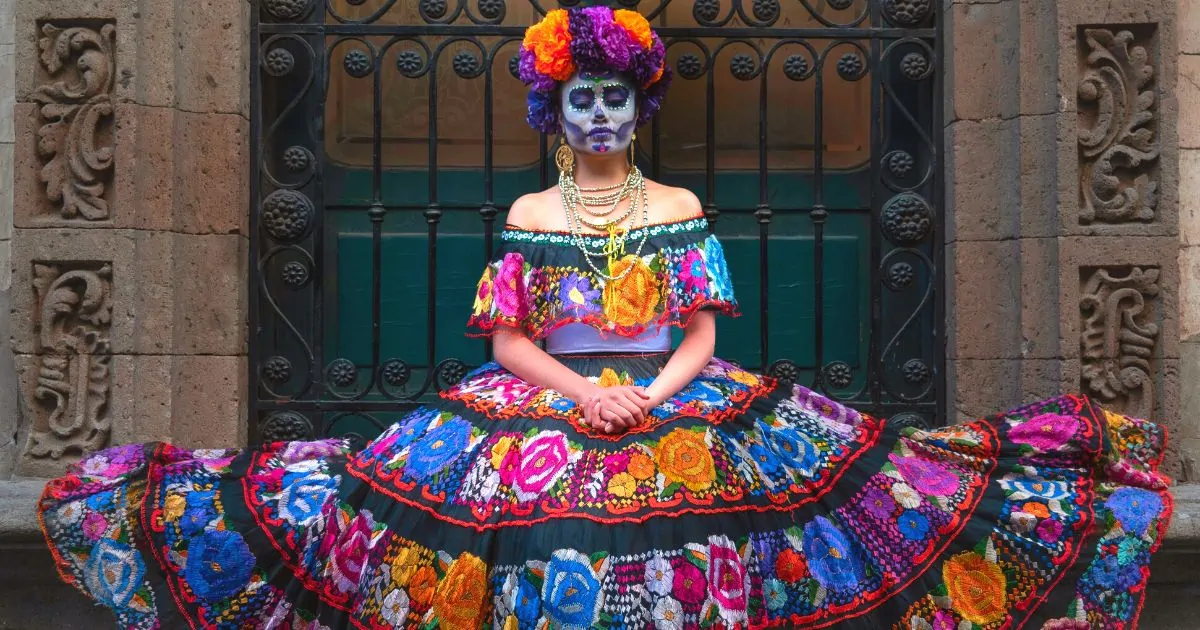
La Catrina, the elegant skeleton lady in a feathered hat, is the most famous Day of the Dead character. 👉 Full story: the history of La Catrina
She began as an etching by Mexican printmaker José Guadalupe Posada, made around 1910–1913. He called her La Calavera Garbancera.
Garbanceros were people who sold chickpeas and who hid their Indigenous roots to pass as European.
Posada’s dressed-up skeleton was a jab at that: no matter how fancy you dress, you’re a skeleton underneath, and death comes for everyone.
11. Mictecacíhuatl (Aztec Lady of the Dead)

Long before La Catrina, there was Mictecacíhuatl (meek-teh-kah-SEE-wahtl), the Aztec Queen of the Underworld.
Side Note: Today, some people see La Catrina as a modern version of Mictecacíhuatl, but that’s not necessarily true.
She and her husband, Mictlantecuhtli, ruled Mictlán, the land of the dead, and she was said to watch over the bones of the dead.
The Aztecs held festivals for the dead in late summer.
After the Spanish conquest, those traditions merged with the Catholic All Saints’ Day and All Souls’ Day. That’s how Day of the Dead got its dates: November 1 and 2.
👉 More history: Day of the Dead Origins: Where Día de los Muertos Really Comes From
12. Xoloitzcuintlis (Mexican Hairless Dogs, AKA Xolos)

The xoloitzcuintli (show-low-eets-KWEENT-lee), or xolo for short, is Mexico’s national dog and a Day of the Dead symbol.
In Aztec belief, xolos guided the souls of the dead across a river on the journey to Mictlán. 👉 More about the Mexican hairless dog (Xolo)
The breed is named after Xolotl, the god of fire and lightning who also escorted souls to the underworld.
Xolos come in three sizes (toy, miniature and standard), and in hairless and coated varieties.
You may recognize one particular famous xolo dog, Dante, Miguel’s loyal sidekick in the movie Coco, is a xolo.
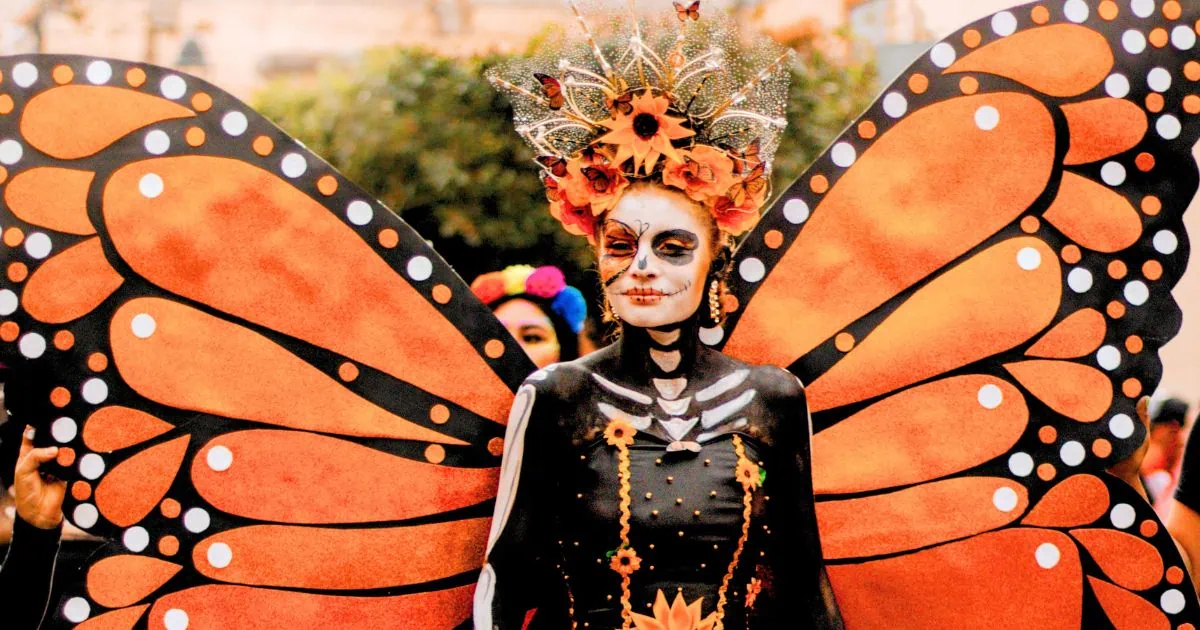
13. Monarch Butterflies
Every year, millions of monarch butterflies fly as far as 3,000 miles (4,800 km) from Canada and the U.S. to central Mexico.
🦋 Note: I visited the El Rosario Monarch Butterfly Sanctuary in Michoacán. Check out the video above to see a glimpse of their migration.
They reach the forests in late October and early November, right around Día de Muertos.
Because of that timing, many people in Mexico say the monarchs carry the souls of the dead returning home.
You’ll see butterflies on altars, in papel picado, and in sand tapestries.
The butterflies stay through about March, so you can visit the sanctuaries in Michoacán and the State of Mexico later in the season.
14. Alebrijes (Colorful Day of the Dead Art)

Alebrijes (ah-leh-BREE-hehs) are brightly painted fantasy creatures, part one animal, part another.
They aren’t an ancient Day of the Dead symbol, but they’re now part of the modern celebration. 👉 What Are Alebrijes: A Guide to Oaxaca’s Colorful Art
They’re also the spirit guides in Coco (Pepita is an alebrije, and Dante becomes one).
The first alebrijes were papier-mâché figures made by Mexico City artisan Pedro Linares.
In 1936, when he was 30, he fell seriously ill. In his fever dreams, strange creatures shouted a made-up word: “alebrijes!”
When he recovered, he started making alebrijes out of papier-mâché.
In Oaxaca, woodcarver Manuel Jiménez Ramírez of San Antonio Arrazola started carving and painting similar creatures from copal wood.
Today, the Oaxacan villages of San Antonio Arrazola, San Martín Tilcajete and La Unión Tejalapam are known as the “alebrijes towns” because artisans have been making them there for generations.
If you’re not visiting Oaxaca, don’t worry, you can see and buy alebrijes throughout Mexico.
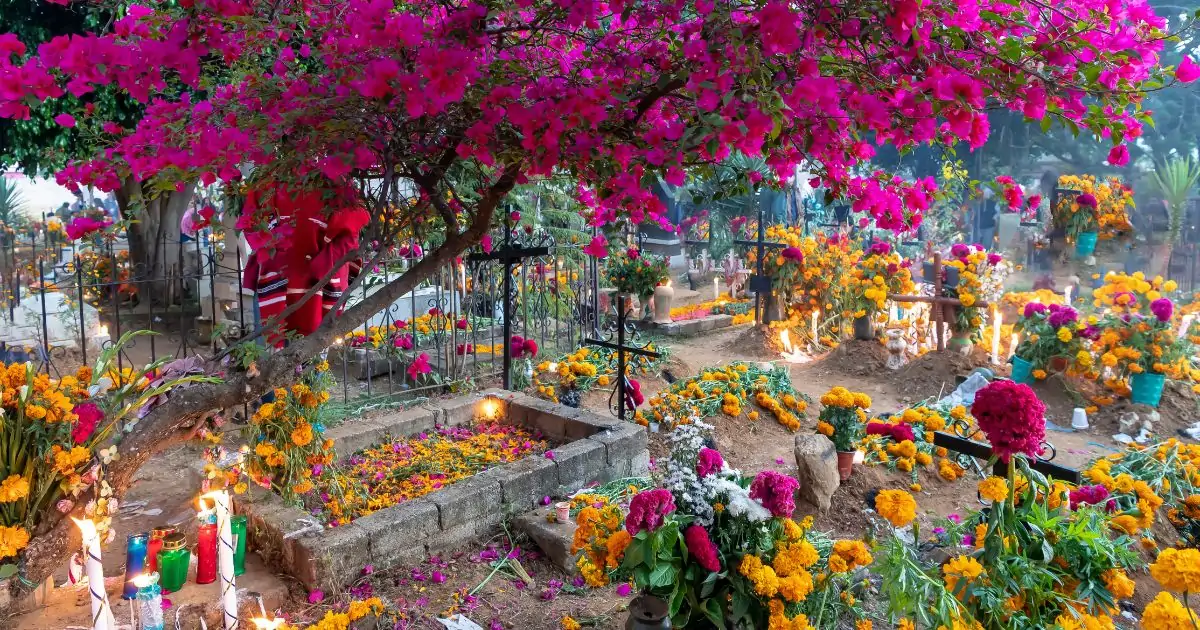
15. Decorated Graves and Cemeteries (Panteones)

The cemetery is where the holiday feels most personal.
In the days before November 1, families clean their loved ones’ graves, then decorate them with marigolds, cockscomb, candles, photos and food.
On the night of November 1 (and in some towns, October 31), many families hold a vigil at the grave, sometimes all night, with music, food and drinks.
It’s a party, not a funeral.
The biggest cemeteries in each city usually have the most elaborate decorations.
In Oaxaca, the Panteón General and the cemeteries of Santa Cruz Xoxocotlán are famous; near Mexico City, San Andrés Mixquic is the best known.
Note: Always ask before photographing a family or their loved one’s grave, and avoid photographing children. Some families welcome visitors; others want privacy.
The cemeteries were my favorite part of Day of the Dead in Oaxaca. 👉 See my Oaxaca Day of the Dead guide for which cemeteries to visit.
16. Comparsas and Muerteadas (Day of the Dead Parades)

You’ll hear a comparsa (parade) long before you see it: brass bands, drums and fireworks, followed by dancers in costumes and masks.
Note: In Oaxaca, they’re also called muerteadas.
Many comparsas are informal, and anyone can join in as they wind through the streets toward a cemetery.
In Oaxaca City, a big opening parade (the Magna Comparsa) kicks things off, and nearby towns like San Agustín Etla hold all-night muerteadas.
Mexico City has its own large, organized parade along Paseo de la Reforma. In 2026, it takes place on Saturday, October 31. 👉 Mexico City Day of the Dead Parade guide
17. Mojigangas (Giant Puppets)

Mojigangas (moh-hee-GAHN-gahs) are giant puppets, often 10 to 15 feet (3 to 4.5 m) tall, worn by a dancer who spins them through the streets.
The tradition came from Spain and is especially strong in Oaxaca and San Miguel de Allende, though I have also seen them in Mexico City.
During Día de Muertos, you’ll see skeleton and Catrina mojigangas towering over the parades.
18. Sand Tapestries (Tapetes de Arena)

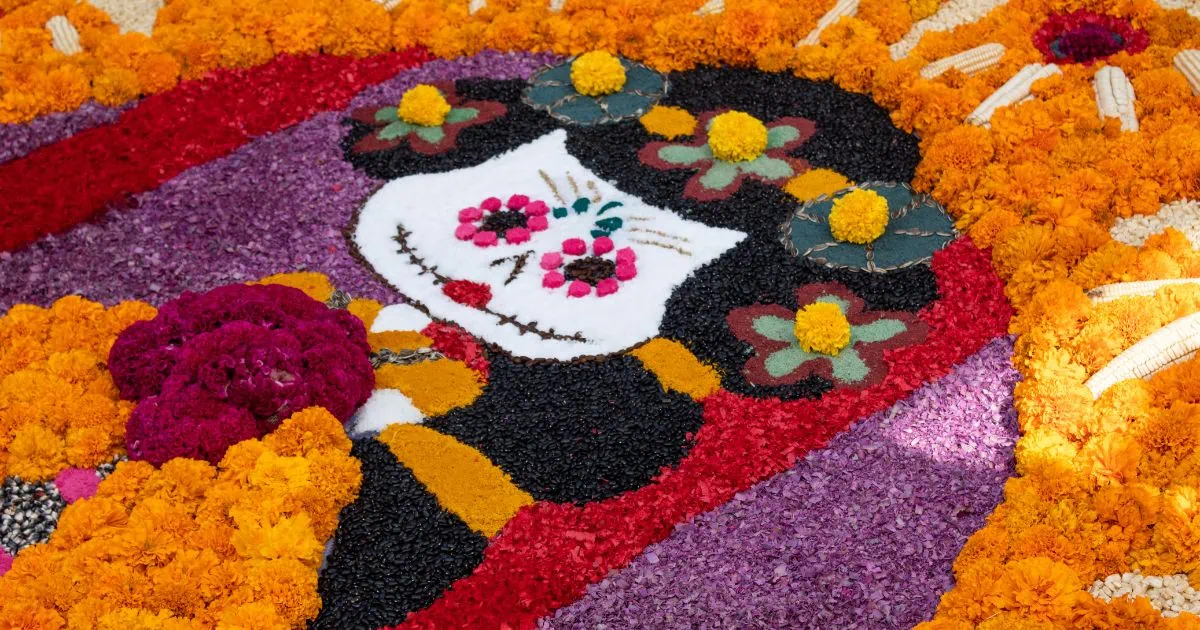
In Oaxaca especially, you’ll find tapetes, intricate “rugs” made of colored sand, sawdust, beans, seeds and flower petals, laid out on the ground in front of altars and along the streets.
They show skeletons, Catrinas, flowers and monarch butterflies.
Because the wind and footsteps eventually scatter them, tapetes are a reminder that everything returns to dust.
Some are also made in front of a home altar to honor a person who died that year.
The towns of Santa Ana Zegache and Zaachila, south of Oaxaca City, are known for them. ⚠️ Note: Never step on or touch a tapete.
19. Calaveras Literarias (Day of the Dead Poems)
Calaveras literarias are short, rhyming poems written as if someone is already dead, usually with a lot of teasing.
Newspapers publish them about politicians and celebrities, kids write them at school, and friends write them about each other.
They started as political satire in the 1800s, which is the same tradition Posada was drawing in when he created La Catrina.
They’re a good example of the holiday’s attitude: laughing at death, instead of fearing it.
20. Day of the Dead Colors and Their Meanings

What color represents the dead? Orange, the color of the marigolds that guide souls home.
The most iconic Day of the Dead colors are orange and yellow, with magenta from the cockscomb flowers right beside them.
Papel picado adds every color of the rainbow, and each color is commonly said to carry its own meaning.
Meanings vary by region and family, but these are the ones you’ll hear most often, along with their meaning:
- 🟠 Orange: Light and the sun; guides souls home (said to be the color the dead can see)
- 🟡 Yellow: Light, the candle’s flame, and the sun’s energy
- 🔴 Red/Magenta: Blood and life; in some traditions, those who died in battle or in childbirth
- 🟣 Purple: Grief and mourning (this is also a Catholic color of mourning)
- 🩷 Pink: Celebration and joy
- ⚪️ White: Purity, hope; often used for children’s altars
- ⚫️ Black: Death and the land of the dead (Mictlán); mourning
- 🔵 Blue: Water for the thirsty souls
- 🟢 Green: Life and nature; those who died too young
Orange is the color you’ll see most, because marigolds are everywhere: on altars, around doorways, on graves, and in the petal paths that lead the dead home.
Hanal Pixán: The Mayan Day of the Dead Celebration
In the Yucatán Peninsula, Day of the Dead is called Hanal Pixán, Maya for “food of the souls.”
Many of the same symbols show up (altars, candles, photos, flowers). A few are uniquely Yucatecan:
- Mucbipollo (pib): a large tamal wrapped in banana leaves and baked underground, made only for this holiday. It’s the defining food on Yucatecan altars.
- Embroidered tablecloths and jícaras (gourd bowls) on the altar.
- A red or black string tied around children’s wrists, traditionally to protect them from being carried off by the visiting souls.
Living in Mérida, Hanal Pixán is the version of the holiday I know best. It blends Maya and Catholic traditions, and the food is the star.
👉 For the full guide, read Hanal Pixán in Mérida on my Mérida site.
Day of the Dead Symbols: FAQ
What are the main symbols of Day of the Dead?
The main symbols are the ofrenda (altar), marigolds (cempasúchil), sugar skulls, pan de muerto, candles, papel picado, copal incense, photos of the dead and La Catrina.
Animals linked to the holiday include the xolo dog and the monarch butterfly.
What are 5 symbols of Day of the Dead?
1) Marigold flowers, 2) sugar skulls, 3) the ofrenda (altar), 4) pan de muerto and 5) La Catrina.
Candles, papel picado and photos of the dead are close behind.
What is the most familiar symbol of Day of the Dead?
The skull, or calavera, shows up as sugar skulls on altars, as La Catrina, the elegant skeleton lady, and as the skull face paint people wear in the parades.
Marigolds are a close second, since they’re on nearly every altar and grave.
What is the main icon of Día de los Muertos?
La Catrina. You’ll see giant Catrina figures in plazas and parades, and her face painted as a calavera (skull) on thousands of people.
What is the flower of Day of the Dead?
The marigold, called cempasúchil in Mexico and also known as flor de muerto (flower of the dead).
Its bright orange color and strong scent are said to guide souls home.
What color represents the dead?
Orange. The orange of the marigold (cempasúchil) is said to be the color the souls can see, guiding them home.
Purple is the color of mourning, and black represents death and Mictlán, the land of the dead.
What do the colors of Day of the Dead mean?
Orange and yellow (marigolds) light the way for the dead; magenta and red represent blood and life; purple represents mourning; pink represents celebration; and white represents purity and hope.
Note: Day of the Dead color meanings vary by region and family.
What decorations are used for Day of the Dead?
The most common Day of the Dead decorations are marigolds, papel picado banners, candles, sugar skulls, Catrina figurines, skeleton figures, and photos of the dead on an ofrenda.
In cemeteries, families decorate graves with flowers and candles.
Who are the main characters of Day of the Dead?
La Catrina, the elegant skeleton woman, is the best known.
Others include Mictecacíhuatl, the Aztec Lady of the Dead; the xolo dog, which guides souls to Mictlán (the Underworld); and alebrijes, colorful spirit creatures.
You’ll also see calacas, skeleton figures shown dancing, drinking and going about everyday life.
What does the sugar skull represent?
A specific person who has died. Their name is often written on the forehead, and the skull is placed on their altar or grave.
Small sugar skulls are also given as gifts with a friend’s name on them.
What does the monarch butterfly symbolize on Day of the Dead?
Monarchs arrive in central Mexico in late October and early November, right around the holiday.
This is one of the reasons some say that monarch butterflies carry the souls of the dead returning home.
Why is the dog a symbol of Day of the Dead?
In Aztec belief, the xoloitzcuintli (xolo) dog guided souls across a river on their way to Mictlán, the land of the dead.
It’s also the breed of Dante in the movie Coco.
When is Day of the Dead in 2026?
November 1 and 2, 2026 (Sunday and Monday). November 1 honors children who have died, and November 2 honors adults.
Celebrations start on October 31, and in many places, in the last week of October. 👉 Day of the Dead in Mexico: Everything You Need to Know
Is Day of the Dead the same as Halloween?
No. They fall at the same time of year, but Day of the Dead is a family holiday to remember and welcome back loved ones who have died.
It’s joyful rather than spooky, and it has its own symbols and traditions.
My Final Thoughts on Day of the Dead Symbols

Once you know what the symbols mean, a Day of the Dead altar stops being just a beautiful display.
It tells a story: who the person was, what they loved, and how much their family wants them to come home.
I’ve now celebrated Day of the Dead in Oaxaca, Mexico City and Mérida, and each one felt different.
What stays the same is the feeling. It’s a celebration of the people we’ve lost, not a day of mourning.
If you’re planning to go, Oaxaca City, Mexico City, Mérida, Pátzcuaro, Morelia and San Miguel de Allende all have memorable celebrations.