Pan de Muerto Meaning: What the Famous Day of the Dead Bread Symbolizes


Wondering about the Pan de Muerto meaning? Then you’re in the right place because I’m about the share this bread’s fascinating history with you.
If there’s one food I look forward to seeing return to Mexican bakeries every fall, it’s pan de muerto — and as someone who lives in Mexico, I always eat my fair share!
For me, pan de muerto is one of the clearest signs that Día de Muertos is approaching, but it’s also much more than a seasonal pastry.
Pan de muerto is an important part of the ofrenda, and its shape, ingredients, aroma, and regional variations all tell part of the story of Mexico’s relationship with death and remembrance.
So what does pan de muerto mean? Let’s dive in and discover all the coolest pan de muerto fun facts.

What is Pan de Muerto?

Pan de muerto, which literally translates to bread of the dead, is one of the central foods placed on ofrendas for the deceased.
It is a traditional Mexican bread prepared around Día de Muertos (the Day of the Dead holiday), although the exact recipe and appearance vary considerably from one region of Mexico to another.
The classic version most people recognize is round and soft, with strips of dough placed across the top to resemble bones (pictured above).
It is usually covered with sugar and flavored with ingredients such as orange blossom water, orange zest, anise, or other regional ingredients.
And if you’ve never had freshly baked pan de muerto, you’re missing one of my favorite parts of the season.
The combination of the soft bread, sugar, and subtle citrus or floral aroma makes it feel very different from an ordinary loaf of bread.
What Does Pan de Muerto Symbolize?

The meaning of pan de muerto is closely connected to death, remembrance, and the cycle of life.
- The traditional round shape is commonly interpreted as representing the cycle of life and death.
- The round ball of dough (seen only in some varieties of pan de muerto, including the one pictured above) in the center is often described as a skull.
- The strips of dough crossing the top are commonly interpreted as bones, or a cross.
Most interpretations say the four sections of dough between the “bones” represent the four cardinal directions — 🧭 north, south, east, and west.
Perhaps not as popular of an interpretation, others say they represent the four elements — 🌎 earth, air, fire, and water.
There’s no one right answer because the symbolism of pan de muerto isn’t completely uniform throughout Mexico.
Why Does Pan de Muerto Have Bones on Top?

The most recognizable feature of traditional pan de muerto is the dough arranged across the top.
These pieces are commonly called canillas (little bones in English), and they are generally understood to represent bones 🦴
You’ll often see four strips arranged across the bread, with a small round piece in the center.
The result is a bread that looks surprisingly cheerful for something called “bread of the dead.”
That’s part of what I find so interesting about Día de Muertos in general; death is acknowledged openly, but the visual language of the celebration is often colorful, warm, and full of food.
Instead of trying to hide death away, the tradition creates a way for families to remember the people they have lost.
What Does the Circle on Pan de Muerto Mean?

The little round piece dough in the center of the bread is commonly interpreted as either a skull, or the completion of the cycle of life and death.
Some sources describe the crossed pieces as bones and connect them with the four cardinal directions, though you may also encounter other interpretations.
This is one reason I think it is useful to be cautious about articles that claim there is only one definitive explanation for every detail of an ofrenda or pan de muerto.
Día de Muertos traditions have developed over centuries and vary between communities.
Why Does Pan de Muerto Taste Like Orange?

One of the things you’ll probably notice when you eat traditional pan de muerto is its fragrance.
Many recipes use agua de azahar (orange blossom water), while others include orange zest or other flavorings like anise for a delicate floral and citrus aroma.
The fragrance is also sometimes given symbolic meaning.
Some interpretations connect the aroma of orange blossom with remembrance of the dead.
In other words, the bread isn’t just meant to look distinctive. Its smell is part of the experience.
Is Pan de Muerto a Pre-Hispanic Tradition?

So this is where the history of pan de muerto gets complicated.
You’ll often read that it originated from pre-Hispanic offerings involving food made from amaranth, followed by the introduction of wheat bread by the Spanish.
Mexican government sources, including the Instituto Nacional de Antropología e Historia (INAH, or National Institute of Anthropology and History), have repeated versions of this explanation.
They describe modern pan de muerto as a product of the encounter between Indigenous traditions and Spanish colonial culture.
While the Spanish do have a variation of it called pan de ánimas (bread of souls), pan de difunto (bread of the deceased), it is difficult to reduce the Mexican pan de muerto history to one simple origin story.
INAH points out that many elements of the modern November 1 and 2 celebrations have European Christian histories, while Indigenous practices surrounding the dead were different and took place at different times.
So rather than saying that today’s pan de muerto is simply an unchanged pre-Hispanic food, I think it is more accurate to understand it as part of the much longer cultural development of Día de Muertos.
Indigenous traditions, Spanish colonial influences, Catholic practices, and regional Mexican customs all contributed to the traditions we see today.
When Do Mexicans Eat Pan de Muerto?

Pan de muerto is strongly associated with October and November.
You’ll often start seeing it in Mexican bakeries in September, with production increasing as Día de Muertos approaches.
The bread is commonly eaten around November 1 and 2 and is also placed on ofrendas as an offering for deceased family members.
The idea of putting food on an altar is especially meaningful because the ofrenda is intended to welcome loved ones back.
Families may place foods and drinks that the deceased enjoyed when they were alive.
Pan de muerto becomes part of that welcome — and, of course, the living eventually get to eat it too.
Do People Actually Eat the Pan de Muerto on the Altar?

Yes. The bread placed on an ofrenda is an offering, but pan de muerto is also very much a food for the living.
This is one of the things I love about Día de Muertos; that food connects the living and the dead in a very tangible way.
Families prepare favorite dishes, buy special breads and sweets, and gather around food while remembering relatives who are no longer there.
The meal becomes part of the act of remembering.
Pan de Muerto Is Different Across Mexico
If you travel around Mexico during Día de Muertos, don’t assume that every pan de muerto will look like the familiar round loaf covered in white sugar.
The Mexican Ministry of Foreign Affairs notes that recipes differ around the country, with sugar-coated versions common in central Mexico and distinctive varieties found elsewhere.
This is why I think travelers should try pan de muerto in more than one part of Mexico, if they can, as the differences can be surprisingly dramatic.
Oaxaca Pan de Muerto

There are many regional varieties — including the one in the image above, which depicts just one of the versions of Oaxaca pan de muerto.
A type of pan de yema (egg yolk bread), this Oaxacan pan de muerto is more savory in taste, and decorated with sesame seeds and a carita (small molded face) in the center. This is said to represent the departed.
The Mexican Ministry of Culture has documented Oaxaca’s pan de yema as one of the regional forms of bread associated with Día de Muertos.
🥐 Types of Pan de Muerto From Oaxaca Mexico
Since I’ve experienced Día de Muertos in Oaxaca City, this is one regional variation I particularly associate with the holiday, though there are others.
- Pan Carita: From Oaxaca’s Central Valleys, this round pan de yema (egg yolk bread) is decorated with sesame seeds and a face in the center.
- Mitla Style: Large, elaborate egg-yolk loaves from San Pablo Villa de Mitla feature intricate designs, religious figures, or human faces painted with white sugar paste, intricate icing, and Zapotec geometric patterns.
- Costa Region Style: Made with butter and sesame seeds, this variation is shaped into the full form of a person lying in a casket with their arms crossed over the front.
The Most Popular Pan de Muerto in Mexico

In Mexico City and most of the country, the classic round version with the cross on top and sugar is especially familiar (seen above).
It is generally covered with sugar and decorated with the traditional bone-like strips.
This is probably the version you’ll see most often in photographs of Mexican Día de Muertos celebrations.
It is also the version many visitors imagine when they hear the words “pan de muerto bread.”
Other Regional Varieties of Pan de Muerto

There are many more, depending on the Mexican state or region you’re in.
In Guerrero state, pan de muerto is known as pan de muñeco (doll bread) or pan de mono (monkey bread), shaped like a human with arms and legs, and topped with bright pink sugar (see image above).
In Michoacán state, you can find breads shaped and decorated in ways that are quite different from the classic central Mexican version.
These include a wide variety of breads shapes, including ones shaped like people, animals, flowers, and other figures.
This regional diversity is important, and the reason there really isn’t one single “Day of the Dead bread” recipe that represents every part of Mexico.
What Ingredients are in Pan de Muerto?

The ingredients depend on the recipe. A traditional sweet version commonly contains:
- Wheat flour
- Sugar
- Eggs
- Butter or another fat
- Yeast
- Orange zest, orange blossom water, or orange flavoring
- Sesame seeds (used in some pan de muerto recipes)
- Anise (used in some recipes)
The official Mexican Secretaría de Agricultura recipe lists wheat flour, sugar, eggs, and flavorings such as orange blossom and anise among the ingredients commonly used in traditional recipes.
Modern bakeries have also become very creative, so you’ll find versions filled with chocolate, cream, cajeta, and other sweet fillings.
Some are enormous; some are individually sized; some are traditional and understated; and others look more like elaborate desserts.
What Does Pan de Muerto Have to Do With the Ofrenda?

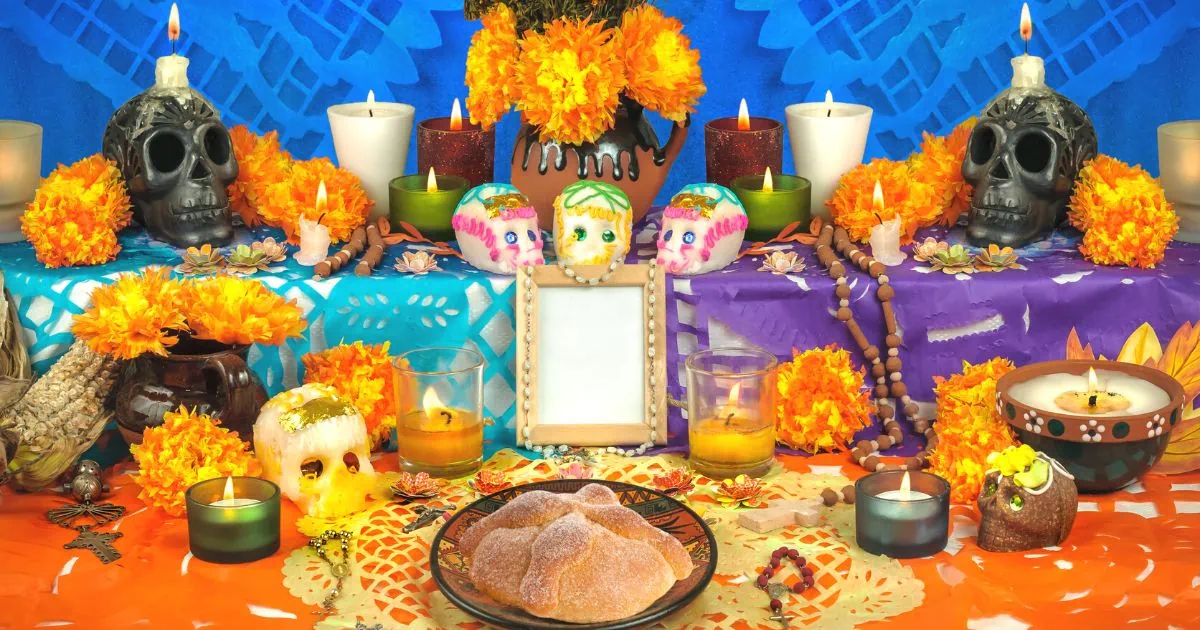
Pan de muerto is one of the foods traditionally placed on a Day of the Dead altar.
An ofrenda is meant to welcome and remember deceased loved ones, so the foods placed there often have a personal connection.
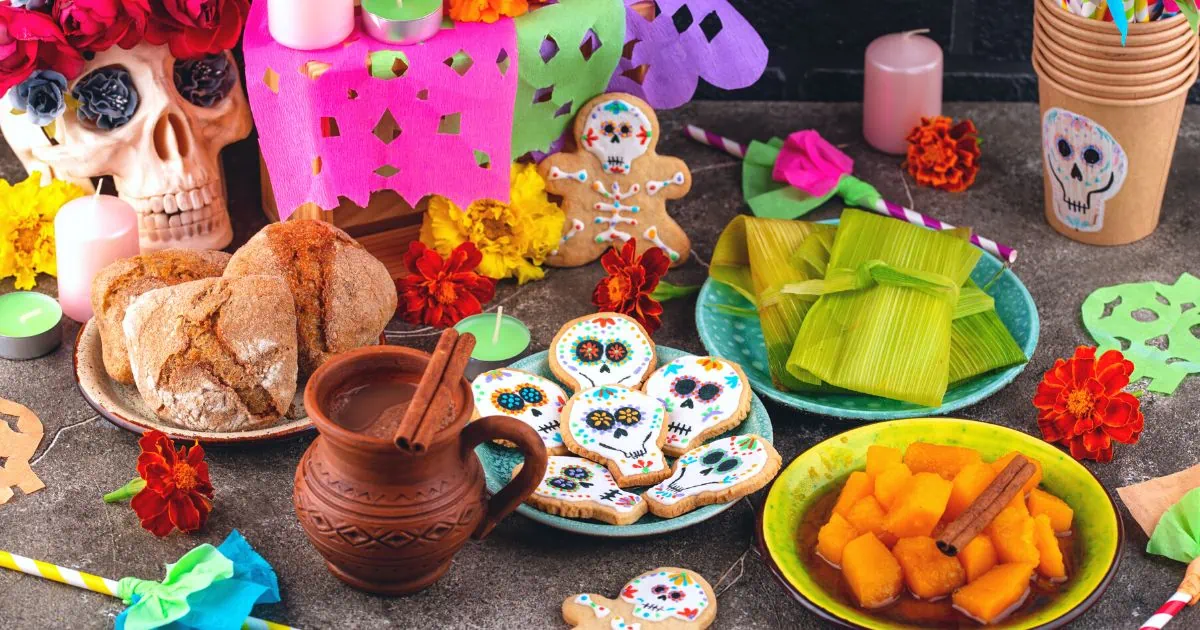
You might find the favorite meal, fruit, candy, a favorite drink, and/or a special dessert of the person being remembered
You’ll also often find pan de muerto alongside these other offerings.
I’ve seen it incorporated into ofrendas (altars) in different ways in Mexico City, Oaxaca City, and Mérida Mexican Day of the Dead celebrations I’ve attended.
Sometimes the bread is a very prominent part of the display, but other times, it’s simply one of several foods arranged around the photos, incense, cempasúchil (marigold flowers), and candles.
Is Pan de Muerto Sweet?

Usually, yes. The classic version is a sweet bread, often covered generously with sugar.
The sweetness is part of what makes it such a popular seasonal treat, though the flavor isn’t necessarily overwhelmingly sweet (similar to a hot cross bun).
A good traditional pan de muerto has a soft, slightly rich texture with a subtle orange blossom or citrus fragrance.
Of course, modern versions can be much sweeter, especially when they’re filled with cream, chocolate, or other fillings.
If you’re visiting Mexico in October or November, I’d recommend trying a traditional version before experimenting with the more elaborate bakery creations.
Why I Love Pan de Muerto

After living in Mexico since 2018, I’ve come to associate the smell of pan de muerto with the arrival of Día de Muertos.
It is one of those seasonal foods that immediately tells me what time of year it is.
I also love that the bread captures so much of what makes Día de Muertos different from the way many people outside Mexico think about death.
There are skulls and bones, but there is also bread.
There are candles and flowers, but there is also coffee, chocolate, fruit, and favorite foods.
The celebration makes room for grief and remembrance while also making room for life.
And somehow, a warm piece of sweet bread fits perfectly into that picture.
Pan de Muerto Meaning: It’s More Than Just Bread

So, what does pan de muerto mean?
At its simplest, it is a traditional Mexican bread associated with Día de Muertos and placed on ofrendas to honor deceased loved ones.
Its circular shape, central piece, and bone-like decorations have developed layers of symbolism connected with death, remembrance, and the cycle of life.
But there isn’t one explanation that applies perfectly to every region or every family.
That’s what makes learning about pan de muerto so interesting.
The bread is part of a living tradition that continues to change while remaining deeply connected to Mexico’s long history of remembering the dead.
And if you happen to be in Mexico during October or November, don’t just admire it on an altar.
Buy one from a local bakery, it down with a cup of coffee or hot chocolate, and enjoy it.