
17 Mexican Independence Day Facts You Probably Don’t Know



Want to LEARN some Facts about MEXICAN INDEPENDENCE DAY?
You’re in the right place, as this article covers all the popular and lesser-known Mexican Independence Day facts.
🇲🇽 I’ve lived in Mexico since 2018 and participated in many Independence Day celebrations — which are always a good time!
In fact, it’s one of the biggest holidays in Mexico, and among its most elaborate celebrations. However, many people don’t know the history behind this iconic day.
That’s where this article comes in. From learning about facts about Miguel Hidalgo and who he is, to facts about the Mexican Revolution, it’s all here.
Ready to learn more about Mexican Independence Day history, including some lesser-known Mexican Independence War facts? Let’s dive in!
When is Mexican Independence Day?
September 16 — While many think Cinco de Mayo (May 5th) is Mexico’s Independence Day, it’s actually celebrated each year on September 16th.
What is Mexican Independence Day?
Mexican Independence Day marks the beginning of Mexico’s fight for sovereignty from Spanish rule, which began in 1810 and ended in 1821.

While many are familiar with the basic outline of events and figures, like Miguel Hidalgo y Costilla’s Grito de Dolores (Cry of Dolores), numerous lesser-known facts offer deeper insights into this critical historical moment.
Here are 17 interesting facts about Mexican Independence Day and tidbits about the history of Mexican Independence Day that you probably don’t know:
Best Mexican Independence Day Facts
1. The Many Names of Father Miguel Hidalgo

Father Miguel Hidalgo y Costilla, a central figure in the Mexican War of Independence, has the full name Miguel Gregorio Antonio Ignacio Hidalgo-Costilla y Gallaga Mandarte Villaseñor.
Born on May 8, 1753, in Pénjamo, Guanajuato, Mexico — a part of New Spain — Hidalgo was a criollo. This is a person of Spanish descent born in the Americas.
Before leading the independence movement, Hidalgo served as a priest in the town of Dolores, Guanajuato. It is now known as Dolores Hidalgo in his honor.
Hidalgo’s comprehensive name reflects the Spanish naming convention, incorporating family names from parents and grandparents, highlighting his distinguished heritage.
Despite his religious status, Hidalgo’s involvement in political and social reform laid the groundwork for his leadership role in the fight against Spanish colonial rule.
Mexican Independence Day Facts
2. The Actual Date of Independence in Mexico

Contrary to popular belief, Mexican Independence Day does not commemorate the day Mexico achieved independence from Spain.
Rather, it marks the beginning of the independence movement that would eventually lead to Mexican independence from Spain.
The famous Grito de Dolores, a call to arms by Miguel Hidalgo y Costilla, occurred on September 16, 1810.
This event sparked the Mexican War for Independence from Spain, which continued for more than a decade.
Actual independence from Spanish rule was formally achieved on September 27, 1821 (the Mexican Independence date), following the signing of the Treaty of Córdoba.
This treaty not only recognized Mexico as an independent nation, but also established the terms of its sovereignty. It concluded Mexico and Spain’s 11-year conflict.
Mexican Independence Day Facts
3. The Premature Cry of Dolores
El Grito de Dolores, which marks the beginning of the Mexican War of Independence, was initially planned for October 1810.
However, the conspiracy was discovered prematurely, convincing Miguel Hidalgo y Costilla to act sooner than intended.
On the morning of September 16, 1810, Hidalgo issued a call to arms against Spanish rule, sparking the beginning of the independence movement.
This event is considered the moment that led to the Mexican fight for freedom. The premature nature of the call did not deter its impact.
It rallied a diverse group of indigenous people, mestizos, and other classes to join the cause against Spanish tyranny.
Mexican Independence Day Facts
4. The Original Intent of El Grito de Dolores

The Grito de Dolores is famously associated with the start of Mexico’s war for independence from Spain.
However, it was initially a call to fight against Spanish tyranny, rather than a declaration of independence.
Father Miguel Hidalgo y Costilla used this cry to rally his congregation to rise against the oppressive Spanish rule — but they did not explicitly demand independence.
Instead, it focused on ending the injustices and abuses inflicted by Spanish authorities on the indigenous and mestizo populations.
However, it turned out that most people wanted independence, and the movement’s objectives evolved significantly in response to its enthusiastic popular support.
As the uprising spread, its goals broadened to include pursuing independence from Spain.
Mexican Independence Day Facts
5. The War Lasted 11 Years

The Mexican War of Independence lasted 11 years. It began on September 16, 1810, when Father Miguel Hidalgo issued the Grito de Dolores.
The official date of Mexican independence is September 27, 1821. On this day, the war finally ended and Spain recognized Mexico’s independence.
This extended period of warfare was marked by numerous battles, shifting alliances, and a significant toll on the Mexican population.
The struggle involved a wide array of forces, including insurgent groups led by leaders such as Father Miguel Hidalgo y Costilla, José María Morelos and Vicente Guerrero.
It also included Agustín de Iturbide, who played a role in the conflict’s resolution with the Plan de Iguala.
As we round on this list of the Top 5 facts about Mexican Independence Day, here’s a bonus fact: Iturbide’s ideas helped create the first version of the Mexican flag 🇲🇽
Mexican Independence Day Facts
6. La Corregidora’s Conspiracy

Josefa Ortiz de Domínguez, better known as La Corregidora, played an essential role in the conspiracy that ignited the Mexican War of Independence.
As the wife of the corregidor (mayor) of Querétaro state, she was in a unique position to gather intelligence and rally support for the cause.
Despite being detained by Spanish authorities who suspected her involvement, Ortiz de Domínguez communicated the imminent threat to fellow conspirators, facilitating the early start of the uprising led by Hidalgo.
The courageous actions and strategic thinking of La Corregidora were crucial in the days before El Grito de Dolores.
These actions make her a key figure in the movement’s origin and a symbol of women’s involvement in the fight for Mexican independence.
Mexican Independence Day Facts
7. Victory at Monte de las Cruces

The Battle of Monte de las Cruces, fought on October 30, 1810, marked an early victory for the Mexican insurgents.
Despite lacking formal military training and inferior equipment, Hidalgo’s forces defeated a well-armed Spanish army.
The triumph at Monte de las Cruces was a critical morale booster for the independence movement.
It ultimately proved that Spanish forces could be overcome, and inspired continued resistance against the Spanish Crown.
Mexican Independence Day Facts
8. Miguel Hidalgo: The Vineyard Revolutionary

Miguel Hidalgo y Costilla was much more than a religious leader and revolutionary.
He was also an advocate for economic independence, demonstrated through his defiance of Spanish laws against local wine production.
Hidalgo encouraged the cultivation of European grapevines in Mexico, challenging Spain’s efforts to protect its wine industry from New World competition.
This act of rebellion against Spanish economic restrictions was symbolic of Hidalgo’s broader commitment to breaking colonial chains and fostering self-sufficiency among Mexicans.
One of the more unknown facts about the Mexican Revolution is that Hidalgo wanted to empower his countrymen by promoting local agriculture and industry.
A brilliant strategy, he knew this would weaken Spain’s economic grip over its colonies and help usher in their overall downfall.
Mexican Independence Day Facts
9. Father Miguel Hidalgo Was Executed

Following his capture, Father Miguel Hidalgo y Costilla was defrocked as a priest.
He was also tried for treason against the Spanish crown for his leadership role in the Mexican War of Independence.
Hidalgo was found guilty and ultimately executed by firing squad on July 30, 1811, in Chihuahua, Mexico.
His execution was a significant blow to the early independence movement, but his legacy and the cause for which he fought continued to inspire subsequent generations of revolutionaries.
Mexican Independence Day Facts
10. Another Priest Took Over After Hidalgo’s Execution

Following Father Miguel Hidalgo’s execution in 1811, leadership of the Mexican independence movement was assumed by another Roman Catholic priest named José María Morelos.
A former student of Hidalgo, Morelos was a capable military leader and strategist who significantly advanced the cause for independence.
Under his leadership, the movement saw several successes.
Among them, he managed to convene the Congress of Anáhuac, which outlined the first constitution for independent Mexico, known as the Constitución de Apatzingán, in 1814.
Morelos continued the fight for Mexican independence until his capture and execution by Spanish forces in 1815.
As we round out this Top 10 interesting facts about Mexican Independence Day list, know that his efforts furthered the progress of the independence movement and laid foundational principles for the nation.
Mexican Independence Day Facts
11. The Formation of the Army of the Three Guarantees

After José María Morelos’s execution in 1815, Vicente Guerrero came about as a leading figure in Mexico’s struggle for independence.
Guerrero, a mestizo of African and Indigenous descent, was known for his exceptional guerrilla warfare tactics.
His unwavering commitment to the cause attracted a diverse following, contributing to the movement’s resilience.
In an important turn of events, Guerrero joined forces with his former enemy, Agustín de Iturbide in 1821.
They formed the Army of the Three Guarantees (Ejército Trigarante or Ejército de las Tres Garantías in Spanish), a collaboration later formalized in the Plan de Iguala.
Guerrero’s alliance with Iturbide played a crucial role in the successful negotiation of independence from Spain later that year.
Mexican Independence Day Facts
12. Agustín de Iturbide: From Enemy to Emperor

Initially, Iturbide led efforts against the independence movement, showcasing his loyalty to the Spanish crown.
However, as the momentum for independence grew, Iturbide adapted, aligning with the insurgents’ cause through the Plan de Iguala in 1821.
This plan proposed a constitutional monarchy and affirmed independence and unity under Catholicism, which played a crucial role in achieving Mexican independence.
Following the successful negotiation for Spain’s recognition of Mexico’s sovereignty, Iturbide was declared Emperor Agustín I.
Mexican Independence Day Facts
13. The Plan de Iguala and the Three Guarantees: The Colors of a Nation

One of the fun facts about Mexican Independence Day I found most interesting is that the green, white and red colors of the Mexican flag carry deep historical significance.
They’re also rooted in the Plan de Iguala’s Three Guarantees (Las Tres Garantías in Spanish), one of the key doctrines in the Mexican Independence War.
Crafted in 1821 by Agustín de Iturbide, this groundbreaking document outlined a vision for a nation built on the pillars of religion, independence, and unity.
We see these pillars represented in the Mexican flag and Mexico’s colors:
- 🟩 Green symbolizes the army’s commitment to independence
- ⬜️ White represents the purity of the Catholic faith
- 🟥 Red signifies the unity, specifically the blood of the national heroes who fought for Mexico’s independence
This reinterpretation of the nation’s values marked a step towards Mexico’s liberation from Spanish rule, and added the essence of its newfound identity within the fabric of the flag.
Mexican Independence Day Facts
14. The Short-Lived First Mexican Empire

Mexico’s first empire, established immediately after independence in 1821 with Agustín de Iturbide as Emperor Agustín I, was a brief experiment in governance and national identity.
The empire represented Mexico’s initial attempt to define its post-colonial governance structure, opting for a constitutional monarchy.
However, internal conflicts, economic difficulties, and opposition to Iturbide’s rule led to political instability.
By 1823, the empire dissolved when Iturbide abdicated the throne among rising republican sentiments, paving the way for the establishment of the Mexican Republic.
After abdication and a brief exile, Iturbide returned to Mexico in 1824.
Upon his return, he was arrested and executed by firing squad on July 19, 1824, in Padilla, Tamaulipas, México.
Mexican Independence Day Facts
15. Spain’s Delayed Recognition

Spain’s acknowledgment of Mexican independence came significantly later than the declaration, a delay rooted in geopolitical and bureaucratic challenges.
After the Plan de Iguala and the Treaty of Córdoba in 1821, which outlined the terms for Mexico’s independence, Spain hesitated to recognize the new nation formally.
This reluctance was due to Spain’s hopes of regaining control and the complex international politics of the era, with European powers and the Holy Alliance influencing Spain’s decisions.
It wasn’t until 1836, following internal pressures and the global recognition of Mexico’s sovereignty, that Spain officially recognized Mexican independence.
As we near the end of this list, you now have the Top 15 facts about Mexican Independence Day!
Mexican Independence Day Facts
16. Chile en Nogada: A Culinary Celebration
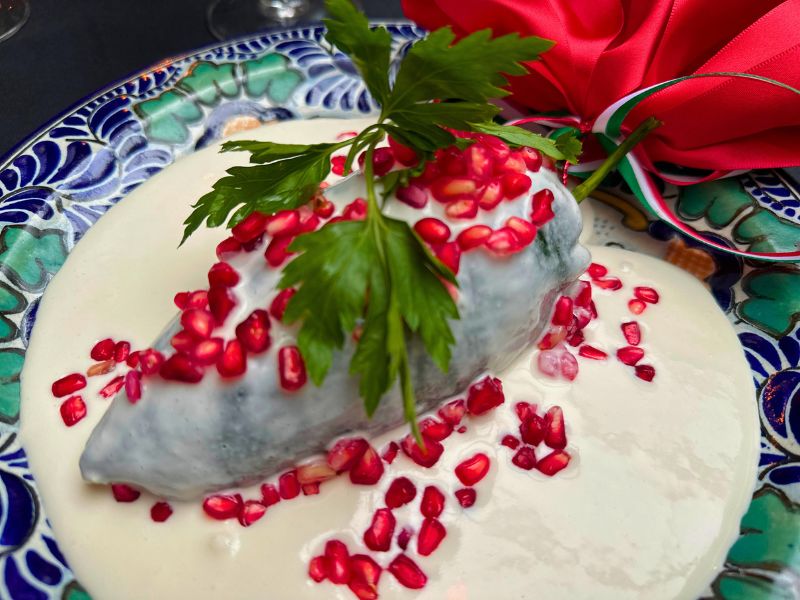
Chile en nogada is more than a traditional Mexican dish. It is the national dish of Mexico, and symbolizes the nation’s independence and identity.
Created in Puebla around the time of Mexico’s independence from Spain, this dish was designed to celebrate the newly-established nation.
Today, you’ll usually only find chiles en nogada served in the month of September to commemorate the Mexican Independence Day holiday.
What is chile en nogada?
They are poblano chiles stuffed with a picadillo mixture of meat and fruits that get topped with a walnut cream sauce (called en nogada sauce), pomegranate seeds and chopped parsley.
Chiles en nogada proudly display the colors of the Mexican flag: green, white, and red.
Its creation is attributed to nuns in Puebla who prepared it to honor Agustín de Iturbide, symbolizing Mexico’s victory and unity.
Today, chile en nogada remains a symbol of national pride and Mexican culture. It is enjoyed particularly around the Mexico Independence Day holiday.
Though there’s no official Mexican Independence Day food, if there were, it would undoubtedly be chiles en nogada.
On a personal note, I look forward to chile en nogada season each year. They reflect the rich tapestry of Mexico’s history and culture in one delicious culinary treat!
Mexican Independence Day Facts
17. Mexican Independence Day is A Two-Day Celebration

With celebrations in all major cities and many small towns throughout the country, Mexican Independence Day festivities extend beyond a single day.
It’s usually a two-day celebration that officially begins on the evening of September 15th, and continues through September 16th.
The celebration starts with the reenactment of the Grito de Dolores, which takes place on the night of September 15th at midnight (though it’s technically September 16th).
Celebrations include ringing the bell Hidalgo rang, followed by the president or local officials reciting the Grito from a balcony or in public squares across Mexico.
With each line of the Grito de Dolores recited, the gathered crowd will reply with a loud chant of ¡Viva! (signifying “Long Live Mexico!”).
The festivities continue into September 16th, Mexico’s official Independence Day, with parades, music, food, concerts, and cultural displays reflecting the nation’s pride and historical resilience.
The largest Mexican Independence Day celebration is in Mexico City where the current president will lead the Grito to a massive crowd gathered at midnight.
What is the difference between Cinco de Mayo and Mexican Independence Day?
The difference between Cinco de Mayo and Mexican Independence Day lies in their historical significance, events, and how they’re celebrated.
As these are two of the most important Mexican holidays, let’s do a deeper dive into both of them so their differences are more apparent.
🇲🇽 Mexican Independence Day

This day is celebrated on September 16th and marks the start of Mexico’s struggle for independence from Spain.
It commemorates the Grito de Dolores, a call to arms made by Father Miguel Hidalgo y Costilla in 1810. This battle cry initiated the Mexican War of Independence.
This day is one of Mexico’s most important national holidays, observed with fireworks, parties, food, and the reenactment of the Grito de Dolores.
🇲🇽 Cinco de Mayo

This day is observed on May 5th and celebrates the Mexican army’s victory over the French forces at the Battle of Puebla in 1862.
The battle took place under the leadership of General Ignacio Zaragoza and celebrates Mexican resilience and patriotism — but it’s not Mexican Independence Day.
While Cinco de Mayo is celebrated in parts of Mexico, especially Puebla, it has become more widely celebrated in the United States as a day of Mexican-American culture.
mexican independence day vs cinco de mayo
Mexican Independence Day celebrates Mexico’s quest for freedom from Spanish rule, while Cinco de Mayo marks a specific military victory over the French Army.
Independence Day is a major national holiday in Mexico, whereas Cinco de Mayo (5 de Mayo) has gained significant popularity in the United States.
Facts About Mexican Independence: FAQ
What happens on Independence Day in Mexico?
Independence Day in Mexico, celebrated on September 16th, features festivities that include fireworks, parades, food, music, and the reenactment of the Grito de Dolores.

The President of Mexico recites the Grito from the balcony of the National Palace in Mexico City, a tradition echoed by local leaders throughout the country.
The bells ring, and shouts of ¡Viva! and ¡Viva México! follow. These chants loosely translate to “Long Live Mexico!”
Mexican Independence Day Facts
Why did Mexican independence start?
Mexican independence began as a movement against Spanish rule, fueled by political and social reform desires.
Led by Father Miguel Hidalgo in 1810, it was a response to the injustices faced by Mexicans under Spanish colonialism.
This included restrictions on local industries and the exploitation of indigenous people and mestizos (people of mixed race; usually Spanish and indigenous Mexicans).
Mexican Independence Day Facts
How long was Mexico’s fight for freedom?
Mexico’s fight for freedom lasted approximately 11 years.
It began with the Grito de Dolores in 1810 and concluded with the signing of the Treaty of Córdoba in 1821, recognizing Mexico’s independence from Spain.
Mexican Independence Day Facts
Who helped Mexico gain independence?
Mexico’s independence was achieved through the efforts of several key figures who led the fight against Spanish rule.
The six most notable leaders in the Mexican Independence Movement include:
1. Father Miguel Hidalgo y Costilla: Considered the Father of the Nation, he initiated the independence movement with his Grito de Dolores call to arms in 1810.
🇲🇽 Want to know more? Check out these 10 facts about Miguel Hidalgo.
2. José María Morelos: A priest and revolutionary leader who took up Hidalgo’s cause after his execution, Morelos significantly advanced the independence movement.
3. Vicente Guerrero: A military leader who continued the fight for independence and later played a crucial role in the final stages of the war.
4. Agustín de Iturbide: Initially a royalist officer, he switched sides and formulated the Plan de Iguala, ultimately leading to Mexico’s independence. He became the first emperor of independent Mexico.
5. Mariano Matamoros: This Roman Catholic priest and revolutionary rebel soldier fought for independence against Spain in the early-19th Century.
6. Juan Aldama: He served as a Spanish Army cavalry captain before joining the insurgents in 1810 at the start of the Mexican War of Independence.
One of the lesser-known facts about Mexican Revolution is that these leaders (and others) were instrumental in guiding Mexico through a complex and prolonged struggle toward independence.
Mexican Independence Day Facts
Did Mexico get independence in 1930 or 1821?
1821 — Mexico’s independence from Spain was officially achieved with the signing of the Treaty of Cordoba on August 24, 1821.
While 1821 is the “Mexican Independence Day year,” 1930 is one of the years considered to be the end of the Mexican Revolution.
The official end date of the Mexican Revolution is a hotly debated topic, the answer to When did Mexico gain independence? is agreed upon as August 24, 1821.
In short: If someone is telling you Mexico got independence in 1930, they have their dates mixed up!
Mexican Independence Day Facts
How long has Mexico been independent?
After a long struggle that lasted about 11 years from 1810-1821, Mexico has been independent for more than 200 years.
What day is Mexican Independence Day?
Each year, Mexican people celebrate Independence Day on September 16.
If you were wondering, Is today Mexican Independence Day? — It is if today is September 16th!
Mexican Independence Day Facts
Is Cinco de Mayo Mexican Independence Day?
No — Though a popular misconception, Cinco de Mayo is not Mexican Independence Day.
These two holidays commemorate different events, and take place in different months of the year.
- Mexican Independence Day September 16th
- Cinco de Mayo May 5th
I hope this clears up the Is Cinco de Mayo the Mexican Independence Day? question one and for all.
Mexican Independence Day Facts
How is Mexican Independence Day celebrated in Mexico?
The holiday officially starts with the reenactment of El Grito de Dolores, which takes place at midnight on September 16th.
However, in many places the celebrations actually started on September 15, and continues into the early morning hours of September 16.
Depending on where you are, there might be Mexican Independence Day parades, concerts, fireworks, street-wide parties, carnivals, and more.
Mexican Independence Day Facts
What is the Grito de Dolores?
El Grito de Dolores (The Cry of Dolores) was a rallying cry declared by Catholic Priest Miguel Hidalgo y Costilla in the early morning hours of September 16, 1810.

His words are credited with sparking the Mexican War of Independence, which continued for about 11 years. Ultimately, Mexico won this war against Spain.
Each year on September 16th at midnight, there are reenactments of the Grito de Dolores in major cities and many small towns throughout the country.
The largest reenactment takes place in Mexico City when the president of Mexico recites the Grito de Dolores from the main balcony in the Palacio Nacional de México (National Palace).
Each year, the crowds seem to get bigger and bigger. According to this NPR news events story, there were upwards of 140,000 at the event in 2022.
🇲🇽 The words of El Grito de Dolores
¡Mexicanos y Mexicanas! (Mexicans!)
¡Vivan los héroes que nos dieron patria y libertad! (Long live the heroes who gave us homeland and freedom!)
¡Viva Miguel Hidalgo y Costilla! (Long live Miguel Hidalgo y Costilla!)
¡Viva José María Morelos! (Long live José María Morelos!)
¡Viva Josefa Ortiz de Domínguez! (Long live Josefa Ortiz de Domínguez!)
¡Viva Ignacio Allende! (Long live Ignacio Allende!)
¡Vivan Aldama y Matamoros! (Long live Aldama and Matamoros!)
¡Viva la independencia nacional! (Long live national independence!)
¡Viva México! (Long live Mexico!)
¡Viva México! (Long live Mexico!)
¡Viva México! (Long live Mexico!)
Mexican Independence Day Facts
What are some facts about Mexican Independence Day for kids?

Looking for Mexican Independence Day facts for kids and Mexican Independence Day facts for students?
Though we’re talking about a war, there are some things you can share. Here are the Top 5 facts about the Mexican War and Independence that are kid-friendly:
1. Mexican Independence Day is celebrated on September 16th, not May 5th, which is Cinco de Mayo.
2. It marks the day in 1810 when Father Miguel Hidalgo y Costilla urged Mexicans to fight for their freedom.
3. The celebration includes a famous shout called the Grito de Dolores.
4. People in Mexico enjoy traditional foods, live music concerts, fireworks, street parties and parades during this important holiday.
5. 🇲🇽 The colors of the Mexican flag — red, white, and green — are displayed in many public places, and many people also wear patriotic clothing with these colors.
Mexican Independence Day Facts
Do people dance on Mexican Independence Day?
Yes — Dancing is a significant part of the celebrations on Mexican Independence Day (and most holidays, weddings, birthdays, etc.)

Traditional dances in Mexico, including folkloric dances with colorful costumes, are performed to the rhythm of mariachi music and/or local music from each region.
These dances are a form of celebration and a way to honor Mexico’s rich cultural heritage — and they’re just one of the things that make Mexico unique.
One of the most important independence of Mexico facts is that dance plays a key role in the festivities, from public squares to private gatherings.
Mexican Independence Day Facts
How do you say Mexican Independence Day in Spanish?
Wondering, What is Mexican Independence Day called in Mexico? It is referred to in Spanish as Día de la Independencia de México.
Within Mexico, you’d leave off that “de México” part at the end which means “in Mexico,” and just say Día de la Independencia, meaning “Independence Day.”
Mexican Independence Day Facts
How do you say Happy Mexican Independence Day?
In a literal translation, it’s Feliz Día de la Independencia de México. However, ¡Viva México! (Long Live Mexico!) is more commonly used.
Final Thoughts: Mexican Independence Day Facts
Exploring Mexican Independence Day’s celebrations and rich history offers a unique opportunity for those interested in deepening their understanding of Mexico’s past.
Whether through news articles that delve into the annual festivities and ceremonial customs, travel plans that consider Mexico a prime destination during this patriotic holiday, or educational content that enriches one’s knowledge with intriguing Mexican independence facts — there are many ways to engage with and appreciate this significant event.
This day marks a pivotal moment in Mexico’s history, and serves as a testament to the nation’s enduring spirit, cultural richness, and the unity of its people.