Mexican Sugar Skulls: The Meaning Behind This Popular Day of the Dead Candy


One of the most recognizable symbols of Día de Muertos are authentic Mexican sugar skulls.
These colorful little skulls appear in Mexican markets and bakeries every autumn, decorated with bright icing, tiny flowers, dots, and elaborate patterns.
Some have names written across the forehead. Others are decorated with hearts, swirls, or glittering details.
If you’re visiting Mexico around Día de Muertos, you’ll probably see them displayed alongside cempasúchil flowers, papel picado, and pan de muerto.
But what is the meaning of sugar skulls, and why are they such an important part of the celebration?
The answer involves remembrance, the Mexican relationship with death, and the way Día de Muertos combines different cultural traditions.
Disclosure: This article may contain affiliate links, meaning when you make a purchase, I earn a small commission. Affiliate links cost you nothing to use, and help keep my content free. It’s a win-win for us both. For more info, see the Disclosure Policy.
What are Mexican Sugar Skulls?

One of the traditional Day of the Dead foods, Sugar skulls are decorative skull-shaped sweets known in Spanish as calaveritas de azúcar.
They are traditionally made using sugar-based mixtures pressed into skull-shaped molds and decorated with colorful icing.
Some are small enough to fit in the palm of your hand, while others are much larger.
Although sugar is the best-known material, skull-shaped sweets can also be made with chocolate, amaranth, and other ingredients.
The Mexican government’s Secretariat of Agriculture describes sugar skulls as traditional sweets placed on ofrendas to remember the deceased and keep the customs of Día de Muertos alive.
What Do Sugar Skulls Symbolize?

One of the most common Day of the Dead symbols, the meaning of sugar skulls is closely connected to remembrance and the acceptance of death as part of life.
A skull is a direct reminder of mortality, but the colorful decoration changes the way it is presented.
Instead of being shown as something frightening, the skull becomes an object that can be decorated, offered, and incorporated into a celebration.
This fits with the broader atmosphere of Día de Muertos, when families remember relatives who have died through photographs, food, flowers, music, and other personal offerings.
The skull doesn’t mean that the family has forgotten the sadness of losing someone.
Rather, it is one way of acknowledging death while keeping the memory of the person present.
Why are Sugar Skulls Placed on Day of the Dead Altars?

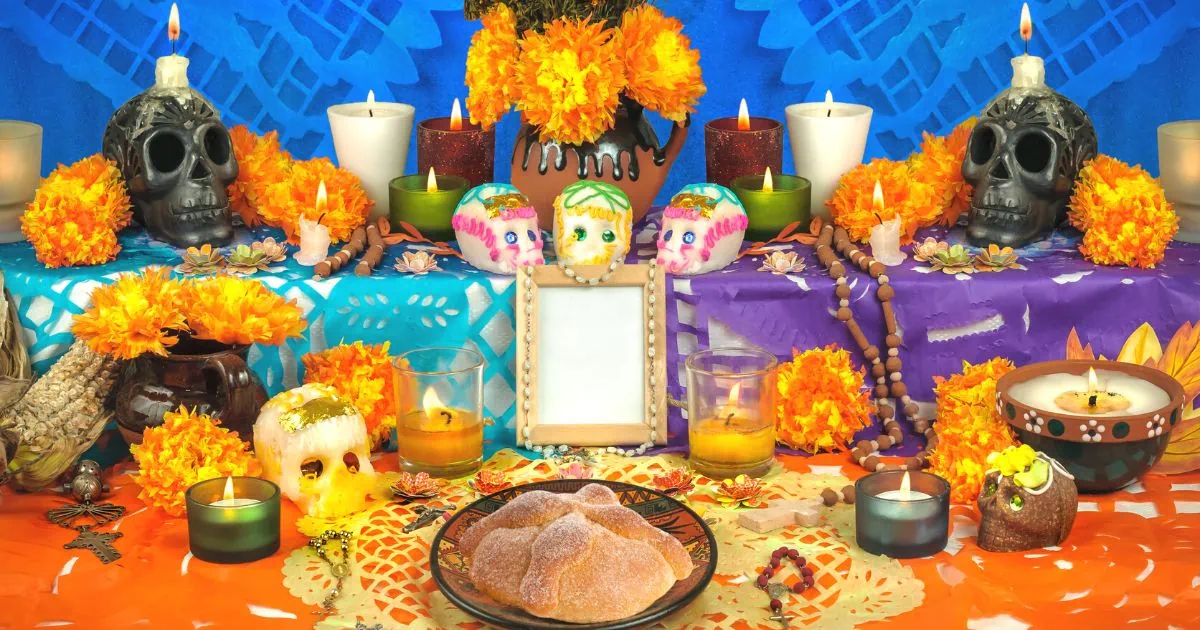
Sugar skulls are commonly placed on Day of the Dead ofrendas (altars) or other offering spaces prepared to honor deceased loved ones.
An ofrenda might include photographs, candles, water, flowers, favorite foods, and objects that belonged to the person being remembered.
Sugar skulls are part of this collection of symbolic offerings.
Some families choose skulls decorated with the names of deceased relatives. Others include them as part of the overall decoration.
Practices differ by household and region, so not every altar includes the same number or style of sugar skulls.
If you want to understand how the different objects fit together, see my guide to the meaning of every item on a Day of the Dead altar.
Why Do Sugar Skulls Have Names on Them?

One of the most distinctive features of some sugar skulls is the name written across the forehead.
The name may belong to the deceased person being remembered, particularly when the skull is prepared for an ofrenda.
Names can also be written on skulls intended as gifts to living friends or family members.
The practice can be understood as a reminder of our shared mortality, but it can also be playful and affectionate.
A decorated skull with someone’s name on it isn’t automatically meant as an insult or a threat.
In the context of Día de Muertos, skull imagery is often used in ways that bring people together through humor, memory, and an acknowledgment of life’s limits.
The exact purpose of a particular skull depends on who made it and how it is being used.
What Do the Colors on Sugar Skulls Mean?

Sugar skulls can be decorated in almost any combination of colors.
You’ll commonly see bright pink, yellow, orange, purple, blue, green, and white icing.
You may find online explanations assigning a fixed meaning to each color. However, these interpretations aren’t universal rules every Mexican family follows.
Colors can be chosen for symbolic reasons, personal preferences, or simply because they look beautiful together.
Here are a few common interpretations you may encounter:
⚪️ White
White is sometimes associated with hope, purity, or the idea of the spirit.
🟣 Purple
Purple is often associated with mourning or spirituality in explanations of Día de Muertos symbolism.
🟠🟡 Orange and Yellow
These colors may bring to mind cempasúchil, the orange marigold closely associated with the holiday.
🩷🔵🟢 Pink, Blue, and Green
Bright colors can make the skulls look cheerful and festive. Their use doesn’t necessarily have a single established symbolic meaning.
I think it’s worth remembering that the overall decoration matters, too. The colors make each skull distinctive and allow artisans to show their creativity.
What Do the Flowers and Patterns on Sugar Skulls Mean?

Sugar skull decorations can include flowers, hearts, dots, swirls, butterflies, and geometric patterns.
Flowers are particularly common because they complement the floral imagery used throughout Día de Muertos.
Some designs resemble marigolds or other familiar flowers. Others are simply decorative patterns that make the skull more colorful.
Hearts may suggest affection or remembrance, while elaborate lines and dots can give each skull a distinctive appearance.
There isn’t necessarily a hidden meaning behind every individual detail, and much depends on the artisan’s design and the person choosing the skull.
Where Did Sugar Skulls Originate?
The history of sugar skulls is often explained as a blend of Indigenous Mesoamerican traditions and techniques introduced during Spanish colonial rule.
Before the arrival of the Spanish, various Mesoamerican cultures used skull imagery in religious and ceremonial contexts.
The tzompantli, a structure associated with the display of human skulls, is one example of the historical presence of skull imagery in parts of Mesoamerica.
However, today’s sugar skulls are not simply ancient skull offerings recreated in sugar.
Alfeñique and Sugar Skulls

The sugar-based decorative sweets known as alfeñiques (seen above) are associated with confectionery techniques introduced from Spain and adapted in Mexico.
Mexico’s Secretariat of Culture discusses this history in its article on the origins of sugar skulls.
The history is therefore more complicated than saying that modern sugar skulls are an unchanged pre-Hispanic tradition.
Día de Muertos developed over time, bringing together Indigenous customs, Catholic observances, and regional practices.
Are Sugar Skulls Meant to Be Eaten?

Some are edible, but not all decorative skulls are intended to be eaten.
Traditional sugar skulls are made from sugar-based mixtures and may be edible, although they can be very hard and extremely sweet.
Some are created primarily as decorations and may contain materials that aren’t meant to be consumed.
Chocolate sugar skulls and amaranth sugar skulls (seen above) versions are also available; these are meant to be consumed.
If you buy a skull from a market or shop, ask what it is made from before eating it, particularly if it has elaborate decorations or added materials.
Are Mexican Sugar Skulls and La Catrina the Same Thing?

No. Although both are associated with Día de Muertos and use skull imagery, they are different symbols.
A sugar skull is a decorative sweet, often placed on an ofrenda or given as a gift.
La Catrina is a famous skeletal female figure in an elegant outfit, associated with Mexican printmaker José Guadalupe Posada and later popularized in art by Diego Rivera.
La Catrina has her own history and symbolism, including commentary on social class and the imitation of European fashions.
If you’re interested in her story, I’ve covered it separately in The Story of La Catrina, Mexico.
Keeping these two symbols separate is useful when learning about the many ways skulls appear in Mexican culture.
What Is the Difference Between a Sugar Skull and a Calavera?

The Spanish word calavera means skull.
In the context of Día de Muertos, it can refer to a physical skull, a skull-shaped decoration, or skull imagery more generally.
A calaverita de azúcar specifically refers to a sugar skull, as azúcar is the Spanish word for sugar.
You may also encounter calaveritas literarias, which are short, often humorous verses about death.
These verses sometimes imagine Death visiting a living person, such as a friend, politician, or public figure.
The word calavera therefore covers a wider range of meanings than the term sugar skull does.
Are There Sugar Skulls in Mexico?

I’ve experienced Día de Muertos celebrations in Mexico City, Oaxaca City, and Mérida, and one thing I appreciate is how familiar symbols can appear in different settings.
Sugar skulls are easy to recognize, but the wider atmosphere of a celebration depends on the community and its traditions.
In Mexico City, you may see them in public displays, home altars, shops, mercados (markets) — with some vendors selling unique variations like chocolate sugar skulls.
In Oaxaca City, they’re sold in mercados (markets) and appear on public ofrendas (altars) and in large-scale art decorations associated with the holiday.
In Mérida, you may also encounter skulls as part of seasonal displays and ofrendas during Hanal Pixan — though they are MUCH less common than in central Mexico.
These examples aren’t meant to suggest that every community uses sugar skulls in exactly the same way.
Families make their own decisions about the offerings and decorations they prepare.
Can You Make Your Own Sugar Skulls?

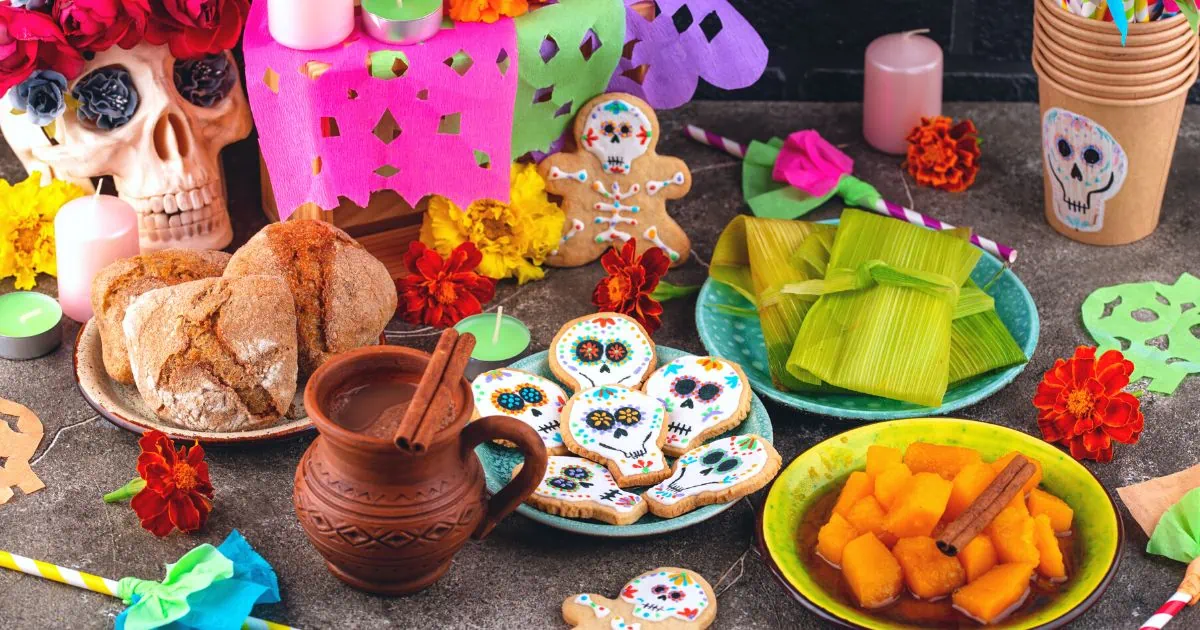
Yes, although the traditional process can take some practice — which is why many opt to make sugar skull cookies instead (seen above).
Sugar skulls are often made by pressing a sugar-based mixture into a mold and allowing it to dry or set.
Once the skull is firm, decorative icing can be used to add flowers, dots, names, and other details.
You can find kits and molds designed for making sugar skulls at home.
If you’re preparing an ofrenda, making your own can be a fun way to involve children or other family members in getting ready for Día de Muertos.
Just remember that the skull doesn’t have to be elaborate to be meaningful.
Why Sugar Skulls Matter During Día de Muertos

Sugar skulls are among the most recognizable decorations associated with Día de Muertos, but their importance goes beyond their appearance.
They bring skull imagery into a setting centered on memory, family, and the continuing relationship people feel with deceased loved ones.
The names, colors, and decorations make each skull personal, while their placement on an ofrenda connects them to the wider tradition of honoring the dead.
After living in Mexico since 2018, I appreciate how Día de Muertos can acknowledge death without making every part of the celebration feel sombre.
There is room for remembrance, affection, artistry, and even humor — and sugar skulls capture that combination in a particularly memorable way.
They remind us of mortality, but they also remind us that remembering someone can be an act of love.