
45+ Famous Landmarks in Mexico You Probably Didn’t Know Existed


wondering, What are some famous landmarks in Mexico?
As one of the largest countries on Earth, there are seemingly countless landmarks in Mexico that will WOW you!
So how do you choose which Mexico landmarks to see when you travel to Mexico?
Since a lot of the decision will come down to where you’re traveling in Mexico, there’s a handy Landmarks in Mexico map below.
This will help you see which of the best places in Mexico are where, so you can see what fits in with your travel plans.
In this article, you’ll find everything broken down by category: Mexico City landmarks, historic landmarks and ancient ruins, man-made and natural landmarks in Mexico, and more.
Ready to discover all the most famous places in Mexico? Let’s get to it!
Must See Landmarks in Mexico
These first 14 sites on the list are the must-see landmarks in Mexico City. The Mexico capital has plenty of interesting landmarks you won’t want to miss.
As one of the biggest cities on Earth, the list of Mexico City famous places could go on for a long time, so this is an abridged list.
However, it does cover all the famous and historical landmarks in Mexico City you won’t want to miss.
After that, we’ll get to the rest of the list, which has important landmarks from all over Mexico.
Landmarks in Mexico City
1. Templo Mayor (Aztec Temple)

Centuries ago, the Great Pyramid of Tenochtitlan served as the central location for the entire Aztec Empire.
After the Spanish conquest, it was buried, and the present-day Zocalo (Town Square) in Downtown Mexico City was built on top of it.
The first efforts to find the templo began in the 19th Century, though public interest wasn’t very high.
Archeologists persisted, and by the 20th Century, they had a good idea where the temple might be — however, it was ultimately discovered by accident.
On 21 February 1978, workers for the electric company were digging [in Centro Historico]… and just over two meters down, the diggers struck a pre-Hispanic monolith.
source: Wiki
Today, you can tour the remnants of the temple and see some of the most important archeological treasures at this historic site.
During the excavations, upwards of 7,000 objects and artifacts were recovered at this Mexico City Aztec Temple.
Some of them are now displayed at the adjoining Templo Mayor Museum, one of the best museums in Mexico City.
Landmarks in Mexico City
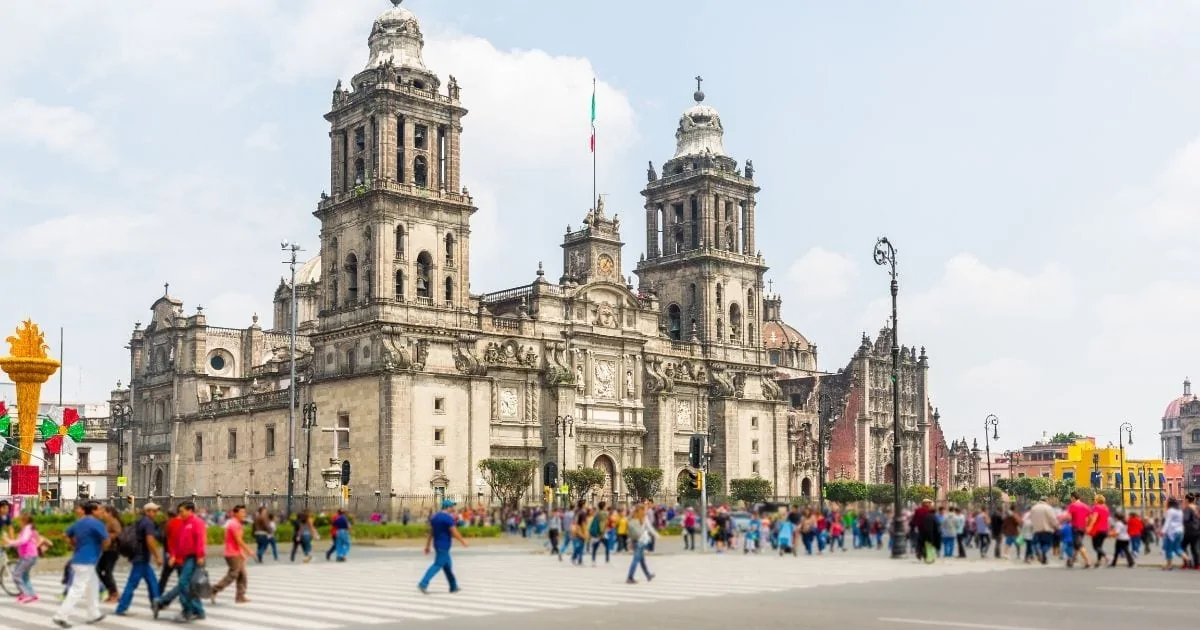
2. Metropolitan Cathedral

The Templo Mayor and Catedral Metropolitana are two of the most important landmarks or monuments of Mexico City.
The two are also intertwined, as the bricks used to build the cathedral were the same ones taken from the Great Pyramid of Tenochtitlan (Templo Mayor).
It took an astounding 240 years to build this opulent structure — one of the 10 largest churches on the Americas Continent.
The Mexico City Cathedral also has the largest pipe organs on the continent, and is a must-visit for first time Mexico City travelers.
Landmarks in Mexico City
3. Palacio Bellas Artes

Among the most famous buildings in Mexico City, the golden-domed Palacio Bellas Artes is one of the most recognizable of all Mexico City landmarks.
It houses a museum and performance space, where you can often see the famous Ballet Folklórico de México.
🌳 Alameda Central Park
Located next to Bellas Artes, you’ll be in Parque Alameda, home to the Benito Juárez Hemicycle.
This impressive monument pays homage to former President Benito Juárez, who implemented constitutional reforms that helped establish democracy in Mexico.
Landmarks in Mexico City
4. Mexico City Zócalo

In cities throughout Mexico, you’ll find a Zocalo (Main Square). Being a huge city, the Mexico City Zocalo is larger than most.
There are a few sites in the Plaza de la Constitución, another name for the Zocalo, including the Templo Mayor, Cathedral and Mexico National Palace.
🏰 Palacio Nacional (Mexico National Palace)
Located in the heart of Mexico City, the Palacio Nacional is one of the must visit national landmarks of Mexico.
It is the main building in Mexico City that houses government offices and the officials who keep the country running.
Aa long building at 660-feet in length (201 m), it takes up one entire side of the Zocalo Square.
It is one of the most famous Mexican buildings, and most important for present-day politics. The Mexican president also has an office inside.
Landmarks in Mexico City
5. Chapultepec Castle (Castillo de Chapultepec)

Located in Bosque de Chapultepec — which means Chapultepec Forest, but is better known as Chapultepec Park — you’ll find Chapultepec Castle.
Sitting at the top of Chapultepec Hill, this is technically the only castle in North America, as it’s the only castle on the continent that once housed royals.
It was the official residence of Emperor Maximilian I and Empress Carlota from 1864-1867, during the Second Mexican Empire.
Since it’s construction, Chapultepec Castle has been used as a home, military academy, and presidential palace. It’s now one of the best Mexico City museums.
Both Chapultepec Castle and the National History Museum should be on any Mexico City itinerary.
Located nearby, don’t miss the Monumento a los Niños Héroes (Monument to the Boy Heroes). These six young boys played a key role in the Mexican-American War.
Landmarks in Mexico City
6. Floating Gardens of Xochimilco

Xochimilco (pronounced so-chee-mil-ko) is one of the best places to visit in Mexico City.
Located in the southern part of the city near the Coyoacan neighborhood, Xochimilco is famous for an intricate network of canals and colorful gondola boats.
The Xochimilco canals are a UNESCO World Heritage Site in Mexico that offer a fascinating insight into the Aztec civilization.
Carved by hand, this prehispanic civilization once used the canals as a main thoroughfare for trade and commerce.
There are really two ways to visit Xochimilco — one a sort of party cruise, and the other by taking a tour of the chinampas, or floating gardens.
The latter shows the historic side of Xochimilco, where farmers still use techniques from ancient times to grow organic food.
Landmarks in Mexico City
7. Basilica de Guadalupe

The Basílica de Santa María de Guadalupe, usually just called the Basílica de Guadalupe, is the 13th largest church in the world.
One of the best architectural sites in Mexico, the most recent building of the basilica was built by famed Mexican architect, Pedro Ramírez Vázquez.
A popular place for religious worshipers and tourists all year, this holy site sees upwards of one million visitors and pilgrims on December 12.
This is the Dia de la Virgin de Guadalupe holiday, and this church was built in her honor.
Landmarks in Mexico City
8. Ángel de la Independencia

The most famous monument in Mexico City! The large, gold Angel towers over Avenida Reforma, one of the main streets in Mexico City.
There are other monuments to see on Reforma Avenue as well, including the Diana the Huntress Fountain and Monument to Cuauhtémoc.
🛕 Monumento a la Revolución

Located just off Reforma Avenue in the Plaza de la República, you’ll find the grand Monument to the Revolution — one of the most famous structures in Mexico City.
This domed monument commemorates the Mexican Revolution, and several war heroes are buried there, including Pancho Villa and other famous Mexicans.
Landmarks in Mexico City
9. UNAM (Universidad Nacional Autónoma de México)

The National Autonomous University of Mexico (UNAM) received the prestigious UNESCO World Heritage Site designation in 2007.
It is one of 35 Mexico UNESCO World Heritage Sites, with three of them in Mexico City alone.
The UNAM campus has sprawling open spaces and buildings constructed by more than 60 architects, engineers and artists.
Done by the architect and painter, Juan O’Gorman, his iconic painting on the Central Library UNAM is said to be the largest mural ever done.
Besides those of O’Gorman, you can see the work of other great Mexican muralists, like David Alfaro Siqueiros and Diego Rivera amongst the UNAM murals.
Besides the art, the historic architecture at UNAM will wow anyone interested in design and esthetics.
Landmarks in Mexico City
10. Frida Kahlo Museum (Casa Azul)

Rounding out this list of the Top 10 landmarks in Mexico is La Casa Azul (The Blue House) — one of the best museums in Mexico City.
Once home to Frida Kahlo and Diego Rivera, two of the most famous Mexican artists of all time, people from all over the world come to visit the landmark.
The Blue House Frida Museum offers a glimpse into Frida’s life, her art, and ultimately, her death on July 13, 1954.
The museum is located in the historic Coyoacan Mexico City neighborhood — and you’ll want to save some space on your Mexico City itinerary to visit Coyoacan.
Besides the Museo Frida Kahlo Mexican artist house, don’t miss the Fuente de los Coyotes (Coyote Fountain) and 16th Century San Juan Bautista Church.
🎞 Cineteca Nacional
The Cineteca Nacional (National Cinema) is also located in Coyoacan.
It’s more of an experience than a traditional movie theater, but if you need a good reason to simply relax and have a movie night in Mexico City — this theater is unlike any you’ve seen before.
Landmarks in Mexico City
11. National Anthropology Museum

The Museo Nacional de Antropología is the most-visited of all the best museums in Mexico City.
It’s also massive — with 23 exhibition halls that span 3,225 years of history.
In it, you’ll see the Piedra del Sol (Aztec calendar or Aztec sunstone), a replica of Moctezuma’s headdress, and the Olmec head statues.
These are of course just some of the highlights in the Mexico City National Museum of Anthropology.
🗿 Love Mexican history?

If you’re deeply fascinated by the extensive history of Mexico, book this Mexico Unearthed at Anthropology Museum Tour.
It’s led by a female anthropologist slash archeologist, with 25-plus years of experience in Mexican history.
Landmarks in Mexico City
12. Estadio Azteca Stadium
Home to the Mexican national team and Mexico City soccer team, Club América, is the biggest Mexico football stadium — Estadio Azteca.
It’s also one of the world’s highest stadiums, at 7,218-feet (2,200 m) above sea level, and the best place to see soccer games in Mexico City.
Mexico Fun Facts: Mexico City is about 1.5 miles above sea level (2.4 km), so when making your Mexico packing list, remember to include altitude sickness meds.
🤼♀️ Arena México

To see another popular Mexico sport, lucha libre, you’ll visit Arena Mexico.
The beloved part-comedy, part-sport of Mexican wrestling is a cultural phenomenon, and many Mexico City visitors have a lucha libre match on their itinerary.
Landmarks in Mexico City
13. Cafebreria el Pendulo

Cafebreria el Pendulo is a chain of bookstores located in Mexico City that offer a great place to relax, have a coffee, and buy some books.
There are locations in Roma Norte on the famous Avenida Alvaro Obregon, and in the posh Polanco neighborhood, which looks like a jungle meets bookstore.
Also in Polanco, don’t miss the Museo Soumaya (Soumaya Museum) — one of the best free things to do in Mexico City.
For a nice meal, Polanco has some of the best restaurants in Mexico City, like Pujol, ranked among the Top 10 best restaurants in the world.
Landmarks in Mexico City
14. Torre Latinoamericana

When it comes to modern, famous architecture in Mexico, there’s no building more important than the Torre Latinoamericana Tower.
In fact, many would consider it the most famous building in Mexico City’s Downtown, and the most famous building in Mexico.
One of the key buildings in Mexico City and all Latin America — the Torre Latinoamericana skyscraper is one of the dominant buildings in the Mexico City skyline.
On a clear day, head up to the Mirador (viewing platform), for the best views of Mexico City from its highest point of view.
Landmarks in Mexico City
15. Teotihuacan Ruins

The Mexico City Pyramids of Teotihuacan (pronounced tay-oh-tee-wok-on) are located in San Juan Teotihuacan.
About one hour from Mexico City, head to this UNESCO World Heritage Site to climb the Teotihuacan pyramids — Pyramid of the Sun, Pyramid of the Moon, Pyramid of Quetzalcoatl.
On a personal note, I’ve been to A LOT of ruins in Mexico, and I think the Pyramid of Quetzalcoatl has some of the most beautiful architectural features of them all.
After visiting, don’t miss all the local villages, restaurants and shops in San Juan Teotihuacan, Mexico.
This is one of the 177 or so Mexico pueblos magicos (magic towns). Some of the most noteworthy places in the country, the magic towns are worth a visit on your trip to Mexico.
🎈 Best Teotihuacan tours

The best way to visit Teotihuacan Ruins? On a Teotihuacan hot air balloon tour so you can see this massive site from above.
🗿 Xochicalco Ruins
The Ruins of Xochicalco (pronounced so-chee-lack-oh) are another one of the UNESCO World Heritage Sites in Mexico.
Located in Morelos State, one state south of Mexico City, Xochicalco and the Tepoztlan pueblo magico (magic town) are popular day trips from Mexico City.
Landmarks in Mexico
16. San Miguel de Allende Parroquia

If you’ve ever seen photos of San Miguel de Allende, you’re likely seen the Parroquia de San Miguel Arcángel.
Located in Centro Historico (Historic Downtown), you’ll find this iconic Gothic church from the 17th Century — one of the most beautiful churches in Mexico.
The parroquia is just one building surrounding El Jardín (the Garden), located in the Zocalo, or the main Town Square
Sit on a bench and enjoy people watching in this beautifully-manicured garden, as street vendors go by and the sounds of live mariachi music fills the air.
Landmarks in Mexico
17. La Quebrada (Acapulco Cliff Divers)

The La Quebrada Cliff Divers are a group of professional high divers in Acapulco — the closest beach to Mexico City.
The divers perform shows for the public each day, diving from rocks 100- to 135-feet (30-41 m) from the cliffs of La Quebrada into the Pacific Ocean below.
👀 For another unique Mexico beach experience, there’s also Zipolite, Oaxaca — where you’ll find the only legal Mexico nude beach, but also a lot of natural beauty.
Landmarks in Mexico
18. Piedra Herrada Monarch Butterfly Biosphere Reserve

Every November, hundreds of millions (possibly billions) of monarch butterflies migrate from Canada and the northern United States to Central Mexico’s Oyamel Forests.
They remain there until April, then begin their eight month journey back. It is one of the largest animal migrations on Earth.
During the trip, four generations of butterflies will live and die. Scientists still don’t know how or why, but the monarchs return to the same place in Central Mexico each year!
The entire 139,000-acre (56,259 hectare) Monarch Butterfly Biosphere Reserve is a UNESCO World Heritage Site.
There are numerous Piedra Herrada Sanctuary tours to see the butterflies, as it’s in a remote location — so a tour is definitely the easiest way to go!
There are a few places within the reserve to see the butterflies, including El Rosario in Michoacan State, and the Piedra Herrada Sanctuary.
Located less than two hours from Mexico City, Piedra Herrada in Valle de Bravo, Mexico, is the most popular.
Once you reach the top of the mountain where the butterflies congregate, you stand and witness thousands of monarch butterflies.
They weigh down branches of trees, fly about and surround you, covering both you and the ground paths.
Everywhere you look, you’ll see the bright orange of the monarch’s bodies. They will land on you, and flutter to the ground beneath you.
It truly is one of the most incredible natural sites you’ll ever see.
Landmarks in Mexico
20. Santa Prisca Church in Taxco

Taxco de Alarcon, usually just called Taxco, has been called one of the most beautiful pueblos magicos in Mexico.
While beauty is in the eye of the beholder, the magic town of Taxco doesn’t disappoint in the esthetics department.
Among the most iconic sites in this hillside town located in the Sierra Madres is the Parroquia de Santa Prisca y San Sebastián (Church of Santa Prisca).
It towers over Taxco, and dominates the skyline in this white and terra cotta-colored town.
💒 History of the Taxco Church
The construction was ordered by José de la Borda, one of the most prosperous mine owners of the region of Taxco in the 18th Century.
From 1758 to 1806, the temple was the tallest building in Mexico, but was surpassed by the Church of Our Lady of Mount Carmel in San Luis Potosí City. (source: Wiki)
Landmarks in Mexico
21. Monte Alban Ruins

Both Oaxaca City Centro Historico (Historic Downtown) and the Ruins of Monte Alban near downtown are both UNESCO World Heritage Sites in Mexico.
Monte Alban Oaxaca is located high atop a mountain, and offers spectacular views of the towns in the valleys below.
Along with Hierve el Agua, Monte Alban is one of the best things to do in Oaxaca Mexico!
The ruins have been around since the 6th Century, and what remains today are terraces, large courtyards and some of the best pyramids in Mexico.
🗿 Mitla Ruins in oaxaca

The Prehistoric Caves of Yagul and Mitla is another Oaxaca UNESCO World Heritage Site. The two are located not far from one another, both near Oaxaca City.
Besides Monte Alban, the Ruins of Mitla is Oaxaca’s second most important archaeological site.
They are located in the Oaxaca pueblo magico (magic town) of San Pablo de Mitla, near Oaxaca City.
Rather than a group of pyramids, like many of the best ruins in Mexico, Mitla is a collection of shorter buildings decorated with intricate carved stone in elaborate geometric designs.
It is one of the holiest sites for the native Zapotec and Mixtec peoples, once used as a holy burial site.
💀 Dia de los Muertos in Oaxaca City

The best time to visit Oaxaca, Mexico, is the last week in October and first week in November for Day of the Dead in Oaxaca.
This is also during the dry season, so you can enjoy the Día de Muertos festivities and visit all the prehispanic ruins in the State of Oaxaca with nice weather!
Landmarks in Mexico
22. Chichen Itza Mayan Ruins

The most famous landmark in the Yucatan Peninsula, and one of the New Seven Wonders of the World, visiting Chichen Itza is a Mexico bucket list experience for most travelers.
As Chichen Itza is one the largest Mayan ruin sites in the world, there are several Mayan pyramids and unique structures to explore, like El Castillo (The Castle).
For one of the most unique landmarks in Mexico, check out the Pink Lakes of Las Coloradas, located about 2.5 hours from Chichén Itzá.
Among the best things to see at Chichen Itza, there’s El Castillo (the Temple of Kukulcan), which you’ve likely seen in photos.
Other notable sites include the Temple of the Warriors, Group of a Thousand Columns, Great Ball Court and Cenote Sagrado (Sacred Cenote).
Landmarks in Mexico
23. Palenque Mayan Ruins

The Mayan Ruins of Palenque is a UNESCO World Heritage Site located in the small pueblo magico of Palenque. It’s also one of my Top 10 Best Mexico sites!
It is about four hours from the town of San Cristobal de las Casa, which is the top Chiapas State travel destination.
Located deep in the jungle, there’s so much to see at Palenque Ruins (pronounced pa-lan-kay). When visiting Mexico, don’t miss these structures at Palenque:
- Templo de las Inscripciones (Temple of the Inscriptions)
- Templo del Conde (Temple of the Count)
- El Palacio (The Palace)
- Tumba de la Reina Roja (Tomb of the Red Queen)
🗿 Bonampak Ruins & Murals
Located in Chiapas State, the same as Palenque, the Mayan Ruins of Bonampak are best known for the well-preserved Bonampak Murals, more of an artistic than an architectural feature.
The paintings at Bonampak date back to 790 AD, making them about 1,250-years-old!
Landmarks in Mexico
24. Tulum Ruins

Tulum is located in the Yucatan Peninsula about 1.5 hours south of Cancun, and considered one of the best beach towns in Mexico.
A top Mexico destination, Tulum is known for beautiful beaches, bohemian vibes, posh resorts, swimmable Tulum cenotes, colorful cafes, and the Tulum Mayan Ruins.
Compared to other ruins in Mexico, Tulum Ruins is quite small. However, it’s one of the most beautiful, located on a cliff that overlooks the Caribbean Sea.
There are only about five large structures at the site, including the Templo del Viento (Wind Temple) and El Castillo pyramid (The Castle).
🗿 Chacchoben Ruins
Not far from Tulum, the beach town of Mahahual, and Bacalar Lagoon, AKA “the Maldives of Mexico,” you’ll find the Ruins of Chacchoben (pronounced cha-cho-ben).
These off the beaten path ruins are deep in the jungle, with Mayan pyramids containing hieroglyphic writing.
Landmarks in Mexico
25. Uxmal Mayan Ruins

Located less than two-hours from the colorful, colonial city of Merida, you’ll find the Mayan Ruins of Uxmal (pronounced yoosh-mall).
This UNESCO World Heritage Site is considered the second most important archeological site in the Yucatan Peninsula, behind Chichen Itza.
Though lacking the name recognition Chichen Itza has, Uxmal is equally impressive — if not moreso.
As it’s less crowded and less touristy, seeing only about one-tenth the annual visitors of Chichen Itza, many say Uxmal feels more authentic.
🗿 Mayápan Ruins
This is one of the best Mayan Ruins near Merida, though sadly, so few visit.
For those who visit the Mayan Ruins of Mayapan, you may end up having the whole palace to yourself (especially if you visit on a weekday).
This makes for a truly magical experience at one of the best man made Mexico landmarks in Yucatan.
There are several structures and pyramids at Mayapan, including the large, central pyramid that looks like El Castillo at Chichen Itza.
There’s also a The Observatory, a circular structure that closely resembles the round Toltec Ruins in the city of Tula near Mexico City.
Landmarks in Mexico
26. Best Cenotes in Mexico

There are about 6,000 cenotes in Mexico — which are natural jungle pools (sinkholes) that contain crystal-clear waters.
Most Mexico cenotes are in the Yucatan Peninsula, like the Tulum cenotes, cenotes near Cancun and Merida cenotes, all fed by the same underground rivers and subterranean caves.
Located beneath the entire Yucatan, there’s the Sistema Sac Actun, Sistema Ox Bel Ha and Sistema Dos Ojos, three giant, flooded cave systems.
Sistema Sac Actun is the longest underwater cave in the world ever explored, and one of the few places on Earth you can go cave diving.
💧 Cenote Ik Kil

Located not far from Chichen Itza Mayan Ruins and the pueblo of Valladolid, Mexico, you’ll find one of the most Instagram worthy Mexico destinations.
The gorgeous Ik Kil Cenote went viral on social media a few years back, but once you get there, you’ll see why!
💧 Cenote Dos Ojos

Dos Ojos Cenote, meaning “two eyes cenote,” is actually two cenotes in one.
There’s the ojo azul (blue eye), an open cenote with bright blue water, and the ojo negro (black eye), a completely dark cave cenote that you need a guide to enter.
It’s very popular with divers, snorkelers and those who just want to swim.
Cenote Dos Ojos is part of the Sistema Sac Actun, along with other Mexico cenotes like Cenote Pet Cemetery, Cenote El Pit and Cenote Taak Bi Ha.
💧 Cenote Suytun

Another one of the famous and Instagrammable cenotes in Mexico, Suytun Cenote is located fully underground in a cave.
There is a single ray of light that shines in from the top, onto a manmade platform in the center, making it the perfect place for Mexico cenote photos.
Landmarks in Mexico
27. El Zacatón Sinkhole

While the vast majority of Mexico cenotes are in the Yucatan Peninsula, there is one very large cenote you’ll find in the North Mexico state of Tamaulipas.
Cenote El Zacatón is one of the coolest off the beaten path Mexico sites — with a deep water cenote and free-floating island.
Landmarks in Mexico
28. Mexico Hidden Beach of Isla Marietas

Those traveling to Puerto Vallarta or Sayulita, can cross the Marietas Islands off their Mexico bucket list.
On one of the small islands in this chain, you’ll see the famous hidden beach in Mexico — Playa del Amor (Lover’s Beach).
As this Mexico hidden gem has grown in popularity thanks to social media and YouTube, the government has limited the number of daily visitors to preserve Islas Marietas National Park.
Now, only about 125 people per day may visit the secret beach on a Marietas Islands tour.
Landmarks in Mexico
29. El Arco de Cabo San Lucas (Cabo Arch)

Located on the southern tip of the Baja California Peninsula, one of the best things to do in Cabo San Lucas is visit El Arco (The Arch) at Land’s End.
This is the area where the Pacific Ocean meets the Sea of Cortez (Gulf of California), with several large, natural rock formations.
There is a small beach at El Arco called Lover’s Beach (Playa del Amor), but it disappears during high tide.
For this reason, the best way to visit the Cabo Arch is by boat, kayak or this Cabo Arch SUP Tour on a stand-up paddle board, to see the iconic Arch of Cabo San Lucas, Mexico.
💧 La Bufadora: Mexico Blowhole

Another one of the famous landmarks of Mexico is La Bufadora Blowhole, one of the most popular activities in Ensenada, Mexico.
Located about 75-minutes from San Diego, this is one of the largest marine geysers in the world. You can easily drive from the U.S. to Mexico to see it.
Landmarks in Mexico
30. Playa Balandra Beach

Balandra Beach is one of the most famous beaches in Baja, and one of the best beaches in Mexico.
Located in Baja California Sur State, just 30 minutes south of La Paz, Mexico, this pristine, white sandy beach with turquoise water is a must see in Baja Mexico.
At Playa Balandra, you can wade across the bay between schools of fish to take a photo at Mushroom Rock.
Many rent a SUP paddleboard or kayak and explore the bay, or just throw a towel on the sand, and relax as vendors walk past selling drinks, snacks and souvenirs.
It is definitely best to arrive at this beach in the early morning, as the parking lot fills up by the afternoon.
If you are camping nearby, plan to spend the whole day at Playa Balandra Mexico, as sunsets are absolutely remarkable and you should be in no rush to leave!
Landmarks in Mexico
31. San Ignacio Lagoon

Laguna San Ignacio lagoon is located a few hours from Mulegé, an off the beaten track town in Baja California Sur State on the West Coast of Mexico.
This remote lagoon is one of the winter sanctuaries of the eastern Pacific gray whales. From about late-January to early-April, the gray whales come to San Ignacio Lagoon.
With its relatively shallow waters, killer whales won’t enter this bay, making it a safe place for the gray whales to give birth and raise their calves, before returning to the Pacific Ocean.
Over the years, the whales have become accustomed to, and even friendly with, human visitors.
Unprovoked, they come right up to the tour boats on their own — the baby calf often right alongside the mother.
In doing so, the calves are socialized to humans from birth. When they have offspring of their own, they will teach their babies to do the same.
🐳 Magdalena Bay Whales
Located much closer to popular Cabo San Lucas, you can also visit Magdalena Bay and join a boat tour there to see the grey whales.
Since this area is a bit remote, two day Magdalena Bay tours are among the most popular options. Note: This is a seasonal tour and not available year-round.
Landmarks in Mexico
32. MUSA Cancun Underwater Museum

The Museo Subacuático de Arte (MUSA), or Cancun underwater museum, is one of the top attractions in Mexico, and the best things to do in Cancun.
If you want to go diving in Cancun and/or snorkeling in Cancun, don’t miss it — as MUSA is one of the largest underwater sculpture gardens in the world.
MUSA is located underwater, between Cancun and nearby Isla Mujeres island, in the Mexican Caribbean.
While scuba diving, snorkeling or on a glass bottom boat tour, you’ll see some (or all) of the 500-plus pieces of art created by various artists, and now partially-covered in underwater tropical plants.
Landmarks in Mexico
33. Mesoamerican Barrier Reef

Stretching for 625-miles (1,005 km) along the coast of Honduras, Guatemala, Belize and Mexico, the Mesoamerican Reef is the largest barrier reef in the Western Hemisphere.
It is the second biggest of all coral reefs in the world, after the Great Barrier Reef near Australia.
There are more than 65 species of stony corals and 500 different species of fish, as well as sea turtles or dolphins.
The largest fish in the sea, whale sharks, even migrate through this reef system near Isla Mujeres and Isla Holbox between about May to September.
The best areas to snorkel the Mesoamerican Reef are Cozumel and Riviera Maya — especially the beach in front of Grand Sirenis Resort.
Make sure to take underwater photos as you swim surrounded by colorful fish and marine life, as there’s so few places like this on Earth.
Landmarks in Mexico
34. Laguna Bacalar Lake of Seven Colors

Lake Bacalar is located in the Bacalar pueblo magico (magic town) in south Quintana Roo State, near the Mexico-Belize border.
Most people travel there on the Cancun to Bacalar route, and some continue to Belize and Central America after visiting.
It is the second largest freshwater lake in Mexico, after Lago Chapala near Guadalajara and the small town of Ajijic in Jalisco State.
Bacalar Lagoon, AKA the “Maldives of Mexico” and the “Lake of Seven Colors,” is said to have seven shades of blue.
It ranges from zero to 300-feet-deep (61 m). In the shallows, you see light blue or crystal clear waters, but in deep waters, the lagoon shows as dark blue or indigo.
Landmarks in Mexico
35. Barrancas del Cobre (Copper Canyon)

🇲🇽 Mexico Fun Fact: The Copper Canyon is the eighth largest canyon in the world, and second largest in North America, after the Grand Canyon.
The Barrancas del Cobre (Copper Canyon), is also part of a UNESCO World Heritage Site and a Mexico National Park.
To see it, take the El Chepe Express Train ride, which goes through some areas of the canyon and other beautiful landscapes in North Mexico.
Many board in the city of Los Mochis, Sinaloa, and travel about 220 miles to Creel pueblo magico (magic town) in Chihuahua, Mexico.
This is the most popular way to do a Copper Canyon itinerary, but you do have other options.
Landmarks in Mexico
36. Rio Grande River

The Rio Grande, also known as the Rio Bravo del Norte in Mexico, runs 1,896 miles (3,051 km).
Originating in Colorado (near the Colorado River), this famous landmark in Mexico is the fifth longest river in North America, separating Mexico from the United States.
It spans the entire length of the Texas border. Crossing the border anywhere between Texas and Mexico, means you will cross the majestic Rio Grande River.
Most border crossings utilize a bridge, but at Big Bend National Park in southwest Texas, you can cross by boat.
The Boquillas Crossing in Big Bend is the only Mexico-United States border crossing unmanned by border patrol agents.
However, to cross the border, you still need a passport as you must go through Customs in the tiny village of Boquillas del Carmen, Mexico.
While hundreds of thousands of people cross the Rio Grande between Mexico and Texas at one of 28 international crossings each year, the Boquillas Crossing is by far the most unique border crossing between the two countries.
Once you see it, you’ll know why it’s also known as one of the most unique places in Mexico.
Landmarks in Mexico
37. Cave of the Crystals (Naica)

The Cueva de los Cristales (Cave of the Crystals) is a giant selenite crystal cave that looks downright otherworldly!
Only discovered in 2001, some of these crystals measure as much as 37.5-feet-long (11.4 m), and weigh an astonishing 12 tons (24,000 pounds).
It is located 980-feet (300 m) below the Earth, in the Naica Caves, in the city of Naica, Chihuahua, Mexico.
Not open to the public, a group of scientists from the Naica Project have been studying the Cueva de los Cristales.
Landmarks in Mexico
38. Chicxulub Crater

The Chicxulub Crater is the exact spot where the asteroid hit that wiped out the dinosaurs more than 60 million years ago.
The impact site is located in the present-day Mexico beach town of Puerto Chicxulub (pronounced chee-chee-lube).
You can’t see the impact site, as it’s partially located in the Gulf of Mexico and partially buried beneath the land.
However, what you can see is what was left behind after the meteor’s impact — cenotes! That’s right, the impact is said to have created the cenotes in Mexico.
🦭 La Lobera Sea Lion Crater

Mexico is home to many natural wonders, like La Lobera. This naturally-formed crater on the Pacific Ocean in Baja California State, is near the beach town of Ensenada.
There is a huge sea cave where the ceiling has collapsed, exposing a Mexico secret beach below that’s a popular hangout for seals and a colony of sea lions.
Landmarks in Mexico
39. Cave of the Hanging Snake
The Cave of the Hanging Snakes, known as the Bat Cave by the locals, is located in the small pueblo Kantemó, Quintana Roo State, Yucatan Peninsula.
Besides the snakes, this cave is home to swarms of small bats, which make a delicious meal for the serpents.
For ease of capturing (and eating) the bats, the snakes have moved from the ground to the cracks and crevices in the cave’s ceiling and high walls.
When the bat swarm starts leaving the cave at sundown, the snakes emerge, hanging down to catch the flying bats in their mouths.
La Cueva de las Serpientes Colgantes is a popular tourist attraction, and you can get there in your Mexico rental car.
It is located about two hours from Merida, and two hours, 45 minutes from Tulum, and 3.5 hours from Playa del Carmen.
Landmarks in Mexico
40. Sotano de las Golondrinas

The Sotano de las Golondrinas (Cave of Swallows) is an open-air pit cave in Aquismón, San Luis Potosí State that’s home to numerous bird species.
The cave floor is a 1,092-foot (333 m) drop straight down from the large opening at the top — making it the largest cave shaft ever discovered in the world.
It is among the stops for visitors headed to the Huasteca Potosina Region of Mexico.
This part of the country in Central Mexico is well known for its gorgeous waterfalls, the Xilitla Surrealist Gardens of Edward James, and the Cave of Swallows.
🌎 Gruta de las Canicas
The Gruta de las Canicas (Grotto of the Marbles) is a cave located near the pueblo of Teapa, Tabasco State.
The floor is covered by more than 18 million small, tan-colored calcite mineral spheres that look like marbles. That has earned it the name “grotto of marbles.”
Landmarks in Mexico
41. Great Pyramid of Cholula

If you asked most people where the largest pyramid on Earth is located, 99% would likely say Egypt.
However, the largest pyramid by volume (not height) is the Great Pyramid of Cholula in Cholula, Mexico.
Incredibly, the Great Pyramid of Cholula is mostly buried underground! It is truly one of the coolest historic landmarks in Mexico.
When the Spanish conquistadors invaded Mexico, they put Catholic churches on top of preexisting temples, and the Great Pyramid is located beneath Nuestra Señora de los Remedios Cholula church.
You can tour the excavated parts of the Cholula Pyramid, by heading to the Archeological Zone in Downtown Cholula.
The small Cholula pueblo magico (magic town) is in Central Mexico, about 30 minutes from the city of Puebla, Mexico.
Landmarks in Mexico
42. La Venta Olmec Ruins

The Olmec is the oldest known civilization in Mexico, which flourished from circa 1600 BC to 350 BC — 4,000 years ago!
Not much is known about them, but the best way to experience what remains of Olmec culture is at La Venta, one of the best ancient sites in Mexico.
At this ancient Olmec settlement in Veracruz, Mexico, you can see 77 carved stone monuments, including four of the giant Olmec heads.
These are some of the most famous Mexican monuments ever discovered.
Each of the heads have a different headdress, which archeologists say pay homage to different Olmec rulers throughout time.
Landmarks in Mexico
43. El Tajin (Pyramid of the Niches)

Located in the Mexico state of Veracruz, El Tajín is an off the beaten path, but fascinating site. It is also a Mexico UNESCO World Heritage Site.
El Tajín was once among the largest and most important cities of the Classic Era of Mesoamerica, until abandoned in about 1200 AD.
For those seeking Mexico hidden gems, El Tajin Mayan Ruins will wow you with their massive scale, and unique, carved stone pyramids.
If you visit, you’ll also want to check out the nearby town of Papantla, Veracruz, known for the Voladores de Papantla ritual.
Landmarks in Mexico
44. Las Pozas (Xilitla Surrealist Garden of Edward James)

Among the best off the beaten path tourist attractions in Mexico, Las Pozas (The Pools or The Wells) is in the pueblo magico of Xilitla, San Luis Potosi State.
Oh, and in case you’re wondering, Xilitla is pronounced he-leet-la.
This surrealist garden is the brainchild of eccentric Englishman, Edward James, though he died before it was completed.
The Surrealist Gardens of Xilitla has more than 30 large concrete structures and sculptures inside a nature center that skirts the line between fantasy and reality.
Walking around, it almost feels like you’re in a dream.
Landmarks in Mexico
45. Mines of Guanajuato City

Formerly one of the largest Mexico silver mining towns, both the Guanajuato City Mexico and its mines are a UNESCO World Heritage Site.
As the town now relies more on tourism rather than silver as its main source of income — the mines are mostly frequented by tourists.
History buffs will love visiting some of the old Guanajuato mines, like Mina de la Valenciana (Valenciana Mine), located not too far from Downtown Guanajuato City.
There’s also the Mina el Nopal, Mina de San Juan de Rayas, and the beautiful Museo Bocamina San Ramón.
Famous Landmarks in Mexico Guide & FAQ
What is Mexico’s most famous landmark?
Chichen Itza Mayan Ruins is the most famous site in Mexico, and sees upwards of two million visitors each year.
It’s also one of the Seven Wonders of the World, the only “wonder” in North America, and one of the most impressive man-made landmarks in Mexico.
Landmarks in Mexico
How many landmarks are in Mexico?
There are 35 Mexico UNESCO World Heritage Sites that are protected as landmarks, like Chichen-Itza Ruins, the Historic Centre of Zacatecas, and the Historic Center of Morelia.
However, as Mexico is a huge country with history that dates back tens of thousands of years, these 35 sites just scratch the surface.
To get an accurate number, it would depend on how you define a landmark. In Mexico, there are natural landmarks, manmade landmarks, historic landmarks, and more.
Landmarks in Mexico
What is the oldest landmark in Mexico?
La Venta Ruins — The main pyramid at this ancient Olmec Ruins site is said to be the oldest pyramid in Mesoamerica.

Archeologists and historians don’t know for sure how old it is, but they date La Venta Pyramid to circa 1750 BC — which was almost 3,800 years ago!
Wondering, What is the oldest Mayan landmark in Mexico? That’s Aguada Fénix, which is about 1,000-years-old.
Landmarks in Mexico
Are there any famous landmarks in Mexico City?
There are many landmarks in CDMX — like Palacio Bellas Artes, Xochimilco Canals, Palacio Nacional de México, the Mexico City Cathedral and Teotihuacan Ruins, to name a few.
Landmarks in Mexico
What is the oldest place in Mexico City?
The Coyoacan neighborhood in southern Mexico City is the oldest part of the city. It dates back to the mid-1300s.

This part of town was the site of the first Spanish settlement in Mexico City when the conquistadors landed.
It served as the home base for the Spaniards, and the place from which Hernán Cortés launched his conquest (and eventual takeover) of the Aztec Empire.
Landmarks in Mexico
What is Mexico best known for?
A few things Mexico is known for include ancient Mayan ruins and Aztec ruins, beautiful beaches, rich culture, lively holiday celebrations, colorful festivals, and incredible cuisine.
Landmarks in Mexico
What is the most visited in Mexico?
The 5 most visited cities in Mexico are Cancun, Mexico City, Cabo San Lucas, Puerto Vallarta and Guadalajara.
Coming up right behind them, Tulum, Oaxaca City, San Miguel de Allende, Cozumel and Playa del Carmen round out the list of the Top 10 most visited cities in Mexico.
Famous Landmarks in Mexico Map
For your convenience, every place mentioned on this list of landmarks in Mexico has been pinned to this map.
I hope it helps you visualize where all the famous landmarks Mexico has are located, so you can visit several on a single Mexico trip.
Final Thoughts: Best Landmarks in Mexico
Though this was a big list of cool places in Mexico to visit, it only scratched the surface of Mexico’s best landmarks.
As the 14th biggest country in the world, there are so many more beautiful places in Mexico — which is also the 4th most biodiverse country on Earth.
With everything from adorable native animals to active volcanoes to waterfalls, nature lovers will have no problem finding amazing national natural landmarks to see.
For history buffs, the numerous Aztec, Pre-Hispanic and Mayan Ruins in Mexico will wow you, as the best man-made landmarks in Mexico.
