
21 Famous Mexican Saints You Need to Know About (And Their Symbolic Meanings)

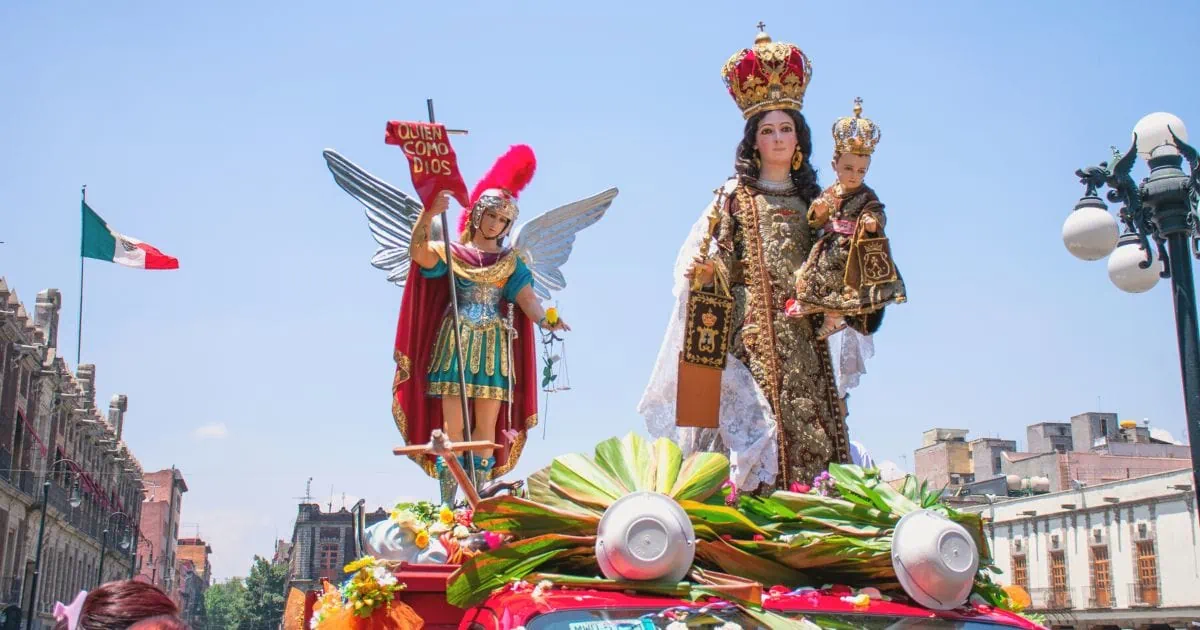

WANT TO LEARN MORE ABOUT MEXICAN SAINTS?
Mexico has 35 canonized saints, plus a handful of beloved folk saints the Catholic Church doesn’t recognize.
The most famous are the Virgin of Guadalupe, the patron saint of Mexico, and Saint Juan Diego, the first Indigenous saint from the Americas.
As I have been living in Mexico since 2018, I have come to understand firsthand how deeply rooted religion and spirituality are in Mexican culture.
Even if you aren’t religious, the stories (and the artwork) are hard to resist. Here are the 21 Mexican saints worth knowing, with their meanings and feast days.
Mexican Saints at a Glance (Names and Feast Days)
| Saint | Known for | Canonized | Feast day |
|---|---|---|---|
| Our Lady of Guadalupe | Patron saint of Mexico (an apparition of the Virgin Mary, not a canonized saint) | — | December 12 |
| San Juan Diego Cuauhtlatoatzin | Saw the Virgin of Guadalupe in 1531 | 2002 | December 9 |
| San Felipe de Jesús | First Mexican saint; patron of Mexico City | 1862 | February 5 |
| San José María de Yermo y Parres | Priest who served the poor | 2000 | September 20 |
| Santa María Natividad Venegas de la Torre (Madre Nati) | First Mexican woman saint | 2000 | July 30 |
| San Rafael Guízar y Valencia | “Bishop of the Poor” of Veracruz | 2006 | June 6 |
| Santa María Guadalupe García Zavala (Madre Lupita) | Cared for the sick in Guadalajara | 2013 | June 24 |
| San José Sánchez del Río | 14-year-old Cristero martyr | 2016 | February 10 |
| 25 Martyrs of the Cristero War | Priests and laymen killed in 1926–1929 | 2000 | May 21 |
| Child Martyrs of Tlaxcala (Cristóbal, Antonio and Juan) | First martyrs of the Americas | 2017 | September 23 |
The 25 Cristero War martyrs are Cristóbal Magallanes Jara, Román Adame Rosales, Rodrigo Aguilar Alemán, Julio Álvarez Mendoza, Luis Batis Sáinz, Agustín Caloca Cortés, Mateo Correa Magallanes, Atilano Cruz Alvarado, Miguel de la Mora, Pedro Esqueda Ramírez, Margarito Flores García, José Isabel Flores Varela, David Galván Bermúdez, Salvador Lara Puente, Pedro de Jesús Maldonado Lucero, Jesús Méndez Montoya, Manuel Morales Cervantes, Justino Orona Madrigal, Sabás Reyes Salazar, José María Robles Hurtado, David Roldán Lara, Toribio Romo González, Jenaro Sánchez Delgadillo, Tranquilino Ubiarco Robles and David Uribe Velasco.
Mexico’s Female Saints (Santas Mexicanas)
Mexico has two canonized female saints: Santa María Natividad Venegas de la Torre, known as Madre Nati, and Santa María Guadalupe García Zavala, known as Madre Lupita.
Both were nuns from Jalisco who spent their lives caring for the sick and the poor. You’ll find both of their stories below (#5 and #10).
The most famous female figure among Mexico’s folk saints is La Santa Muerte, who is not recognized by the Church (#1 in the folk saints list).
The 16 Most Important Catholic Saints of Mexico
1. Our Lady of Guadalupe, the Patron Saint of Mexico (La Virgen de Guadalupe)

While not a saint in the traditional sense, there was NO WAY to make this list without Nuestra Señora de Guadalupe (La Virgen de Guadalupe, or the Virgin of Guadalupe).
La Virgen is an Aparición Mariana, or apparition of the Virgin Mary. This means she is the Virgin Mary, appearing in physical form to a human.
In this case, that person was Juan Diego Cuauhtlatoatzin.
The Catholic Church has approved only a handful of Marian apparitions, including those at Fátima in Portugal and Lourdes in France. The one in Mexico took place where the Basilica of Guadalupe stands today, in Mexico City.
Her feast day, December 12, is one of the biggest religious celebrations in the world. Keep reading for the story of how her shrine came to be.
2. San Juan Diego Cuauhtlatoatzin

Juan Diego’s sainthood is tied to the Virgin Mary’s apparitions on Tepeyac Hill in December 1531.
What Happened on Tepeyac Hill?

On December 9, 1531, Juan Diego, an Indigenous convert to Christianity, saw the Virgin Mary on Tepeyac Hill, about 30 minutes from downtown Mexico City.
She asked for a shrine to be built in her honor on that exact spot.
When the local bishop demanded proof, she sent Juan Diego to gather roses blooming on the barren hilltop, in the middle of winter.
He carried the roses to the bishop in his tilma (cloak). When he opened it, an image of the Virgin Mary was imprinted on the fabric.
The Basilica of Our Lady of Guadalupe

That miracle led to the Basilica of Our Lady of Guadalupe, which still displays Juan Diego’s tilma today.
It’s one of the most visited Catholic sites in the world, and one of the best things to do in Mexico City to understand local culture.
I’ve visited the Basilica of Guadalupe myself, though not on December 12, when millions of pilgrims arrive.
If you’d rather go with a guide, this Basilica of Guadalupe and Teotihuacan tour combines the shrine with the history behind it.
The Virgin of Guadalupe was declared Queen of Mexico and Patroness of the Americas. She also symbolizes the blend of Indigenous and Spanish cultures that created Mexico’s mixed heritage (mestizo).
Pope John Paul II canonized Juan Diego in 2002. Today, San Juan Diego is honored as the patron saint of Indigenous peoples, with his feast day on December 9.
3. San José María de Yermo y Parres

San José María de Yermo y Parres was born on November 10, 1851, in Jalmolonga, State of Mexico.
As a priest, he devoted himself to the poor. In 1885, he founded the Congregation of the Servants of the Sacred Heart of Jesus and of the Poor.
He went on to open schools, hospitals and orphanages. Pope John Paul II canonized him on May 21, 2000.
4. San Felipe de Jesús

San Felipe de Jesús was born in 1572 in Mexico City. He became the first Mexican saint and the patron saint of Mexico City.
He joined the Franciscan order and was sent as a missionary to the Philippines. A storm pushed his ship to Japan, in the middle of a fierce persecution of Christians.
He refused to renounce his faith and was crucified in Nagasaki in 1597, along with 25 other Christians.
Pope Pius IX canonized him on June 8, 1862. His feast day is February 5.
5. Santa María Natividad Venegas de la Torre (Madre Nati)

Santa María Natividad Venegas de la Torre was born on September 8, 1868, in Zapotlanejo, Jalisco, near Guadalajara.
She founded the Daughters of the Sacred Heart of Jesus, a religious order that cared for the sick in hospitals.
Pope John Paul II canonized her on May 21, 2000, making her the first Mexican woman to become a saint.
6. San Rafael Guízar y Valencia

As Bishop of Veracruz during the Mexican Revolution and the anti-Catholic persecution that followed, San Rafael Guízar y Valencia often disguised himself to keep ministering to his people.
He founded seminaries to train new priests and became known as the “Bishop of the Poor.”
Pope Benedict XVI canonized him on October 15, 2006, after a miracle was attributed to his intercession (meaning a healing believed to have happened through his prayers after his death).
7. The Saints of the Cristero War
The Church recognizes 25 martyrs of the Cristero War, canonized together by Pope John Paul II on May 21, 2000. Pope Francis added José Sánchez del Río in 2016.
They were priests (like David Galván Bermúdez and Jenaro Sánchez Delgadillo) and laymen, killed during the Cristero War (1926–1929).
What Was the Cristero War?

La Guerra Cristera (the Cristero War) was an armed uprising against laws that restricted the Catholic Church in Mexico.
President Plutarco Elías Calles saw the Church as a threat to his government and enforced strict anticlerical laws. Catholics who took up arms became known as “Cristeros.”
The fighting lasted three years and ended with a truce in 1929, after enormous loss of life.
8. San José Sánchez del Río

San José Sánchez del Río was born on March 28, 1913, in Sahuayo, Michoacán. At just 14, he joined the Cristeros.
Government troops captured him in 1928. He refused to renounce his faith, even under torture, and was forced to walk to his own grave.
His last words were “¡Viva Cristo Rey!” (“Long live Christ the King!”), the Cristeros’ rallying cry.
Pope Francis canonized him on October 16, 2016.
9. San Cristóbal Magallanes Jara

San Cristóbal Magallanes Jara was born on July 30, 1869, in Totatiche, Jalisco, and was ordained a priest in 1899.
He spoke up for workers and farmers and criticized the government’s persecution of the Church.
He was executed on May 25, 1927, in Colotlán, Jalisco, and is often listed first among the 25 Cristero martyrs canonized in 2000.
10. Santa María Guadalupe García Zavala (Madre Lupita)

Santa María Guadalupe García Zavala was born on April 27, 1878, in Zapopan, Jalisco.
With Father Cipriano Iñiguez, she co-founded the Handmaids of St. Margaret Mary and the Poor. She sometimes begged on the street to keep their hospital running.
She died on June 24, 1963, and Pope Francis canonized her on May 12, 2013.
11. Santo Toribio Romo

Santo Toribio Romo González was born in 1900 in Jalisco and became a priest during the Cristero War. He was killed in 1928.
Today, he is known as the patron saint of migrants. Many believe he protects people crossing the US-Mexico border.
12. San José María Robles Hurtado

San José María Robles Hurtado was a Jalisco priest who kept celebrating Mass in secret when public worship was banned.
He was captured and hanged in 1927. He was canonized with the other Cristero martyrs in 2000.
13. San Mateo Correa Magallanes

San Mateo Correa Magallanes was born on July 23, 1866, in Tepechitlán, Zacatecas.
According to tradition, soldiers ordered him to hear the confessions of imprisoned Cristeros and then reveal what they said. He refused, and was shot on February 6, 1927.
14. San Agustín Caloca Cortés

San Agustín Caloca Cortés was born on May 5, 1898, in Teúl, Zacatecas.
When he was arrested with his parish priest, Cristóbal Magallanes Jara, he refused to accept his own freedom unless it was granted to Father Magallanes too.
Both were executed on May 25, 1927, in Colotlán, Jalisco, and both were canonized on May 21, 2000.
15. San David Roldán Lara

San David Roldán Lara was born on March 2, 1902, in Chalchihuites, Zacatecas. He left the seminary in Durango to support his family.
A devout layman, he was arrested during the Cristero War, refused to renounce his faith, and was shot in the mountains near Chalchihuites.
16. The Child Martyrs of Tlaxcala (Cristóbal, Antonio and Juan)

Cristóbal, Antonio and Juan were three Indigenous boys from Tlaxcala, among the first people in Mexico to be baptized after the Spanish arrived.
Cristóbal, the son of a local ruler, was killed in 1527 after challenging his father’s worship of the old gods. Antonio and Juan were killed around 1529.
Pope Francis canonized the three boys on October 15, 2017, making them the first martyrs of the Americas to be declared saints.
5 Famous Folk Saints and Popular Devotions in Mexico
Alongside the official saints, many Mexicans pray to folk saints the Church has never canonized.
Their stories come from local legend, and they’re often called on for protection, healing and help in hard times.
1. La Santa Muerte (Saint Death)

La Santa Muerte blends pre-Hispanic death deities with Catholic imagery. She usually appears as a female skeleton in a long robe, holding a scythe, a globe or flowers.
She’s also called the White Lady, the Bony Lady and the Lady of the Night. Her worship, once secret, has grown fast since the early 2000s.

Her best-known shrine is in Mexico City’s Tepito neighborhood, where devotees gather on the first of every month and on its anniversary, November 1, right before the Day of the Dead.
The Catholic Church rejects her devotion, but she has millions of followers, especially among people who feel left out by society.
💀 Note: Don’t confuse Santa Muerte with La Catrina, one of the most important Day of the Dead symbols.
Want the full story? Read my guide to La Santa Muerte.
2. Juan Soldado

Juan Soldado was a young soldier executed in Tijuana in 1938 for the rape and murder of a girl named Olga Camacho, after barely any trial.
Many believed he was framed. Soon, people reported strange signs at his grave, and he became a symbol of injustice.
Like Santo Toribio Romo, he is considered a protector of migrants, and his grave in Tijuana still draws visitors.
3. Jesús Malverde (The Narco Saint)

Jesús Malverde, called the Narco Saint or the Angel of the Poor, holds a unique place in Mexican popular culture.
Legend says he was a bandit in Sinaloa who stole from the rich to give to the poor, until the authorities killed him around the turn of the 20th century.
His shrine in Culiacán, Sinaloa, draws devotees asking for protection and luck, including people in the drug trade.
🎥 He even inspired a 2021 TV series, Malverde: El Santo Patrón.
4. San Judas Tadeo (Saint Jude)

San Judas Tadeo isn’t a folk saint: he’s Saint Jude, one of the Twelve Apostles. But his popular devotion in Mexico is unlike anywhere else.
The center of it is San Hipólito Church in Downtown Mexico City, where his image sits on the main altar.
Every October 28, his feast day, huge crowds fill the streets around the church.
Devotion to San Judas Tadeo

His millions of devotees, called sanjuderos, are especially devoted in working-class neighborhoods. Saint Jude is the patron of lost causes.
Unlike Santa Muerte and Jesús Malverde, he is fully recognized by the Catholic Church.
5. El Niño Fidencio
José Fidencio Síntora Constantino, better known as El Niño Fidencio, was a famous folk healer from Espinazo, Nuevo León.
Without any medical training, he drew thousands of people seeking cures in the 1920s and 1930s.
He died in 1938, but his followers still make pilgrimages to his shrine in Espinazo every year.
🎥 There are also several YouTube videos about Niño Fidencio if you want to know more.
Mexican Saints Calendar: Key Feast Days

Mexico follows the Catholic calendar of saints, with extra celebrations for its own. The biggest dates:
- February 5: San Felipe de Jesús
- May 21: The Martyrs of the Cristero War
- October 28: San Judas Tadeo
- November 22: Santa Cecilia, patron saint of musicians (and mariachis)
- December 9: San Juan Diego
- December 12: Our Lady of Guadalupe
The table at the top of this post lists the feast day for each Mexican saint. For holidays beyond the saints, see my guide to Mexican traditions and holidays.
December 9–12: Juan Diego and the Virgin of Guadalupe

Every December, pilgrims from all over Mexico and Latin America walk to the Basilica of Our Lady of Guadalupe in Mexico City’s La Villa neighborhood.
Local authorities counted a record 12.8 million pilgrims there in December 2025.
It’s an emotional celebration, but a festive one, with music, dancing and mañanitas sung to the Virgin at midnight on December 12.
Mexican Saints: Frequently Asked Questions
How many Mexican saints are there?
Mexico has 35 canonized saints, including 25 martyrs of the Cristero War and the three Child Martyrs of Tlaxcala. The Virgin of Guadalupe is Mexico’s patron saint, but she is an apparition of the Virgin Mary rather than a canonized saint.
Who are the most important saints in Mexico?
The Virgin of Guadalupe and Saint Juan Diego, who saw her apparition in 1531, are the most important. The Cristero War martyrs, like Saint Toribio Romo, are also widely venerated.
Who was the first Mexican saint?
Saint Felipe de Jesús, born in Mexico City in 1572, was the first Mexican saint. He was martyred in Japan in 1597, canonized in 1862, and is the patron saint of Mexico City.
Who is the 14-year-old boy saint from Mexico?
Saint José Sánchez del Río, a young martyr of the Cristero War, was killed in 1928 at just 14. Pope Francis canonized him in 2016.
Is Guadalupe a saint in Mexico?
Not in the traditional sense. Our Lady of Guadalupe is an apparition of the Virgin Mary, who appeared to Saint Juan Diego in 1531 on Tepeyac Hill. She is the patron saint of Mexico and one of the country’s most powerful national symbols.

Who is the saint of mariachi?
Saint Cecilia, the patron saint of musicians. On her feast day, November 22, mariachis celebrate Día de Santa Cecilia, most famously in Mexico City’s Plaza Garibaldi.
My Final Thoughts on the Most Important Mexican Saints

From the Virgin of Guadalupe to the Cristero martyrs and the folk saints of Tepito and Culiacán, Mexico’s saints tell the story of the country itself.
✝️ Looking for a list of Hispanic saints beyond Mexico? Check out this article on saints from Santiago Apóstol to St. Teresa of Ávila.
Get My FREE Guide: 5 Easy Ways to Save Money in Mexico
Insider tips from someone who’s lived in Mexico since 2018.
