
Virgin of Guadalupe in Mexico: Everything You Need to Know About Mexico’s Patron Saint


WANT TO LEARN MORE ABOUT THE MEXICAN VIRGIN MARY?
You’re in the right place, as this article will tell you everything you need to know about the Virgin of Guadalupe in Mexico.
The Virgin of Guadalupe (La Virgen de Guadalupe) is the patron saint of Mexico.
According to tradition, she appeared to Juan Diego on the hill of Tepeyac in December 1531.
Her feast day, December 12, is one of Mexico’s biggest religious celebrations, and millions of pilgrims visit the Basilica in Mexico City around that date.
As someone who has lived in Mexico since 2018, I’ve seen firsthand how important La Virgen de Guadalupe is for many Mexican people — and I’m going to share what I know here.
From understanding who La Virgen de Guadalupe Mexico is, to who were the main actors in the apparition, to learning more about the Guadalupe Basilica in Mexico City — this Ultimate Guide to the Virgin of Guadalupe in Mexico has it all.
Ready to learn all about La Virgencita de Guadalupe? Let’s go!
Who is Our Lady of Guadalupe?
Our Lady of Guadalupe, also known as the Virgin of Guadalupe, is the Patron Saint of Mexico.

According to tradition, she appeared to an indigenous Mexican named Juan Diego on Tepeyac Hill in December 1531.
Her message was one of love and compassion, and she asked for a church to be built on the site of her appearance.
This story marks the beginning of a deep and enduring devotion to the Virgin Guadalupe, who holds a special place in the heart of Mexico.
To really understand her, you must know she is not just a religious figure — but a symbol of Mexican identity and faith.
The Image of the Guadalupana

The image of Our Lady of Guadalupe is not just any representation.
Rather, this symbol is loaded with meaning and mystery, as well as deep indigenous significance for pre-hispanic people, and Christian significance.
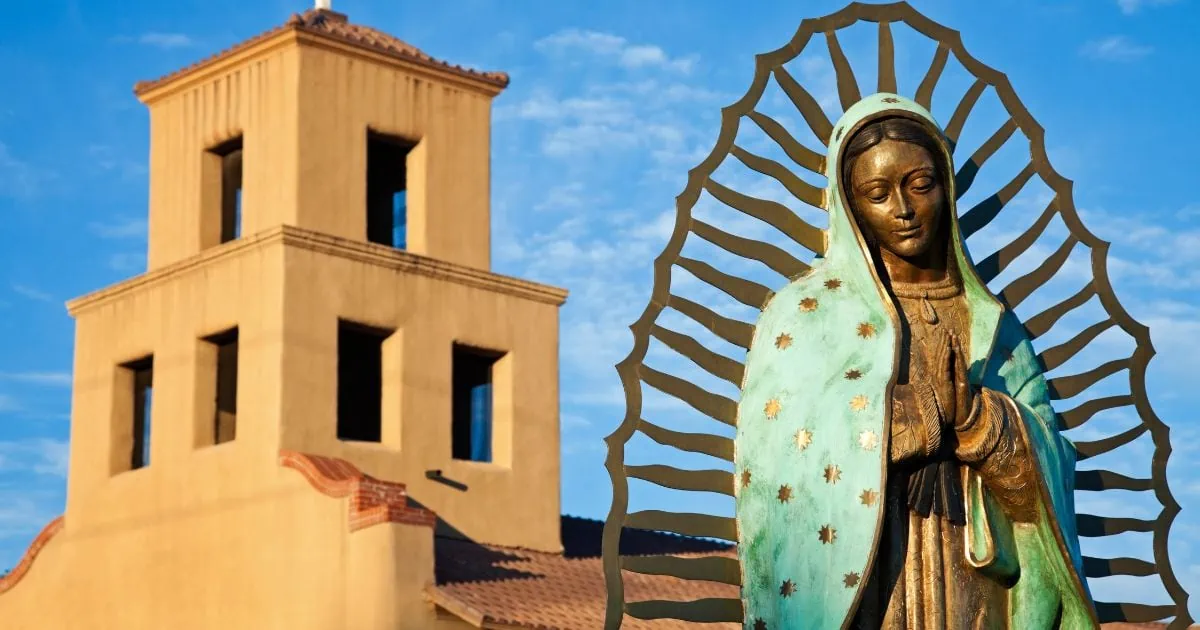
Painted on Juan Diego’s tilmàtli (tilma, or cloak), the image shows the Virgin draped in a robe of stars, standing in front of a sunburst and atop a crescent moon.
She is shown with a gentle, compassionate gaze, and her head is slightly bowed in humility and respect, aligning with indigenous eye contact customs.
The Virgin’s hands are joined in prayer, symbolizing her devoutness.
She has a black ribbon around her waist that signifies she is with child.
This is seen as a sign that she’s pregnant with Jesus.
The cloak’s celestial blue-green color symbolizes the heavens. It is scattered with 46 stars that mirror the sky on the day of her final apparition.
Her dress is earth-toned in color, connecting her to the land. The supporting angel below her signifies divine presence and approval.
Remarkably, the cloak itself has survived in excellent condition for centuries — about 500 years, to be more exact.
For many, this feels like a miracle in itself because the cloak is made of ayate, a simple cloth woven from agave (maguey) fibers, which usually doesn’t last nearly that long.
A Mix of Christian and Indigenous Elements

When you look at the Virgin of Guadalupe’s image, you can see a blending of symbols from Aztec traditions and Roman Catholic beliefs.
Bright rays of light that look like the sunshine from behind her, and there’s a crescent moon at her feet.
Her cloak is sprinkled with stars. These details connect her to Tonantzin, a respected earth goddess in Aztec religion, and show the Virgin’s ties to the indigenous culture.
At the same time, the way she holds her hands, her posture, and her calm facial expression are much like other Catholic portrayals of the Virgin Mary.
This blend of elements from two different faiths makes her image a powerful symbol of unity and cultural fusion.
What is the miracle of the Virgin of Guadalupe?
The Our Lady of Guadalupe story begins in 1531, when the Virgin Mary appeared to Juan Diego on the hill of Tepeyac, near Mexico City.

She asked Juan Diego to request that Juan de Zumárraga, the Bishop of Mexico, build a church on that site in her honor.
This local bishop, skeptical of Juan Diego’s claims, demanded a sign to prove the apparition’s authenticity.
In response, the Virgin Mary instructed Juan Diego to gather roses from the hilltop at Tepeyac Hill.
However, flowers should not have been blooming in the cold December weather. Despite this, Juan Diego found the roses 🌹
He gathered them in his tilma (a type of cloak), and presented them to the bishop.
When Juan Diego opened his tilma to reveal the roses, an image of the Virgin Mary was miraculously imprinted on the fabric.
This event led to the construction of a church in her honor at Tepeyac Hill, where the Basilica of Our Lady of Guadalupe now stands.
It houses the tilma with the image of the Virgin and Virgin of Guadalupe statue Mexico icons — actually, many of them.
Who is St. Juan Diego?
Saint Juan Diego was an indigenous Mexican man who saw the Virgin Mary, and received instructions from her to build a shrine.

He was born in 1474, and was originally named Cuauhtlatoatzin. This word means “the talking eagle” in Nahuatl (the Aztec language).
The man named Juan Diego was a Chichimec peasant who recently converted to Christianity when the Virgin Mary appeared to him in December 1531.
After witnessing the miracle of the image of the Virgin on his tilma (cloak), Juan Diego spent the rest of his life at the site of the apparition.
Here, he shared his story with visitors and professed the message of the Virgin Mary until his death in 1548.
Pope John Paul II canonized him as a Mexican saint in 2002, making him the first indigenous Native American saint.
St. Juan Diego is celebrated for his humility, faith, and devotion, and his feast day is observed on December 9, the anniversary of the first apparition.
Who is Juan Bernardino?
Juan Bernardino was an indigenous Mexican man and the uncle of Saint Juan Diego, one of the most important saints from Mexico.

He is central to the story of the apparitions of the Virgin of Guadalupe that his nephew saw.
According to stories, Juan Bernardino fell seriously ill while Juan Diego was concerned with proving the Virgin Mary’s apparitions to the bishop of Mexico City.
The Virgen Guadalupe is said to have appeared to Juan Diego a fourth time when he was searching for a priest for his dying uncle.
During this apparition, she assured Juan Diego that his uncle would recover. True to her word, Juan Bernardino miraculously recovered from his illness.
She also instructed Juan Bernardino to inform the bishop she wanted to be known under the title of Guadalupe — hence the name, La Virgen de Guadalupe.
Critics Of the Guadalupe Apparition

The story of the Virgin of Guadalupe and her apparitions to Juan Diego has not been without its skeptics.
Some scholars and church figures, including a former abbot of the Basilica of Guadalupe, have questioned the historical documentation of these events.
A key point of contention is the absence of written evidence until 1648, more than a century after the supposed apparitions.
Some critics argue that records thought to be from the 16th Century, are actually from the 17th Century.
Additionally, there’s evidence that the bishop Juan Diego approached was not officially in his role until 1534.
This means he wouldn’t have been able to order the construction of the church in 1531, as he wouldn’t have had the authority yet.
Lastly, there have never been writings nor notes found where this bishop actually mentions Juan Diego or the Virgin Mary apparitions.
Supporters of the Guadalupe Apparition

Despite these debates, many, including Pope John Paul II, support the authenticity of the apparitions.
In fact, it was this pope who canonized Juan Diego and declared the Virgin of Guadalupe the patroness of the Americas.
They point to oral traditions and the continuous veneration of the Virgin of Guadalupe as evidence of her significance.
A shrine dedicated to the Virgin has existed since at least 1556, promoting devotion among the faithful.
The widespread acceptance of the story, its integration into a network of Marian Shrines across Mexico, and the Virgin’s credited role in ending a devastating epidemic in 1736-37, highlight her enduring importance.
Over the centuries, official recognition of the Virgin of Guadalupe’s patronage expanded from Mexico City to include all territories of New Spain, and beyond.
When is Our Lady of Guadalupe’s Feast Day?
The Feast of Our Lady of Guadalupe is celebrated on December 12th each year.

Her feast day was formally approved by Pope Benedict XIV in 1754, and her influence has only grown since.
In 2026, December 12 falls on a Saturday, so expect especially big crowds at the Basilica that weekend.
It is marked by strong worship, particularly among women, and global spread through the efforts of missionaries.
What is Our Lady of Guadalupe the patron of?
Our Lady of Guadalupe is recognized as the Patron Saint of Mexico (La Patrona), and the Empress of the Americas.

Beyond these titles, she holds a special place as the Patroness of the Americas and the Patroness of the Unborn, and is a symbol of protection and comfort to many worldwide.
Her influence and patronage extend to various causes and communities, reflecting her significance in Catholic devotion and cultural identity in Mexico.
Political Importance of the Virgin of Guadalupe in Mexico

Following her apparition in 1531, the image of the Virgin became a symbol of Mexican identity.
It is seen as blending indigenous and Spanish influences into a unique national faith that transcended the divisive origins of colonialism.
In the 16th Century, the Mexico Virgen de Guadalupe became a unifying figure for indigenous peoples and Spaniards, promoting peace and cohesion during social and religious upheaval.
Blending indigenous symbols with Christian iconography in her image was crucial in this unification process.
Virgin of Guadalupe’s Significance in Mexican Independence
The Virgin of Guadalupe’s political significance was further cemented in the 19th Century, particularly during Mexico’s struggle for independence from Spain.
In 1810, Catholic priest and revolutionary leader, Miguel Hidalgo y Costilla, adopted the image of the Virgin of Guadalupe as the banner for his insurgent army.
Hidalgo’s rallying cry — Death to bad government and long live the Virgin of Guadalupe — underscored the Virgin’s role as a symbol of resistance against Spanish tyranny.
Invoking her name and image, Hidalgo linked the fight for independence to a deeply rooted religious and cultural symbol, mobilizing a broad support base with Mexicans.
Then, during the Mexican Revolution, Emiliano Zapata and his rebels also carried the banner of the Virgin of Guadalupe Mexico when they entered Mexico City in 1914.
This act symbolized the Virgin’s role as a protector and an emblem of justice for the people during the Revolution, particularly those fighting for land and freedom.
The Miracles of the Virgin of Guadalupe in Mexico
The Virgin of Guadalupe is attributed with performing several miracles, reinforcing her significance and divine presence in Mexico.
Two of the most remarkable miracles associated with her include the survival of her image after a bomb explosion and her intervention during epidemics.
Miracle on Surviving a Bomb Explosion

In 1921, a bomb hidden within a bouquet of flowers was placed beneath the Virgin of Guadalupe’s image in the Basilica of Our Lady of Guadalupe.
The bomb exploded, causing significant damage to the surrounding area.
However, the image of the Virgin of Guadalupe and the glass frame protecting it remained untouched.
This event was interpreted by many as a miraculous sign of the Virgin’s divine protection and her ability to safeguard her devotees.
Miracle During Three Epidemics
Another notable miracle associated with the Virgin of Guadalupe is the stop of three epidemics that struck Mexico in 1554, 1633, and 1737.
This feat showcases her role as a protector and healer of her people during times of crisis.
During these epidemics, the Mexican people turned to the Virgin of Guadalupe for help, holding processions, prayers, and masses in her honor.
The subsequent stop of these crises reinforced the belief in her miraculous intervention and protective role over her devotees.
Furthermore, there is the story of a man who was miraculously healed after being seriously wounded by an arrow during a procession in her honor.
This healing is said to highlight her compassionate intercession on behalf of individuals.
The Basilica of Our Lady of Guadalupe

The Basilica of Our Lady of Guadalupe, located in Mexico City, is one of Mexico’s most significant religious sites for Catholics in the world.
The original structure, the Old Basilica, was completed in 1709.
This site has undergone several constructions and renovations over the centuries due to the increasing number of pilgrims and a sinking foundation.
In the 1970s, a new, larger basilica was commissioned to accommodate the millions of annual visitors, and provide a more stable home for the tilma, its most sacred artifact.
Modern Basilica of Our Lady of Guadalupe

The modern Basilica of Our Lady of Guadalupe was inaugurated on October 12, 1976.
It was designed by architects Pedro Ramírez Vázquez and Fray Gabriel Chávez de la Mora, two of the most famous Mexican architects.
It features a circular design that allows visitors to see the tilma from any point within the building, and a moving walkway that transports visitors past the relic.
The basilica is part of a larger religious complex with several churches, chapels, a plaza, large sculptures, meticulously-maintained rose gardens, and more.
It’s one of the most visited Catholic pilgrimage sites in the world, with millions of visitors every year — some estimates say about 20 MILLION 😳
The most-visited days are on or around the Feast Day of Our Lady of Guadalupe, which is on December 12th.
This is the largest Our Lady of Guadalupe celebration in Mexico, and one of the most important holidays in Mexico.
Visiting the Basilica de Guadalupe Mexico City

When you plan to visit the Basilica of the Virgin of Guadalupe in Mexico City, you’re stepping into a place that’s not just a site of deep religious significance, but also a hub of daily activity.
Here’s what you need to know about attending mass and getting there:
Masses at Basilica de Guadalupe
The Our Lady of Guadalupe Church holds about 30 masses per day, from 6am to 8pm, welcoming locals and visitors worldwide. 🛐 See the full schedule here.
Whether you’re there to fulfill a spiritual journey or simply to experience the cultural richness of this sacred place, you can participate in the mass.
Or you can just choose to explore the church and the surrounding chapels and buildings.
How to Get to Basilica de Guadalupe

If you want to visit Our Lady of Guadalupe in Mexico City, it’s pretty straightforward. You have several options, which I will outline below.
🚙 By Uber
I took an Uber when I visited, which was about 125 pesos (about $7 USD) each way from the Historic Downtown Mexico City area.
🚉 By Metro
The CDMX Metro offers an easy route if you prefer public transport.
For this, just take the Mexico City Metro Line 6 to La Villa Basilica stop. From there, it’s a short walk of about two blocks to the Plaza Mariana.
🚌 By Bus
Alternatively, Metrobús Line 1 goes to Indios Verdes.
From there, it’s about a 20-minute walk to the Basilica, so the Metro is the easier option.
🚗 By Rental Car
Renting a car in Mexico City? You can drive to the Basílica de Santa María de Guadalupe and use their dedicated parking lot, located here.
The Basilica de Guadalupe address is Fray Juan de Zumárraga No. 2, Villa Gustavo A. Madero, Gustavo A. Madero, 07050 Ciudad de México, CDMX.
You can view it on Google Maps here for a visual.
🚕 By taxi
Taxis are also a convenient option. Just tell the driver you’re heading to “La Villa” or “La Basilica de Guadalupe,” and they’ll know exactly where to take you.
Given its fame as one of the most visited Catholic sites in the world, getting directions to the Basilica de Guadalupe is easy from anywhere in CDMX.
Is it safe to visit Our Lady of Guadalupe Shrine?
Yes — As the most visited church in Mexico City, it is considered safe to visit. In fact, upwards of 20 MILLION people visit each year!
If you prefer, you can go on one of their guided visits. These are offered Monday through Saturday from 11am-3pm, and last about two hours.
While I have personally visited and know the church complex itself to be safe, I will issue a warning about the surrounding areas just outside.
This isn’t known to be one of the safest neighborhoods in Mexico City. I suggest you exercise caution when walking around, and pay extra attention to your belongings.
The Virgin of Guadalupe: A Cultural Icon
The image of the Virgin of Guadalupe has transcended religious boundaries to become a symbol of Mexican identity and culture.
Beyond her significance in Catholicism, she is celebrated by people of various beliefs, embodying themes of unity, protection, and motherhood.
Virgin of Guadalupe’s Influence in Art

Artists and musicians incorporate her likeness to express national pride, social justice themes, and personal devotion.
As a testament to her enduring legacy, you will often see art blending traditional motifs with contemporary styles.
For example, murals in public spaces often depict her as a protector of marginalized communities.
Popular songs from Mexican musicians in genres ranging from mariachi to modern pop use her image to evoke feelings of hope and unity among listeners.
Chicana artists have significantly utilized the Virgin of Guadalupe’s image to talk about social, cultural, and political messages, going beyond traditional religious symbols.
Artist Yolanda Lopez reimagined the Virgin in a contemporary setting to symbolize women’s empowerment, depicting her as a figure actively engaging with the world.
Lopez modernized and personalized the icon to reflect feminist ideals and empowerment within the civil rights movement.
Virgin of Guadalupe in Mexico: Frequently Asked Questions
Why is Our Lady of Guadalupe so important in Mexico?
The Virgin of Guadalupe is central to Mexican culture and identity, symbolizing protection, compassion, and national unity.
Her appearance to Juan Diego in 1531, blending indigenous and Catholic traditions, marked a turning point in Mexico’s religious landscape.
She is seen as a mother figure and a protector of the Mexican people, symbolizing hope and resilience.
Devotion to her spans all aspects of Mexican life, from art and music to social and political movements, highlighting her enduring significance in the hearts of many.
Is the Virgin Mary and Guadalupe the same thing?
Yes — La Virgen Maria (The Virgin Mary) and La Virgen Guadalupe refer to the same figure. However, Guadalupe represents a specific apparition of Mary.
The Virgin of Guadalupe is believed to have appeared to Juan Diego in Mexico in 1531, making her a unique and culturally significant manifestation of the Virgin Mary.
What was the miracle of the Lady of Guadalupe?
The miracle of the Lady of Guadalupe involved the appearance of her image on Juan Diego’s tilma (cloak) in 1531.
After the Virgin Mary asked for a church to be built and the local bishop requested a sign, Juan Diego found roses in December on Tepeyac Hill at her direction.
When he presented these to the bishop, unfolding his tilma, the Virgin’s image was miraculously imprinted on it.
This event led to widespread devotion and the construction of a basilica in her honor.
How many times did the Virgin appear to Juan Diego?
The Virgin Mary appeared to Juan Diego four times at the Hill of Tepeyac in December 1531.
🛐 The first apparition
This occurred on the morning of Saturday, December 9, 1531, when Juan Diego saw a vision of a young woman on Tepeyac Hill near Mexico City.
She instructed him to find the Bishop of Mexico, Juan de Zumárraga, and tell him that he must build her a grand shrine on that very hill.
🛐 The Second apparition
Unsurprisingly, Bishop Zumárraga didn’t believe his claims. However, later that day the woman’s apparition appeared again and asked Juan Diego to keep insisting.
🛐 The third apparition
When he did, Bishop Zumárraga told Juan Diego to return to Tepeyac Hill and ask the woman for a truly miraculous sign that would convince him of her identity.
Later that day, the third apparition appeared to Juan Diego when he returned to Tepeyac. She said she would provide proof on the following day.
🛐 The fourth apparition
This last and most important apparition appeared on December 12th, which is now the Día de la Virgen de Guadalupe Mexico holiday.
According to the story, she placed a pile of flowers in Juan Diego’s cloak. This was unusual because it was mid-December, and there weren’t many flowers in bloom.
When Juan Diego opened the cloak to show them to Bishop Zumárraga, the flowers fell to the floor to reveal the image of the Virgin on the cloak fabric.
Why is she called the Virgin of Guadalupe?
According to tradition, she’s called the Virgin of Guadalupe because the Virgin Mary identified herself with this title during her apparition to Juan Bernardino (uncle of San Juan Diego Cuauhtlatoatzin).
The name Guadalupe was likely chosen to resonate with both the Spanish and indigenous populations.
It linked her to a well-known Marian devotion in Spain and echoed sounds familiar to the Nahuatl language, thus fostering a sense of maternal protection and unity.
Who is the angel under Our Lady of Guadalupe?
The angel under Our Lady of Guadalupe is believed to symbolize her royal and divine status, supporting her as she appears on Juan Diego’s tilma (cloak).
This angel reflects the connection between heaven and earth, underscoring the Virgin’s role as a messenger of God.
Additionally, the angel’s presence signifies the apparition’s importance and the sacred message it carries, reinforcing the spiritual significance of the Mexico Virgin Mary’s image.
Where is the original picture of Our Lady of Guadalupe?
The Our Lady of Guadalupe original image is located in the Basilica of Our Lady of Guadalupe in Mexico City.

It is protected behind bulletproof glass, as the most important artifact at the site — and one of the most important pieces of Catholic iconography in Mexico.
What are the 3 most important facts about Our Lady of Guadalupe?
Three key facts about Guadalupe include: 1) her apparition to Juan Diego in 1531 on Tepeyac Hill, 2) the miraculous appearance of her image on Juan Diego’s tilma, and 3) her role as the Patron Saint of Mexico.
These facts show her significance in Mexican spirituality and culture, representing a blend of indigenous and Catholic beliefs.
The basilica built in Mary of Guadalupe’s honor is one of the most visited religious sites globally, highlighting her widespread veneration.
How long is the cobblestone path to the Church of the Virgin of Guadalupe in Mexico?
There’s no single path — pilgrims walk to the Basilica from all over Mexico, some for days. Many cover the last stretch across the plaza on their knees to give thanks for answered prayers.
Is there a dress code for the Basilica of Guadalupe?
While it’s an informal dress code, modest dress is the norm in all Mexico churches.
Men should remove their hats, and women should cover their shoulders when entering. However, there isn’t anyone strictly enforcing this as you enter.
What time does the basilica close Mexico City?
The main church at the Guadalupe Shrine in Mexico City is open daily, from 6am-9pm.
However, the opening hours at each individual site within the complex can vary.
Final Thoughts: Virgin of Guadalupe in Mexico

The Our Lady of Guadalupe message of love, compassion, and protection has transcended Mexico’s borders, embedding itself into the cultural and spiritual fabric of the Americas.
As a pivotal Guadalupe religious figure, she bridges the histories of the United States and New Spain, fostering a shared devotion that crosses national and cultural lines.
The Mexico Virgin Mary embodies a unique blend of indigenous and Catholic traditions, making Our Lady of Guadalupe facts not just religious points of interest but elements of a shared identity across the continent.
The Mexican Mary’s veneration has grown far beyond the diocese and regions where it began, becoming a global phenomenon.
From an introduction in 1531 to her current status, this journey reflects a rich history of faith, resilience, and unity.
As we dive into this content, it’s clear that Our Lady of Guadalupe’s influence is as relevant today as it was centuries ago, continuing to inspire and unify people worldwide.
