
La Santa Muerte: Why the Mexican Death Saint is More Popular Than Ever


Santa Muerte (Saint of Death or Our Holy Lady of Death) is a Mexican folk saint whose devotion has seen a significant rise over the past few decades.
Known for her skeletal figure and association with death, Santa Muerte holds a complex place in Mexican culture, blending indigenous traditions with Catholicism.
Her growing popularity reflects the socio-economic and cultural dynamics of modern Mexico, making her a figure of both fascination and controversy.
However, there’s a lot more to this controversial Mexican saint — so keep reading to discover the complexities of La Santa Muerte.
Disclosure: This article may contain affiliate links, meaning when you make a purchase, I earn a small commission. Affiliate links cost you nothing to use, and help keep my content free. It’s a win-win for us both. For more info, see the Disclosure Policy.
Historical Background of Santa Muerte
Pre-Colonial Roots

The roots of Santa Muerte can be traced back to pre-colonial Mexico, where death cults and rituals were an integral part of indigenous cultures.
The Aztecs, for example, had a rich tradition of venerating death deities such as Mictecacihuatl — known as the Queen of the Dead or Lady of the Dead.
These rituals were not merely about death but were also a celebration of life and the cyclical nature of existence.
The Day of the Dead, a contemporary Mexican holiday, retains many elements of these ancient practices, emphasizing the continuity of life and death.
Spanish Colonial Influences Through Catholicism

The arrival of Spanish colonizers brought significant changes to indigenous beliefs.
Catholicism was imposed, but instead of erasing native practices, it often merged with them, resulting in a syncretic blend of religious traditions.
Santa Muerte is a product of this syncretism, embodying elements of both indigenous death deities and Catholic saints.
This blending of traditions allowed Santa Muerte to become a unique figure in Mexican spirituality, representing a bridge between the old and the new.
Santa Muerte’s Symbolism and Iconography
Physical Appearance

Santa Muerte is typically depicted as a skeletal figure, often dressed in elaborate robes and adorned with various attributes.
She is usually shown holding roses, a rosary, and/or a scythe and a globe, symbolizing her dominion over death and the world.
Her attire can vary, with different colors dresses and robes representing various aspects of life and death.
For instance, a red robe signifies love and passion, while a black robe is associated with protection and death.
Symbols and Offerings

Devotees of Santa Muerte offer a variety of items to honor her, each carrying its own symbolic meaning.
Common offerings include red apples, alcohol, tobacco, flowers, and candles.
- 🍎 Red apples are believed to symbolize love and health, though any apples can be used
- 🚬 🥃 Alcohol and tobacco are seen as gifts to appease her spirit, and some even offer soda
- 🌹🕯️ Flowers and candles are used to create a sacred space and invoke her presence
These offerings reflect the multifaceted nature of Santa Muerte, encompassing both life-affirming and death-related aspects.
Rise in Popularity Since the 1990s
Socio-Economic Factors

The rise in devotion to Santa Muerte since the 1990s can be attributed to several socio-economic factors.
Mexico has faced significant challenges such as violence from drug trafficking and widespread poverty.
In such a context, Santa Muerte has emerged as a figure of solace and protection — though critics say she’s more associated with criminality and drug cartels.
Many people turn to her for help in times of crisis, believing that she can provide financial support and guidance when other forms of assistance are lacking.
Urbanization and Media Influence

Urbanization has played a crucial role in spreading the devotion to Santa Muerte.
As people move from small pueblos to cities in search of better opportunities, they bring their religious practices with them, creating new communities of devotees.
The media has also contributed to her growing popularity, with TV shows, films, and music featuring Santa Muerte, which normalize and disseminate her image.
You may have even seen Santa Muerte make an appearance in Breaking Bad, Bad Boys for Life, and Penny Dreadful: City of Angels.
This media presence has helped to demystify her, and make her more accessible to a broader audience.
Devotional Practices and Rituals
Altar Setups

Altars dedicated to Santa Muerte are a common sight among her followers.
These altars are carefully arranged with various elements that hold significant meaning to both Santa Muerte, and those creating the altars.
Central to the altar is an image or statue of Santa Muerte, often surrounded by candles, flowers, and offerings like food and drink.
Each item on the altar is chosen for its symbolic value, creating a space that is both sacred and personal to the person creating the altar.
These altars serve as focal points for prayers and rituals, allowing devotees to connect with Santa Muerte in a tangible way.
Common Prayers and Rituals

Devotional practices for Santa Muerte vary widely but often include specific prayers and rituals aimed at invoking her aid.
Common prayers ask for protection, healing, and guidance, reflecting the diverse needs of her followers.
Rituals may involve lighting candles, offering food and drink, and reciting specific incantations.
Personal testimonies from devotees often highlight the effectiveness of these practices, with many people reporting that their prayers to Santa Muerte have been answered in miraculous ways.
Controversies and Misconceptions
Opposition from the Catholic Church and Government
The Catholic Church has officially denounced the worship of Santa Muerte, viewing it as incompatible with Christian teachings.
Governmental actions have also been taken against her worship, often linking it to criminal activities.
These official stances have led to a stigmatization of Santa Muerte devotees, who are sometimes unfairly associated with negative stereotypes.
Misconceptions and Stereotypes

One of the most persistent misconceptions about Santa Muerte is her association with Satanism, a false belief which led to widespread prejudice.
In reality, Santa Muerte is considered a divine worker under God, serving as an intermediary between the human and the divine.
Her role is not to promote evil — but to provide comfort and support to those in need.
By addressing these misconceptions, it becomes clear that Nuestra Señora de la Santa Muerte occupies a unique and valuable place in contemporary Mexican spirituality.
Santa Muerte’s Role in Modern Mexican Culture
Cultural Significance
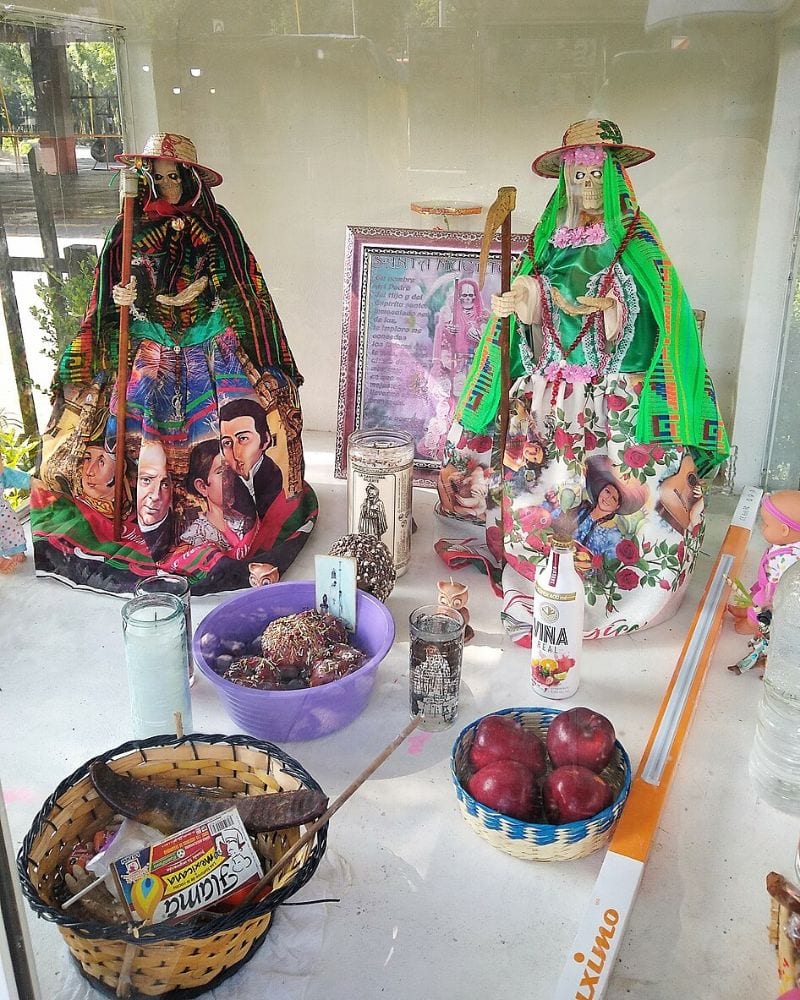
Santa Muerte also goes by MANY names — like La Flaquita (The Skinny Girl), La Niña Blanca (The White Girl), La Niña Negra (The Black Girl), La Señora de las Sombras (Lady of the Shadows), La Huesuda (The Bony Lady), La Niña Bonita (The Pretty Girl), La Madrina (The Godmother), and La Santísima Muerte (The Most Holy Death).
No matter what you call her, there’s no denying Santa Muerte has left an indelible mark on Mexican music, art, literature, pop culture, and more.
Her image appears in various forms of artistic expression, from traditional paintings and contemporary street art to clothing and tattoos.
She is also a prominent figure in festivals and public celebrations, where her presence is a symbol of cultural identity that holds spiritual significance.
Through these representations, Santa Muerte continues to influence and inspire her devotees, reflecting the evolving nature of Mexican culture.
Spiritual and Social Impact
For many marginalized communities in Mexico, Santa Muerte serves as a source of solace and support.
Her inclusive nature makes her accessible to people from all walks of life, providing a sense of belonging and hope to groups often cast aside by the mainstream.
Whether through miracles or simply providing a sense of comfort, Santa Muerte plays a crucial role in the spiritual lives of her followers.
Testimonials from devotees often emphasize the personal impact of their faith in her, highlighting the role she has played in helping them navigate life’s challenges.
Challenges and Future of Santa Muerte Devotion
Recent Setbacks

Despite her growing popularity, devotion to Santa Muerte has faced significant challenges along the way, namely the murder of two at her main altar.
Calle Alfarería Street in Tepito, one of the most dangerous neighborhoods in Mexico City, serves as a central meeting place for Santa Muerte devotees in Mexico’s capital.
On the first of each month, thousands show up to the area’s Santa Muerte altar, which is “guarded” and maintained by Enriqueta Romero (AKA Doña Queta).
Tragically, her husband Raymundo “Rey” Romero, and her younger brother, Rafael Romero, were both shot and killed in front of the altar on June 7th, 2016.
At the time, this raised concerns about the safety and legitimacy of Santa Muerte worship, leading to increased scrutiny and stigmatization.
However, it seems that enough time has passed because more people than ever have been gathering at this same altar in Mexico City.
Despite perceived dangers, worshipers still visit the altar in Tepito each month to ask Santa Muerte to cure their ails, solve their problems, and protect their children.
Continued Growth and Adaptation

Nevertheless, devotion to Santa Muerte in Mexico and abroad continues to persist and adapt. She’s even popular in parts of the U.S., like Miami, LA and New Orleans.
While there’s no data on the exact number of devotees, Bishop Andrew Chesnut, Chair of Catholic Studies at Virginia Commonwealth University, estimates there are 10-12 million worshipers total between the United States, Mexico, and Central America.
Chesnut is considered a Santa Muerte expert, and authored the first English book about her called Devoted to Death: Santa Muerte, the Skeleton Saint.
However many followers she has, they remain dedicated to her, always finding new ways to express their faith and navigate the challenges they face.
The future of Santa Muerte worship is likely to involve further integration into mainstream culture, and continued efforts to combat misconceptions and prejudice.
As her influence grows, Santa Muerte will undoubtedly continue to play a significant role in the spiritual and cultural landscape of Mexico.
Want to Make a Santa Muerte Altar?

Santa Muerte is a complex and controversial figure — but believers will say she can cure your ails, solve your problems, make you wealthy, and remove obstacles from your life.
If you want to create your own Santa Muerte altar, here’s what you might consider adding:
- La Santa Muerte statue
- La Santa Muerte necklace, chains, or pendants
- La Santa Muerte tarot cards
- La Santa Muerte candles
- La Santa Muerte prayer books
- La Santa Muerte rosary
- La Santa Muerte art or drawings
If you want to know more, or are still wondering, What is Santa Muerte? — check out these Santa Muerte books for a deeper dive into the meaning of Santa Muerte.