
Read This Oaxaca Day of the Dead Festival Guide & Itinerary BEFORE You Go

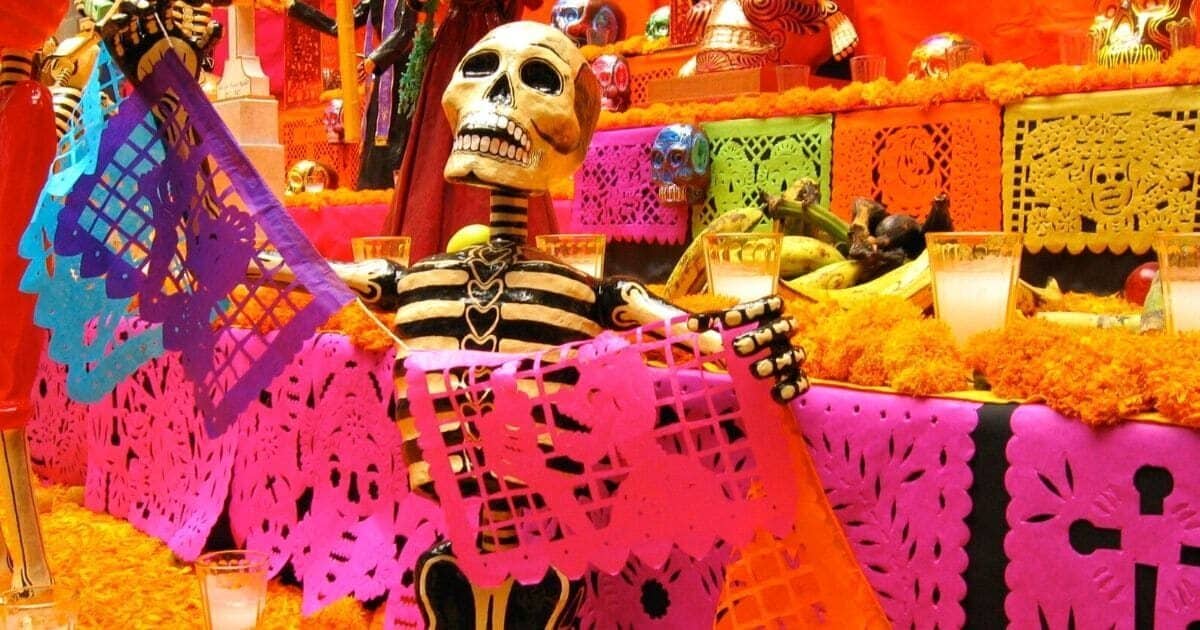

Looking for the ultimate oaxaca day of the dead guide?
You’ve landed on the right article to learn how to plan your trip to Day of the Dead in Oaxaca, Mexico.
I went to the 2018 celebration, and went again in 2022, and I’m going to share all my best tips with you.
Its most popular cultural celebration, Oaxaca Day of the Dead, is a bucket list Mexico experience for many — and in 2003, it was declared a UNESCO Intangible Cultural Heritage event.
In this article, I’m going to share all my Oaxaca Dia de los Muertos travel tips, so you can have as amazing of a time as I did.
By the end of this article, you’ll know all about Oaxaca City, where the festival takes place.
Prefer a group tour with everything planned for you?
This 7 Day Oaxaca Day of the Dead Tour has an amazing trip itinerary where you’ll venture off the beaten path to experience this amazing Mexico holiday like a local.
As Day of the Dead is just two days long, November 1-2, many stick around Oaxaca City for a few extra days, or head to the beautiful beaches of Oaxaca to lengthen the trip — so we’ll cover that as well.
Besides all that, you’ll learn about the history of Day of the Dead, the symbolism of things like ofrendas (altars), sugar skulls and La Catrina herself, which Oaxaca cemeteries to visit, and where to stay in Oaxaca City, Mexico.
In short, we’re covering everything you need to know for an epic Dia de los Muertos trip to Mexico.
Ready to learn about all things Oaxaca Day of the Dead? 🌺💀🌺 Let’s get to it!
When is Day of the Dead in Oaxaca Mexico?
Though it’s called “Day” of the Dead, the holiday takes place over two days each year, November 1-2, and the different days of the festival correspond to different spirits.

As the spirits of our departed are said to return each day at midnight, many celebrations take place at night — so you might see some sources say Day of the Dead is October 31-November 2.
However, some celebrations start as early as October 28 in different parts of the Oaxaca state.
I always recommend visitors arrive to Oaxaca City by October 28th to enjoy all the amazing Day of the Dead vibes.
Since the first day of the celebration starts on November 1, the spirits will return at midnight, which is basically the night of October 31.
Though this is technically the “eve” of Dia de Muertos, much like Christmas Eve, many consider it a festival day.
As you might imagine with such an elaborate affair, the Oaxaca City preparations begin at least a week prior.
It’s really fun to see the city getting decorated with marigold flowers and watching the ofrendas (colorful altars) being constructed, and visiting the cemeteries and grave sites during the day.
Is Oaxaca Day of the Dead 2025 Canceled?
No — There’s no reason to think the Oaxaca City Day of the Dead 2025 celebration won’t happen at full-scale, as it did in 2024.
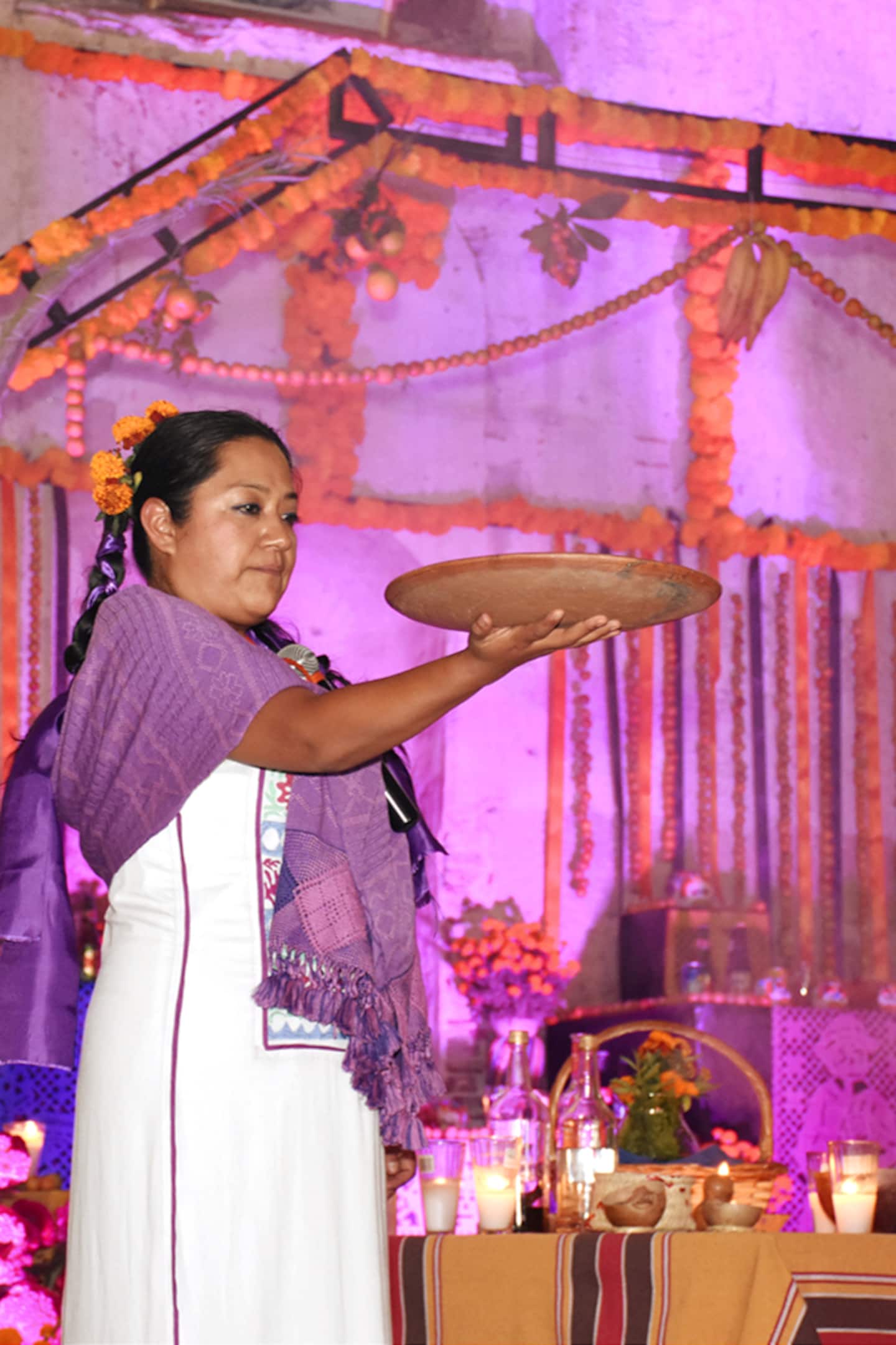
For those who are going, make sure to book your Day of the Dead tour ASAP, as they will sell out.
Where to Stay in Oaxaca: Best Neighborhoods & Best Hotels in Oaxaca
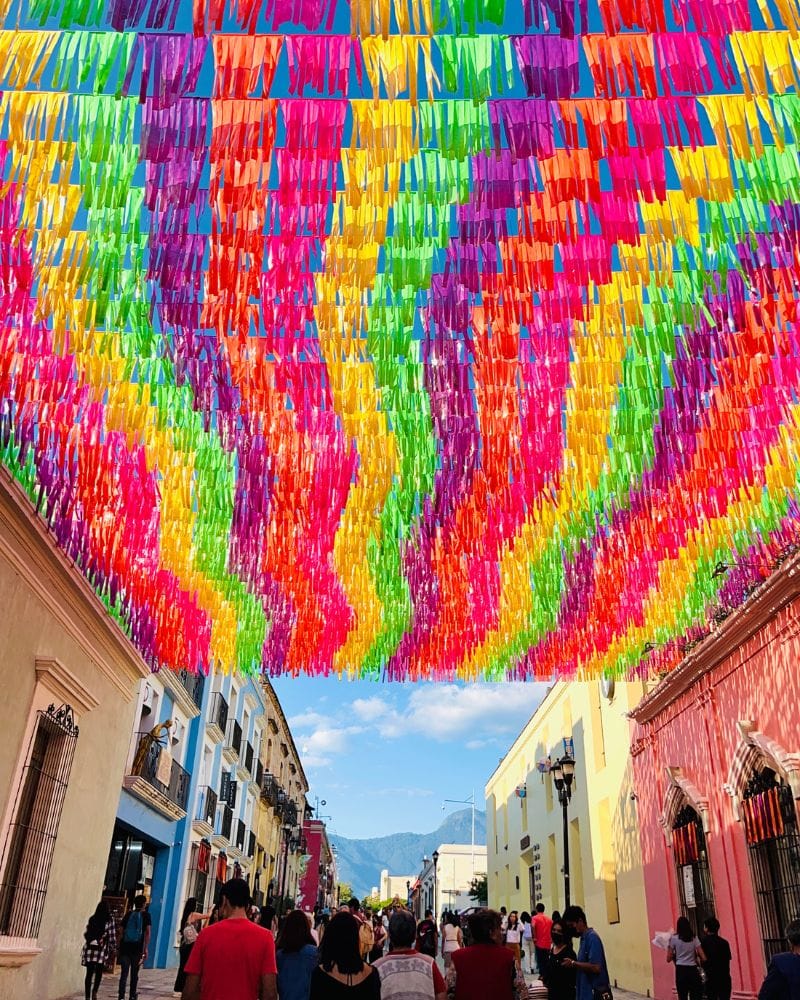
Wondering where to stay in Oaxaca for Day of the Dead?
As they say — Location, location, location — because where you stay for Oaxaca Day of the Dead can make, or break, your trip.
For convenience, choose from the three Oaxaca neighborhoods listed below so you’ll have lots of amenities like restaurants, mezcal bars, ATMs and pharmacies within walking distance.
Wondering about the best Oaxaca Day of the Dead restaurants? A lot of places have decorations up and a special menu, but I recommend you check out Las Quince Letras, which has the best mole in Oaxaca.
🚕💨 Oaxaca Travel Tips
There’s no Uber in Oaxaca and no Lyft in Oaxaca. However, there are taxis and buses. There’s also Oaxaca public transportation, but it isn’t great.
While taxis are usually easy to get, they take longer to hail during Dia de Muertos, the busiest time to visit Oaxaca, Mexico.
This is just one of the reasons all the best places to stay in Oaxaca for Dia de los Muertos are located in and around Centro Historico (Downtown Oaxaca City) — because it’s very walkable.
Centro Historico (Downtown Oaxaca City)

As with most cities in Mexico, you can’t go wrong staying in or around Centro Historico. This is the Historic City Center, or downtown.
This is the area where most Day of the Dead festivities take place, and a walkable part of town, so you won’t need to worry about catching a cab during this busy time in Oaxaca.
Located within Oaxaca Centro Historico, you’ll find some of the best hotels in Oaxaca, like these:
- Quinta Real Oaxaca ($$$$)
- Casa Antonieta Oaxaca ($$$$)
- Casa Oaxaca Hotel ($$$$)
- Casa de las Bugambilias B&B ($$$)
- Hotel Casona Oaxaca ($$)
- Selina Hostel ($) — This is one of the best hostels in Oaxaca City, with single room dorms and private room options.
Jalatlaco Oaxaca City (Best Neighborhood in Oaxaca)
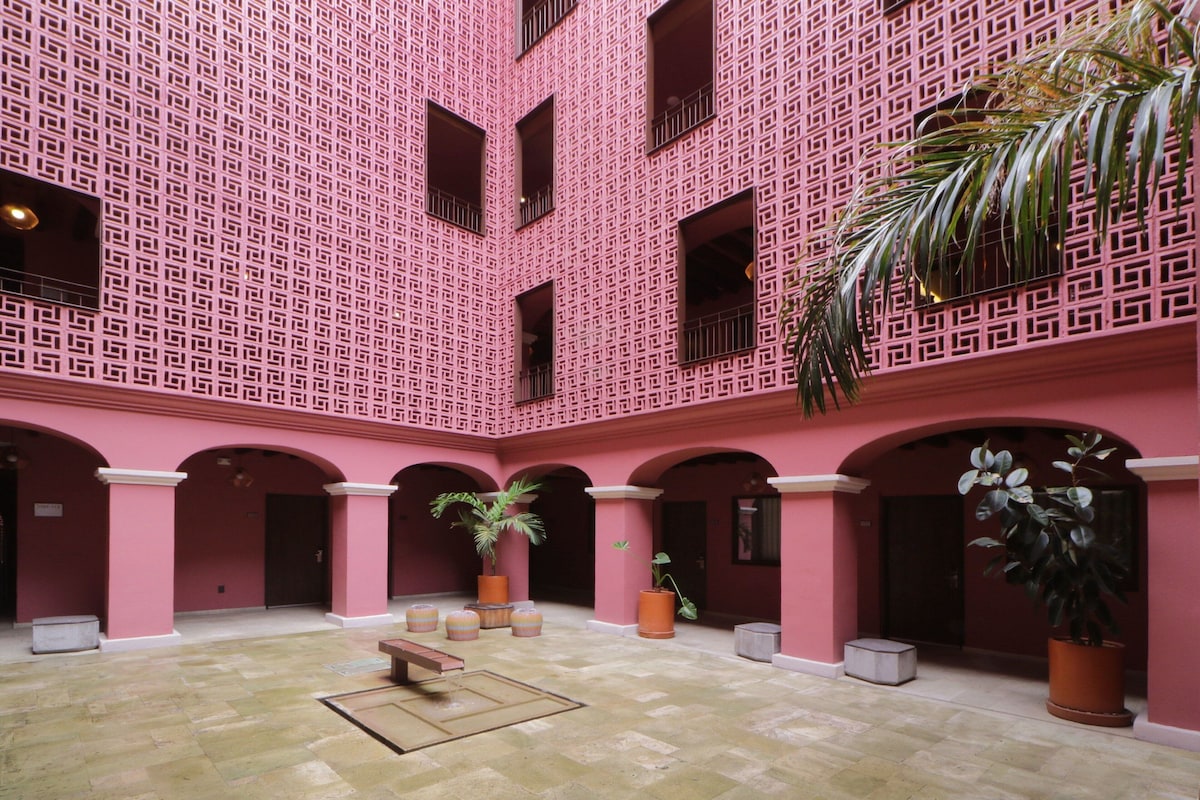
Located one neighborhood over from Downtown Oaxaca, you’ll find trendy, colorful Jalatlaco (pronounced ha-lat-lack-oh).
This is a very safe area, with amazing restaurants, cool street art and colorful, colonial buildings.
The best hotel in Oaxaca City’s Jalatlaco neighborhood is City Centro Hotel Oaxaca.
This is the famous pink Oaxaca hotel that’s quite famous on Instagram (seen in the photo above).
This one often sells out quickly, but Hotel Cazomalli Oaxaca is another nearby option.
Reforma & Xochimilco Oaxaca
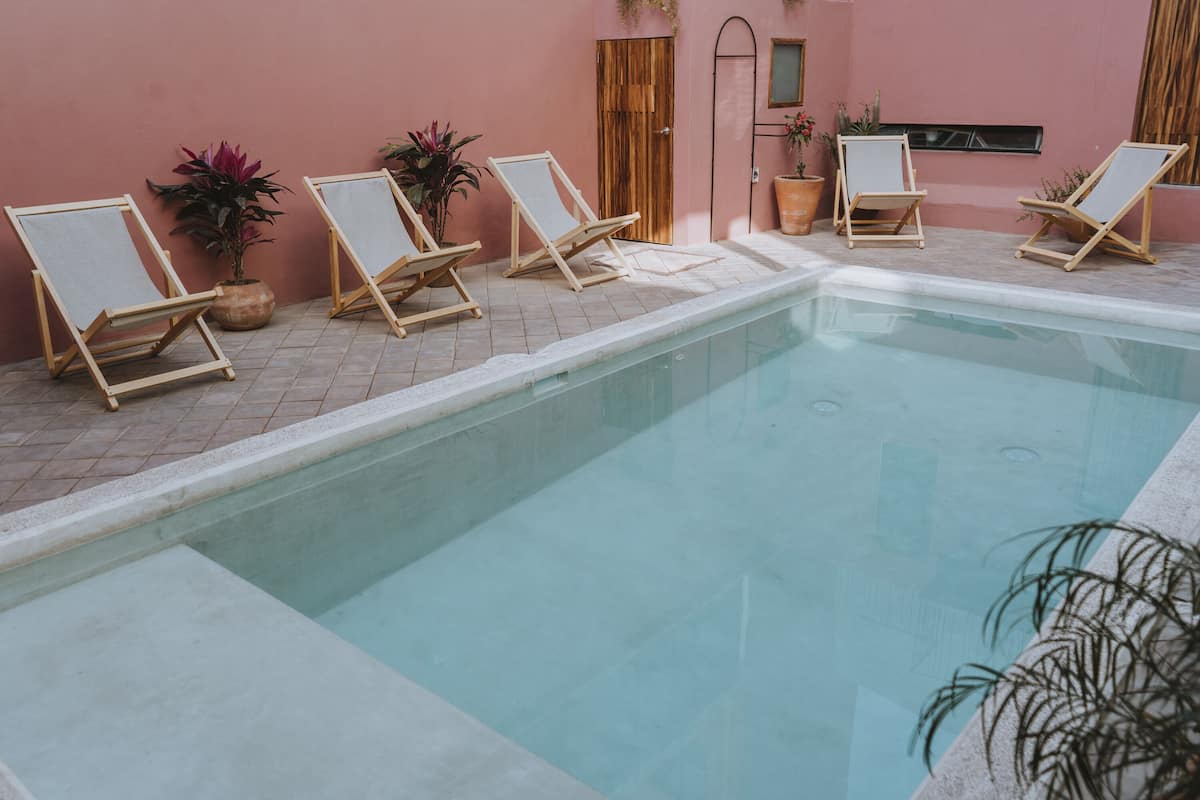
Xochimilco (pronounced so-chee-mill-co), located north of Centro, is another one of the best neighborhoods in Oaxaca City.
This is the oldest, most historic Oaxaca neighborhood, so you’ll still get the colonial city feel in the buildings, but be further away from the crowds and noise.
🌺💀🌺 Oaxaca Travel Tip: Day of the Dead is LOUD! You’ll want noise canceling earbuds or noise canceling ear plugs to get a good night’s sleep during this festive holiday.
Being on the outskirts of Centro Historico means great value at Oaxaca boutique hotels, like El Callejón Hotel ($$$) and Casa de Arte ($$).
In these, you’re also near one of the most historic and best things to see in Oaxaca City; an 18th century aqueduct that runs along Callejon Rufino Tamayo street.
Traveling to Oaxaca on a budget? Backpackers and budget travelers will want to check these best hostels in Oaxaca City to see which ones have availability for Day of the Dead.
Oaxaca Day of the Dead Guide
October 31st: Your Oaxaca Day of the Dead Itinerary Starts Now

Wondering, When does Day of the Dead start? The first day is November 1 at midnight, which is why many say it starts on October 31.
In Oaxaca, the festival feels like it goes on for weeks because there’s so much to do, and there are events both day and night.
Before you arrive, take some time to make your Day of the Dead Oaxaca schedule using the info below.
When you arrive, head to the main Cathedral in Oaxaca, located near the Zocalo (Town Square), and pick up a schedule of events from the tourist booth.
What to expect on All Saint’s Eve
Though not an official festival day, many families observe October 31st, the former All Saints’ Eve, by building elaborate ofrendas (altars) on the cemetery gravestone of their deceased loved one.
Some people in local homes and shops even leave their doors open so passerbys can see the night vigils inside.
To try to see these, head to a pedestrian street, like Calle Macadonio Alcala (AKA Andador Turistico).
As the eve of the souls returning, these preparations must be ready for the spirits’ arrival at midnight.
There’s a lot of energy in town, as people are ready to officially celebrate Dia de los Muertos after weeks of prep.
In fact, it will feel like the festival is in full swing, though the holiday hasn’t officially started.
Families visit the town’s cemeteries to decorate their loved ones’ graves and gravestones, and many put the finishing touches on the ofrendas (altars) outside of their homes.
What to do in Oaxaca on October 31
This is a great day to simply walk around the city, especially Centro Historico (Downtown Oaxaca City) and the Zocalo near the Oaxaca Cathedral.
An orientation walk like this is always a good idea so you get your bearings and get to know the city layout — and in recent years, there’s more to see than ever as this holiday in Oaxaca continues to get more popular.
You can pop into all the shops and art galleries to see all the elaborate altars and floral displays, but don’t forget to look down at the sand art on the ground.
At night, don’t miss the Magna Comparsa, a main event in downtown.
Magna Comparsa means Grand Parade, and this is the first official parade to open the Day of the Dead holiday.
You can also check out the local cemeteries, like the Panteón General Oaxaca main cemetery in Jalatlaco Barrio, Xochimilco cemetery in Xochimilco, and Panteón Viejo Xoxocotlán (AKA Xoxo Cemetery), as they’ll be decorated by now.
In fact, the decorations in some are usually up by October 27th, or sometime around the end of October — but definitely a few days before October 31st.
November 1st: Day of the Little Angels

What was formerly known as All Saints’ Day, is present-day Día de los Angelitos (Day of the Little Angels).
Note: You may also see this day called the Día de los Inocentes, or Day of the Innocents.
However, don’t confuse it with the Day of Holy Innocents Mexican holiday, which is on December 28th.
This Day of the Little Angels on November 1 honors the children who have passed. Their spirits returned the night before, at midnight, but parties continue all day.
What to expect on All Saint’s Day
Celebrations in cemeteries, as well as comparsas (theatrical parades), ofrendas (altars) in the streets and other city-wide festivities.
There are large booths with vendors set up near the Cathedral, selling Oaxaca art and Mexican folk art from other states in the country.
This will often last from early November until the end of weekend following Day of the Dead.
What to do in oaxaca on November 1
The entire town is decorated and in full festival mode, and you’ll want to spend time walking around the colorful Jalatlaco neighborhood and eating some delicious Oaxacan food.
There will be smaller parades all night in the city, or you can head to a giant celebration that’s off the beaten path — the San Agustin Etla Oaxaca Day of the Dead comparsa.
San Agustin Etla pueblo is located about 35-45 minutes from Downtown Oaxaca. It has the biggest, most wild comparsa, and most beautiful cemetery.
I went with a small tour group booked through Agrado Guest House Hotel, and we were the only non-locals at the San Agustin Etla comparsa.
If you want to immerse yourself in any indigenous communities, Etla is the place.
November 2nd: Day of the Dead
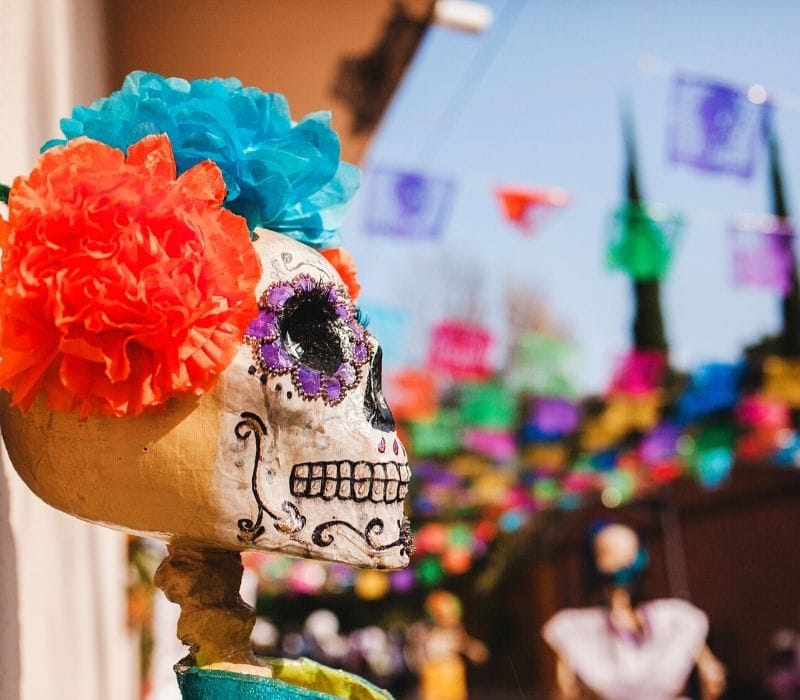
Formerly known as All Souls’ Day, November 2nd is the actual Day of the Dead day.
On this day, family members and loved ones celebrate the adults in their life who no longer walk the Earth.
The spirits of all adults returned the night before, at midnight, but parties will continue all day.
What to expect on All Soul’s Day
More celebrations in cemeteries, as well as comparsas (Oaxaca Day of the Dead parades), ofrendas (altars) in the streets and other festivities.
If Day of the Dead Oaxaca is starting to sound like one giant party, it is — but November 2 is often the most low-key day of the holiday.
What to do in oaxaca on November 2
If there was any place you wanted to see in town, like a shop, restaurant, cafe or art gallery, you’ll want to head there early.
Many places have shortened hours for the holiday, though some don’t open at all.
If not, just enjoy the last few hours of parades and decorations and festivities.
Arriving Early: Before the 31st

🌼 Visit the Oaxaca Flower Fields
A Oaxaca must do before Day of the Dead is to visit the flower fields — because the flowers will be harvested by October 30th, so you have to go before the festival.
There are a few flower fields near Oaxaca City, but the most popular one is Cultivos el Viejo.
This is located about one hour outside of the city, in the small town of Zimatlán de Álvarez, Oaxaca.
A popular spot for getting IG photos, YouTube videos and TikToks, you’ll want to either arrive early in the morning to beat the crowds, or get there in the late afternoon to catch the golden hour light (AKA magic hour).
There is no official entrance fee, but you are expected to give a donation of about $100 pesos ($6 USD) per person to enter this flower field in Zimatlán Oaxaca.
Visit Mitla for the La Catrina Exhibition

Located about one hour from Oaxaca City by car, San Pablo Villa de Mitla (or just Mitla for short) is best known as home to the Mitla Archaeological Site.
This is one of the most important ruins in Oaxaca.
During the holiday, they also have this La Cartina & Skulls Exhibit.
A public art expo (Exhibición de Catrinas y Cráneo in Spanish), you’ll see large-scale La Catrina and sugar skull figures all over downtown Mitla.
In English, Mitla means “place of the dead,” so it seems fitting to visit this Oaxaca pueblo magico (magic town) during Day of the Dead!
The name originates from the Nahuatl word (or Aztec word), Mictlán. In Aztec mythology, Mictlán is the Underworld.
These Zapotec and Mixtec ancient ruins of Mitla are considered the second most important archaeological site in the entire state of Oaxaca, after Monte Alban Ruins.
The Mitla Ruins are said to be as much as 10,000 years old 🤯
⚠️ Oaxaca Day of the Dead Tips: if you keep going about 45 minutes past Mitla, you’ll be in Hierve el Agua. These Oaxaca waterfalls and thermal pools are one of the best places to visit in Oaxaca.
See the Zaachila Tapetes (Oaxaca Sand Carpets)

The word “tapete” literally means rug, but it has another meaning when it comes to Day of the Dead in Oaxaca City and the Central Valleys of Oaxaca.
The Day of the Dead sand tapestries have been associated with the holiday for centuries, and you can see them in Oaxaca City.
However, the best place to see Oaxaca tapetes made of sand is in the small town of Zaachila.
Located about one hour from Oaxaca City by car, head to Calle Coquiza Street in Zaachila and follow the sand carpet route to the Templo de Santa Maria de la Natividad church.
Trust me: This is like nothing you’ve ever seen!
⚠️ Note: The best day to visit Zaachila is Thursday so you can go to the Zaachila Market to buy some Oaxaca souvenirs.
After shopping, head to Mercado Gastronómico de Zaachila to try barbacoa and local Oaxacan food specialties.
Staying After the Festival: November 3rd

Extending your Oaxaca trip?
As Oaxaca Day of the Dead is a two-day festival, many will arrive early, or stay after.
💁♀️ Here’s one of my best Oaxaca travel tips: Head to the best Oaxaca beaches, like Puerto Escondido, Zipolite, Huatulco and Mazunte, after the festival to decompress.
This is an easy road trip that many Oaxaca visitors do, and a great time of the year to visit the beaches.
If beaches aren’t your thing, there are plenty of things to do in Oaxaca City.
You can enjoy a mezcal tasting or one of these best Oaxaca mezcal tours, visit Monte Albán Ruins archeological site, and more.
In fact, there are unique places to visit in Oaxaca all over the state and great day trips from Oaxaca.
These include the surrounding areas of Hierve el Agua, San Felipe del Agua and San Pablo Villa de Mitla.
This is one of the Oaxaca pueblos magicos, or Mexico magic towns, famed for their indigenous culture.
There are also great Oaxaca markets to check out, both in the city, and the surrounding area.
These include: Zaachila Market (Thursdays), Ocotlan Market (Fridays), and the popular Sunday Tlacolula Market in Tlacolula Oaxaca.
Visiting Mexico City
If you have the travel time for a long journey in Mexico, you’re only a one hour flight from Mexico City.
This is the largest city on the continent, and a good place to really get to know Mexico.
There’s no end to the things to do in Mexico City — including museums, tacos, ancient ruins, amazing restaurants, fun lucha libre Mexican wrestling matches, and so much more.
In fact, I lived in Mexico City for a year, and still didn’t see it all!
Oaxaca Day of the Dead Tips

A little further own in the article, you’ll see how to get to Oaxaca City — but for now, let’s get into some specifics you need to know about the actual Oaxaca Day of the Dead in Mexico festival.
Besides the Day of the Dead dates, which are November 1st and 2nd, and how you’ll get to Oaxaca City — there are two more key things to keep in mind for Day of the Dead travel planning (listed below).
1. Book Oaxaca Accommodation ASAP
Oaxaca City is a smaller town, and eventually, ALL Oaxaca hotels, Oaxaca VRBOs, Oaxaca Airbnbs, and all Oaxaca hostels will eventually sell out.
It happens every year — and I’m not kidding, fear-mongering, nor exaggerating when I say that!
If you have particular needs when it comes to where you stay (ie. no stairs, quiet area, full kitchen, on-site parking), book early so you find a place that checks those boxes.
Check out these articles to help you pick the best Oaxaca hotels for Day of the Dead.
2. Book Day of the Dead Tours ASAP

If you’re looking to do a Day of the Dead tour in Oaxaca, you’ll want to book these well in advance, and as early as possible.
For the most part, tours are kept small at just 5-10 people, and thousands attend this Oaxaca festival — so the tours all end up selling out as well.
Oaxaca Day of the Dead Tours
As a lot of Mexican tour companies don’t have websites, so unless someone has recommended you a tour company by name, it’s not super easy to locate Oaxaca Dia de los Muertos tours online.
Note: Facebook is usually a better place to find Mexican companies and local businesses than Google. You’ll also want to check Facebook pages for up-to-date info about local businesses throughout the course of the week.
Since this festival also doesn’t have an official list of events posted online for you to research in advance, local tour guides are a game changer.
They will know best to show you where to find the best cemeteries, fireworks, festivities taking place, and comparsas (boisterous parades with a live band, usually a brass band).
Prefer a group tour with local Guides?
This 7 Day Day of the Dead Tour Oaxaca has an amazing trip itinerary planned, but also plenty of free time to experience Day of the Dead Mexico like a local.
If you want to do a group tour, and don’t want to spend hours (or days) searching for a Day of the Dead Oaxaca tour company, book an Airbnb Experience or group tour with Viator — you can book some below right now.
These tours are all led by Oaxaca locals or a local guide from Mexico, so you’re in good hands.
Here are a few of the best tours in Oaxaca City, with a heavy focus on Day of the Dead and other uniquely Oaxacan cultural experiences.
11 Day of the Dead Do’s and Don’ts

🟢 Do: Book your Oaxaca hotel, Oaxaca VRBO or Oaxaca hostel, and your Day of the Dead tours well in advance. (You’ve been warned 💀)
🟢 Do: Participate! When you see a parade going by, jump in and start dancing with the locals; it’s one of the best ways to participate.
This holiday is about remembering the deceased, so many local families in Oaxaca do love it when you ask about their departed loved ones honored on the altars.
🟢 Do: Have a day where your only plan is to walk the city. During Day of the Dead in Oaxaca, the whole town is transformed for this giant party, so explore as much as you can while the decorations are up.
🟢 Do: Ask for permission to take photos. To err on the side of caution, get permission from families in the cemeteries and at their ofrendas (altars), and when photographing people.
🟢 Do: Carry cash on you at all times. In Mexico, cash is still king, and in Oaxaca City, many places don’t take cards.
This is especially true with taxis, in any local market (mercados), and with street vendors, which will all be cash only.
🟢 Do: Pack noise canceling earbuds or noise canceling earplugs to get a good night’s sleep during this festive holiday.
Day of the Dead is basically a three-day party with loud music and city-wide celebrations.
🛑 Don’t: Treat this as a tourist attraction.
The Day of the Dead Festival is a centuries-old cultural tradition, so have fun, but know this is not the same thing as getting wasted on Bourbon Street during Mardi Gras in New Orleans.
🛑 Don’t: Touch or disturb anything, including altars, cemetery decorations, and sand art on the ground.
🛑 Don’t: Use flash photography anywhere.
To be safe you’ll want to just turn your flash on your camera from auto to off, so it doesn’t accidentally go off and flash at the wrong moment.
🛑 Don’t: Get wasted to the point that you lose your friends and have no idea how to get back to your hotel.
I get asked a lot Is Mexico safe?, and I usually reply that it’s as safe as you choose to make it.
How to Dress for Day of the Dead
Wondering what to wear for Day of the Dead in Oaxaca? As mentioned, this is not a time for the “sexy costumes” that are popular in the United States.
However, since it is Dia de Muertos, you’ll probably want to pack a special dress or outfit to enjoy the nighttime festivities.
If not, you can buy something when you arrive in Oaxaca.
For this, you can head to a local Oaxaca City mercado (market), like Mercado 20 de Noviembre Market and Mercado Benito Juarez Market, to buy a dress or embroidered flower shirt.
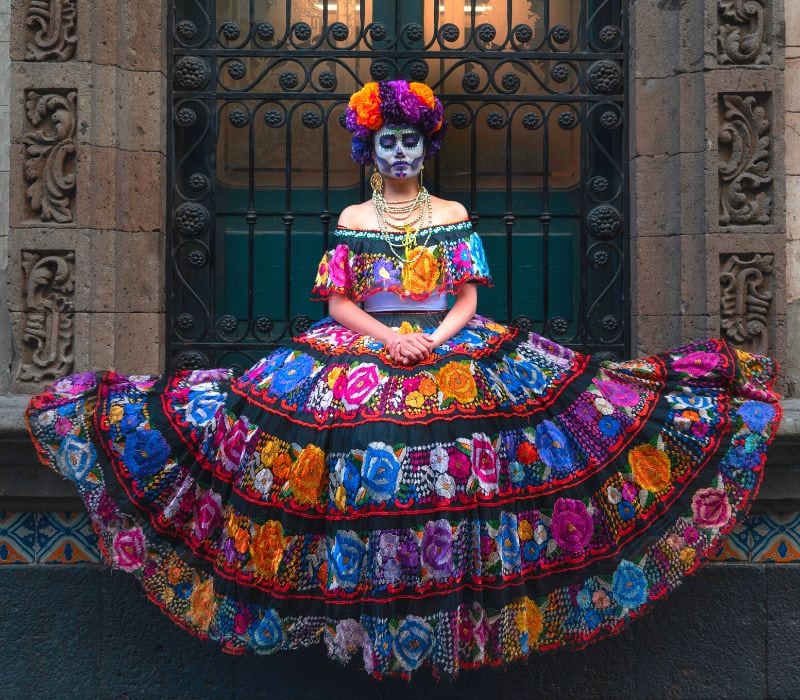
Costumes are the norm for locals, and many do go all out, with traditional Oaxacan garments and face painting.
Want to get your face painted like La Catrina, the famous Day of the Dead Woman?
You don’t need to bring all your makeup for La Catrina face painting, as you can just pay someone about $50 pesos ($3 USD) on the street to do it.
You, however, will want to pack a good makeup remover to get it off at the end of the night. This should be one of your Day of the Dead essentials!
You’ll find plenty of vendors selling inexpensive flower crowns to complete the look — or you can go all out with one of 🌸 these elaborate flower crown headbands.
You can also visit one of the Oaxaca mercados mentioned above, as you’ll sometimes find vendors selling fresh flower crowns.
Planning for Oaxaca Day of the Dead 2025: Oaxaca Mexico Travel Guide & FAQ

Where is Oaxaca, Mexico located?
The state of Oaxaca is located in southern Mexico, just a one-hour flight from Mexico City. You can also take a Mexico City to Oaxaca bus, but it takes about 7-8 hours.
🗺️ Oaxaca Map
Oaxaca (pronounced wa-ha-kah) is truly one of the best travel destinations in Mexico; one not enough people have experienced.
Though it is off the beaten path, you can easily get there with a connecting flight from Mexico City.
Is Oaxaca a city or state?
Both — Oaxaca is the name of the state, and Oaxaca City (or Oaxaca de Juarez) is the capital city. However, many people refer to Oaxaca City as simply Oaxaca.
Oaxaca City is in the center of Oaxaca state.
It is not only the capital city, but also the state’s cultural, historic, artistic and agricultural hub. The entire Downtown Oaxaca City is a UNESCO World Heritage Site.
Oaxaca de juarez
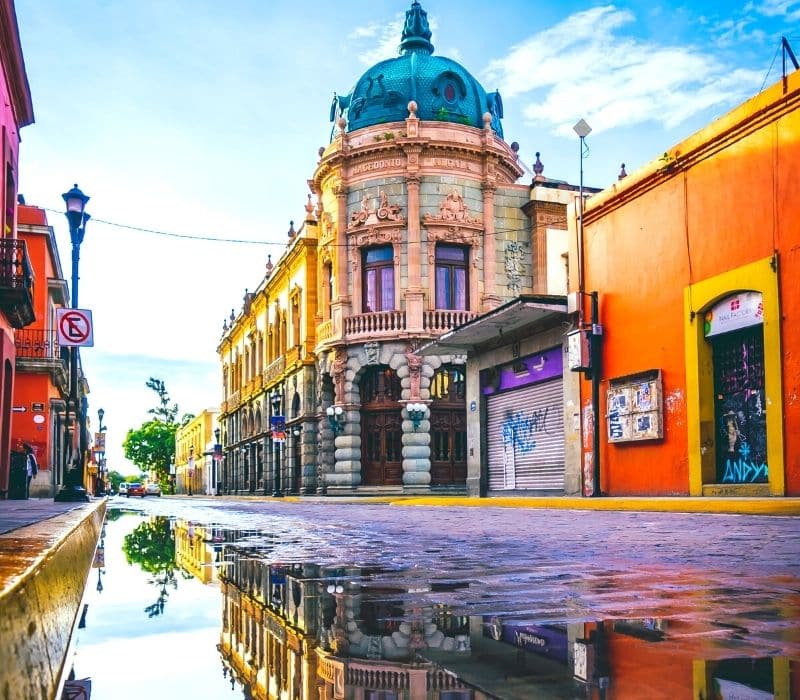
You may hear Oaxaca City referred to by a few names. Officially, it’s Oaxaca de Juarez, though most people simply refer to the eclectic city of Oaxaca as “Oaxaca.”
As Oaxaca is both the name of the city and state, you may want to clarify what the person means when they say Oaxaca — they usually mean the city, but not always.
How do I get to Oaxaca City for Day of the Dead?
You can fly into Oaxaca International Airport (code: OAX), located just 20-30 minutes from Downtown Oaxaca.

OAX has direct flights from U.S. cities including Dallas/Fort Worth, Houston, LA and Chicago.
However, depending on where you’re coming from, you might not find direct flights to Oaxaca City.
In Mexico, you can catch a connecting flight to Oaxaca Airport from a number of places, including Mexico City, Tijuana, Guadalajara, Cancun and Monterrey.
Is there Uber in Oaxaca City?
No — There’s no Uber in Oaxaca, and no Lyft in Oaxaca, but there are taxis and some public transportation options.
Keep in mind Oaxaca Day of the Dead is one of the busiest weeks of the year, so consider booking this Oaxaca Airport transfer — or you might risk waiting over an hour for a taxi driver (this had happened to me).
You can also grab a taxi or take the colectivo (small, shared van) once you arrive at Oaxaca International OAX Airport.
The colectivo costs about $3-5 USD per person, and a private taxi will be about $15-25 USD to get to Downtown Oaxaca City.
While it’s an extra cost, the taxi is much more convenient because it will drop you off where you’re staying.
With the Oaxaca colectivo, however, you usually only get near where you’re staying, then have to walk or get a taxi.
Best Oaxaca Car Rentals

Wondering, Should I get a Oaxaca car rental? In my opinion, if you’re just staying in the city itself, skip the rental car.
If you’re planning to take any Oaxaca day trips and explore Oaxaca before or after Day of the Dead, a Oaxaca rental car will come in handy.
The OAX Airport is the best place for car rentals in Oaxaca City.
🚙💨 For more information, and 10 Mexico driving tips, head to Renting A Car in Oaxaca: Everything You Need to Know.
⭐️ Editor’s Choice: Discover Cars
When I rent a car in Oaxaca City (and when I rent a car in Mexico anywhere, really), I recommend and use Discover Cars.
They compare both local Mexican companies and all the big name corporate car rental companies, so you get the best price.
Also, their Full Coverage Mexican car insurance is the cheapest I’ve found at about $10 USD per day.
▶︎ Book your car here, and make sure to get the insurance.
If you’ll be renting a car in Oaxaca, double check the parking policy at your Oaxaca accommodation.
Some offer free parking, but with others, you may have to pay extra to park.
Mexico City to Oaxaca City

✈️ Mexico City to OaXACA Flights
Domestic flight travel within Mexico is quick, convenient, and relatively inexpensive on low cost carriers like AeroMexico, Volaris and VivaAerobus.
Note: VivaAerobus is the equivalent to Spirit Airlines in the United States, so always remember, you get what you pay for them with.
In general, the bus from Mexico City to Oaxaca costs about $40 USD, and can take eight hours.
However, you can often find Oaxaca plane tickets for as little as $50 USD, for the one hour flight.
Of course, the bus has less of a carbon footprint, so some travelers might opt for the bus over a flight.
🚌 Mexico City to Oaxaca Bus
Mexico City is located about 7-8 hours by bus from Oaxaca City, with overnight trip options available.
If you’re looking into the buses, check for luxury class tickets through Mexico’s largest bus company, ADO.
The luxury tickets are a little more expensive, but a lot more comfy.
Oaxaca vs Mexico City Day of the Dead: Which is better?
It depends — They’re both fun, with a lively atmosphere, parades, decorations and more.
The Oaxaca City festival has more cultural connections, though it’s usually easier to travel to Mexico City for most people.
There are also other Mexico Day of the Dead celebrations like the Merida Day of the Dead festival called Hanal Pixan, the Tulum Day of the Dead festival, Campeche Day of the Dead festival, and many more.
Why celebrate Día de los Muertos in Oaxaca?
Quite simply, it’s one of the most fun Mexico Day of the Dead celebrations.
Imagine walking around a historic colonial city, as you take in all the colorful decorations around you, listen to music from parades dancing past you, enjoy the smell of cempasúchil flowers (marigolds) in the air…
Perhaps the better question here is Why wouldn’t you want to celebrate Día de los Muertos in Oaxaca Mexico!?
Coming to Oaxaca for Day of the Dead? Check out this detailed Oaxaca Safety Guide to get all my best tips for staying safe in Oaxaca City during your trip.
What’s the Oaxaca weather like?
Oaxaca has a temperate, desert climate, so you can expect warm or hot days of about 85°F (29°C) and cool or cold nights of about 55°F (12°C).
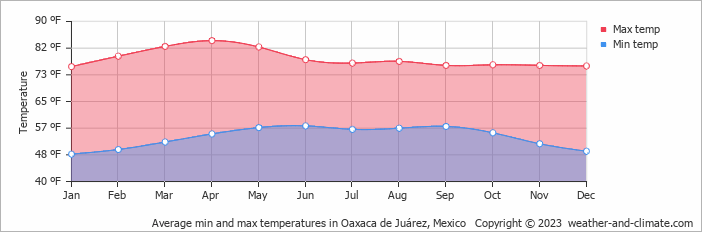
The best advice when packing for Oaxaca is to bring layers.
With such a variant from day to night, you need to be able to easily layer down in the daytime, and layer up at night.
🧳 FREE Printable Packing List for Mexico
Wondering exactly what to pack for Oaxaca and all of Mexico? Download your FREE printable packing list for Mexico here.
This multi-page Mexico packing checklist covers everything you’ll want to bring, and more importantly, what not to bring to Mexico.
Is Oaxaca safe to travel to?
For the majority of visitors, Oaxaca is safe for travel.

Of course, you must keep your own safety as a top priority so remain aware of yourself, your belongings and your surroundings at all times.
Aside from drinking too much mezcal, you’re in little danger in Oaxaca. In fact, Oaxaca is one of the safest states in Mexico.
It is a great place to visit during Day of the Dead, and any time of year.
⚠️ If you’d like to do a deep dive into this topic, check out Is Oaxaca Safe for Travelers Right Now? to get Oaxaca travel safety advice, Oaxaca travel tips and more.
Oaxaca City is the country’s 67th largest city, with a population of about 275,000, but retains a humble pueblo (small town) vibe.
As no place on Earth is 100% safe, you’ll want to follow the 10 General Travel Safety Tips below — the same ones you’d follow when traveling anywhere.
You should also register for the STEP Program and put your mind at ease with travel insurance.
Is Oaxaca safe for solo travelers?
For the most part, Oaxaca is safe for all travelers, including solo travelers.

While there are no guarantees when it comes to safety, I can say that I attended Day of the Dead as a solo female traveler in Oaxaca, and felt perfectly safe.
However, I’ve done a lot of Mexico solo travel, and likely have a biased opinion.
In an effort to add more solo female travel in Mexico voices to the conversation, check out Rebecca’s solo travel in Oaxaca story.
For a deep dive into the subject of Mexico travel safety, check out Is Mexico Safe? 25 Tips to Stay Safe in Mexico.
🎧 Prefer podcasts? This Mexico podcast is full of tips for Mexico solo female travel safety, which you can use during Oaxaca solo travel and beyond.
Do Americans need a visa for Mexico?
No — U.S., Canadian and most European and Asian passport holders don’t need a visa to travel to Mexico.
If you’re from somewhere else, head here to see if you need a Mexico visa.
When you arrive in Mexico and go through Customs and Immigration, you’ll receive UP TO a 180-day (6 month) FMM tourist card or a passport stamp.
If you get the FMM, this is a small piece of paper you need to have on you at all times, as it proves you’re in the country legally.
You also have to give your FMM back to a Customs and Immigration officer at the airport when leaving Mexico.
If you lose it, there is a fee of about $600+ MXN pesos ($30+ USD) to get a new one — so don’t lose your FMM.
⚠️ FMM Update: Nowadays, many Mexico airports are using a passport stamp in lieu of the paper FMM. This makes it much easier to not lose!
What do I pack for Oaxaca?
For the most part, Oaxaca weather averages 80-90°F (26-32°C) during the day, and 60-70°Fs (15-21°C) at night. For most travelers, light layers work perfectly.
With Oaxaca’s sunny, hot days, definitely pack a Water-To-Go Bottle to stay hydrated, eco-friendly sunscreen to avoid sunburns.
If you plan on drinking a lot of Oaxaca mezcal, don’t forget to pack these anti-hangover meds.
As far as how to dress, Oaxacans are modest dressers, so pants or jeans with sleeved tops are the norm, even on hot days.
However, sundresses, flowy, breathable, cotton, and light-colored clothing works.
At night, you’ll want a jacket and boots in Oaxaca City. The temperature in Oaxaca can drop about 20°F (about 10°C) from day to night, so be mindful.

Packing for Day of the Dead in Oaxaca
Since it is Dia de Muertos, you might want to pack a special dress or outfit to enjoy the nighttime festivities — like these.
You can also head to a local Oaxaca City mercado (market), like Mercado 20 de Noviembre and Mercado Benito Juarez, to buy a dress.
Want to get your face painted like La Catrina?
You don’t need to bring all your makeup for La Catrina face painting, as you can just pay someone about $50 pesos ($3 USD) on the street to do it. You, however, will want a good makeup remover.
You’ll also find plenty of vendors selling inexpensive flower crowns to complete the look — or you can go all out with one of these elaborate flower crown headbands 🌸
You can also visit one of the Oaxaca mercados mentioned above, as you’ll sometimes find vendors selling fresh flower crowns.
What is Day of the Dead?
Wondering, What is Dia de los Muertos? The first thing you need to know about Day of the Dead — it is not Mexican Halloween.

Day of the Dead is, however, one of the best Mexican holidays that celebrates our departed.
There are vibrant Day of the Dead celebrations throughout Mexico, not just in Oaxaca City.
However, Day of the Dead is one of the most important holiday celebrations in Oaxaca, and one of the best times to visit.
Unlike many present-day rituals around death, Day of the Dead is not a somber funerary event.
On the contrary, Oaxaca Dia de Muertos is a celebration, one so grand even our deceased loved ones return to attend the party held in their honor.
As this is a cultural celebration, booking a tour with a Oaxaca City local is the best way to truly appreciate all of Oaxaca’s celebrations.
However, even on days you don’t have a tour booked, you can just walk around Centro Historico (Downtown) and take in the visual magic that is Dia de los Muertos in Oaxaca City.
Brief History of Dia de los Muertos

The holiday’s origins date back to the Aztec celebration of the goddess Mictecacihuatl, their Queen of the Underworld.
Much like the current incarnation of Day of the Dead, the Aztec festival was a celebratory affair — as is the Mayan Day of the Dead festival called Hanal Pixan.
After Mexican colonization by the Spanish, who brought with them Christianity, the festival was moved from early-summer to fall.
Its new dates coincided with what Christians called Allhallowtide, another multi-day holiday commemorating the deceased.
Allhallowtide took place on October 31-November 2. The first day, October 31, was known as All Saints Eve; November 1 was All Saints Day; and November 2 was All Souls Day.
10 Day of the Dead Symbols & Customs
1. Day of the Dead Cemeteries

Oct. 31 is the date many families will begin to decorate gravestones in the cemetery.
If you can, try to be in Oaxaca City to see this, especially if you’re into travel photography.
The biggest of Oaxaca City’s cemetery celebrations takes place at the Panteon General (AKA San Miguel Cemetery).
If you’re venturing outside of Oaxaca City, head to the Panteon Viejo and Panteon Nuevo in Xoxocotlan, and the Panteon San Agustin Etla in San Agustin Etla.
Both towns are known for lively celebrations, though you’ll want to have a guided tour booked, or transportation in place before going.
If you’re renting a car in Oaxaca, you can drive, but know the roads can get hectic.
You can also check out the nearby towns of San Bartolo Coyotepec and Teotitlan del Valle.
These different villages are a short drive from Oaxaca City, but rife with authentic Mexican culture and ancient tradition.
OAxaca DAY OF THE DEAD mexico
2. Day of the Dead Sugar Skulls

One of the icons of this holiday is the Day of the Dead sugar skull.
Ironically enough, these confectionery treats don’t really have Mexican (or even pre-Hispanic) roots, and come from Europe.
Italian Catholic missionaries brought sugar art to Mexico in the 1600s.
Unlike Europe, Mexico is abundant in sugar and sugarcane, so it became a natural place for these molded sugar figures to take root and form their own traditions.
Small sugar skulls vs large sugar skulls
During Día de Muertos, sugar skulls will be made in two sizes — large and small.
The small, bite-sized sugar skulls can be eaten. You’ll also see them used for an in-home ofrenda as a family altar decoration.
They can be taken home, and make for one of the best Oaxaca souvenirs.
The larger ones represent a departed person, and that person’s name is written on the forehead of the skull.
They can be in honor and remembrance of the departed children or of an adult.
You’ll usually see these more elaborate, larger sugar skulls placed on an ofrenda or gravestone for that person’s returning spirit.
These larger sugar skulls are not meant to be eaten, as they’re part of the atmospheric vigils.
OAxaca DAY OF THE DEAD mexico
3. Marigold Flowers
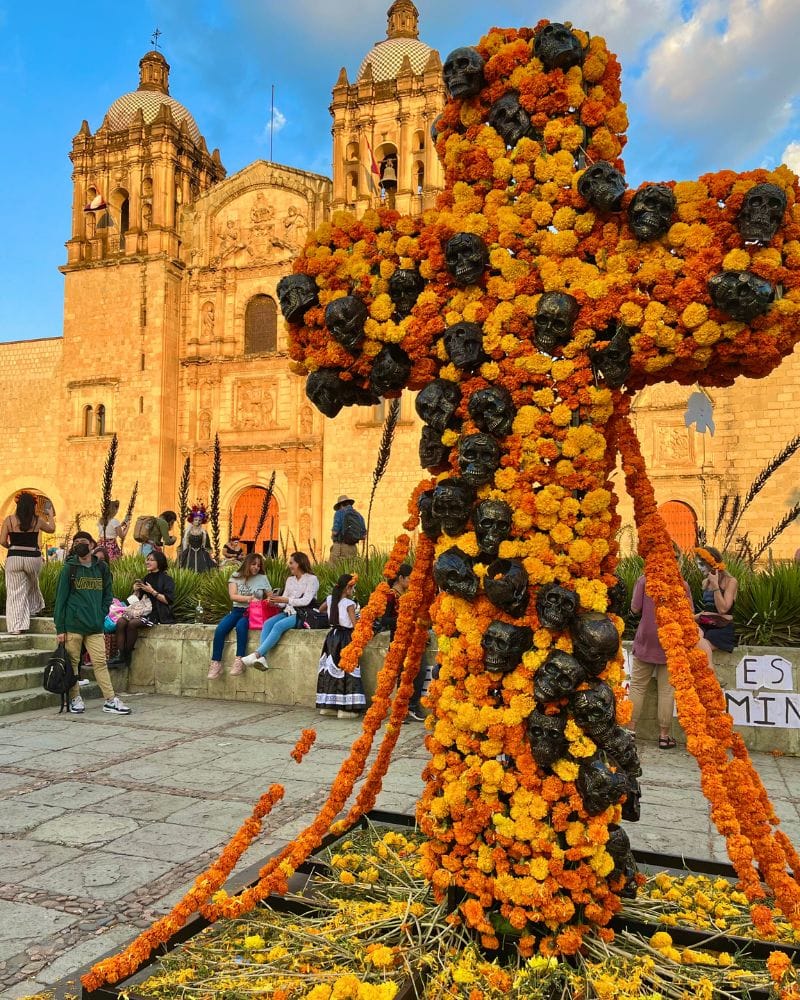
The marigold flower, or cempasuchil (pronounced sem-pa-souch-ill), has been a part of this celebration dating back to its Aztec origins.
🌼 Fun fact: The word cempasuchil means “20 flowers” in the Nahuatl Aztec language.
Throughout Mexico, marigolds are often called flor de los muertos (flower of the dead) because of their close associations with Day of the Dead.
According to Aztecs beliefs, the flower’s bright color and strong scent served a sensory guide for the spirits.
They believed the marigold flowers let our departed know exactly where they should return to meet us.
Nowadays, no Day of the Dead ofrenda (altar) is complete without some cempasuchil flowers on it.
You’ll also see marigolds and terciopelo rojo flowers (cockscomb) all over Oaxaca City — on restaurant tables and as elaborate floral archways outside shops.
🌮🍺 Discover the best Oaxaca restaurants! Head here to get a FREE Oaxaca Map with 33 places pinned so you can easily find all the top restaurants, street food stands and Oaxaca mezcal bars.
OAxaca DAY OF THE DEAD mexico
4. La Catrina: Day of the Dead Skeleton Woman

Besides Frida Kahlo, La Catrina might be the woman most commonly associated with Mexico.
This elegant skeletal lady, who everyone paints their faces to look like, was born in 1910 when Mexican printmaker/illustrator Jose Guadalupe Posada first drew her.
He named this figure, La Calavera Garbancera (The Elegant Skull), and she was drawn as satirical social commentary.
His dapper woman with her fancy feathered-hat was a critique of Mexican society at the time, when many Mexicans were aspiring to dress and act more European.
Posada saw this as a snub to the more humble, and traditional style of Mexican dress.
He created his Calavera Garbancera character as a skeleton who would serve as a reminder that we all eventually die one day — whether we’re wearing fancy clothing or not.
History of La Catrina, Day of the Dead Icon

La Catrina’s transition into the official grand dame of Day of the Dead came after Mexican artist Diego Rivera (Frida’s husband) painted her with a full-body and Victorian dress.
Using a similar face, he took Posada’s La Calavera Garbancera and created who would become known as La Catrina.
Rivera’s 50-foot-long (15 m) painting, Sueño de una tarde dominical en la Alameda Central (Dream of a Sunday Afternoon in Alameda Central Park), is the first-ever depiction of La Catrina.
She is placed in the dead center of the painting (pun intended), with Rivera painted as a boy by her side. Just behind them, you’ll see Frida Kahlo.
🎨 Want to see the painting in real life? You’ll need to head to Downtown Mexico City, to the Diego Rivera Mural Museum, one of the best museums in Mexico City.
OAxaca DAY OF THE DEAD mexico
5. Comparsas (Day of the Dead Parades)

You’ll hear a comparsa (parade) long before you see it coming.
This is great because it gives you time to find it, and then join in with the procession as it passes through the streets
🥁 Note: You may see the word muerteadas used instead of compara, but both words mean parade.
During a comparsa or muerteada, multi-instrument groups of costumed musicians join together to play festive Zapotec (native Oaxacan) live music in the streets.
Anyone can join in at any part along the route, and they are usually headed to a cemetery in Oaxaca City.
The Grand Parade, or Magna Comparsa Oaxaca City (as seen in this Day of the Dead YouTube video), is the one that opens the festival, and goes all over the city.
It is considered one of the main events for the local community and visitors alike, and a wild, fun Oaxaca Day of the Dead tradition.
After it, there will be smaller comparsas, both day and night, and sometimes into the early morning hours around 1am — so don’t forget these ear plugs.
OAxaca DAY OF THE DEAD mexico
6. Ofrendas (Day of the Dead Altars)
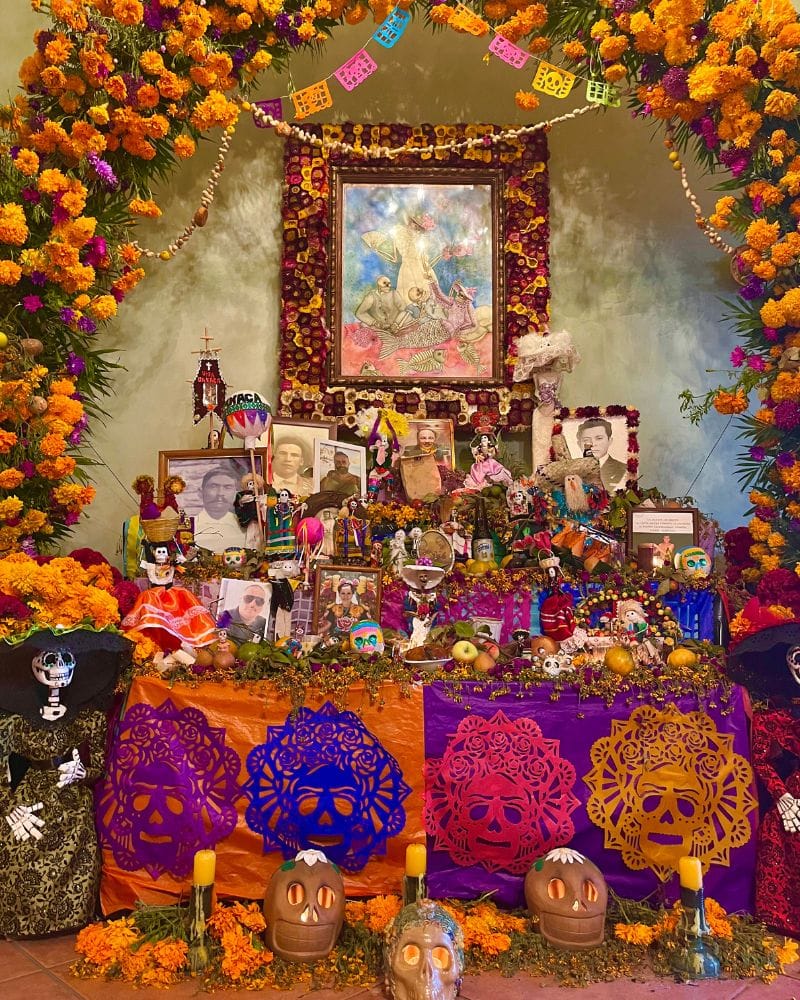
Just walking the streets and alleyways of downtown Oaxaca City, you’ll see hundreds of ofrendas (altars).
They’re decorated with marigold flowers, candles, copal incense and papel picado colorful paper flags.
You’ll also see photos of their loved ones, and whatever food and drink they’d want to consume on their arrival.
They say when the dead return they will be hungry and thirsty from the journey, so we have to prepare accordingly.
OAxaca DAY OF THE DEAD mexico
7. Day of the Dead Sand Tapestries
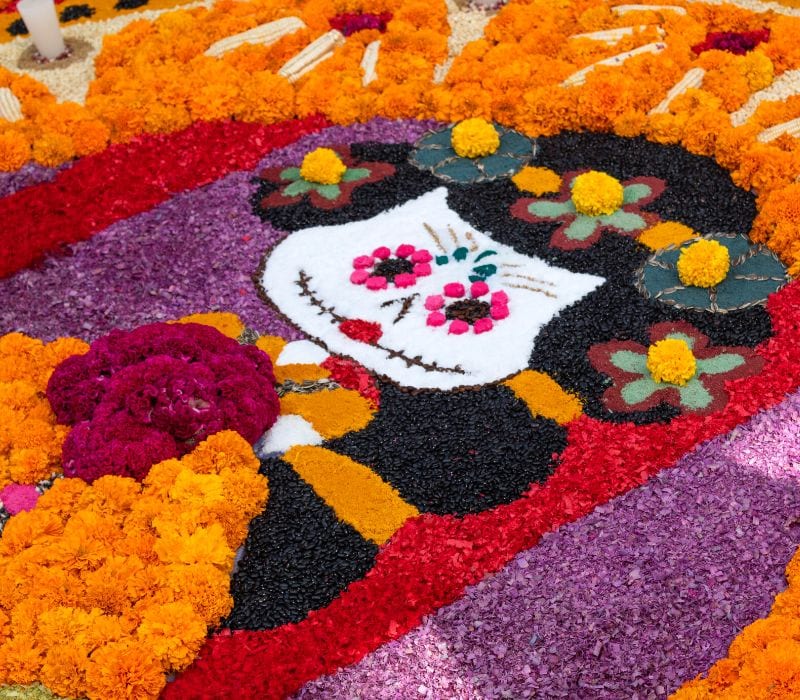
In front of some ofrendas throughout Oaxaca City, you’ll find colorful and intricate tapetes de arena (sand tapestries).
If you’re very lucky, you’ll even see an artist making one.
For this, you would need to arrive to Oaxaca City before the festival starts in late October; around October 29th should be good.
🌼 Oaxaca Travel Tip: Each year, a different neighborhood hosts the annual Sand Tapestry Competition, so make sure to find out where the this year’s will be.
The tradition of sand art plays into the deeper meaning of Day of the Dead, that all things eventually blow away in the wind, or die.
For this reason, you’ll also see ground art made of other natural materials the wind can carry away, like marigold flower petals and even beans.
OAxaca DAY OF THE DEAD mexico
8. Pan de Muerto (Day of the Dead Bread)

Pan de muerto (Bread of the dead) is a type of bread roll or pastry that’s traditionally only made from about mid-September or to mid-November for Day of the Dead.
It is most peoples’ favorite food associated with the holiday, and the pan de muerto recipe and preparation can vary.
☕️ Oaxaca Travel Tip: Many indigenous people of Oaxaca enjoy their pan de muerto dipped in a cup of hot chocolate. This is also the best way to enjoy other local foods, especially pan dulce (sweet bread).
In Oaxaca, unlike many other places in the rest of Mexico, there’s a small candy face placed in the center of the bread. This is said to represent a departed soul.
However, in many other parts of Mexico, the pan de muerto dough has a cross shape on the top of the roll, and it’s topped with sugar.
In Oaxaca City, the bread is topped with sesame seeds and isn’t as sweet.
To sample some, head to a panaderia (bakery), or the local markets in Oaxaca.
You might also find Oaxaca pan de muerto for sale from a street vendor — but no Oaxaca Day of the Dead celebrations are complete without eating some.
OAxaca DAY OF THE DEAD mexico
9. Alebrijes: Oaxaca Art

Alebrijes (pronounced al-lay-bree-hays) aren’t officially a part of Day of the Dead, but they have made their way into the celebrations.
They are the most famous Oaxaca art, and among the best Mexican folk art.
Paper mache alebrijes were first made by Mexican artist Pedro Linares in Mexico City.
However, the more famous wooden alebrije sculptures were made by Manuel Jiménez Ramírez in San Antonio Arrazola, Oaxaca, located near Oaxaca City.
At age 30, the original artist, Pedro Linares, suffered an illness which left him bedridden in pain, and having fever dreams at night.
One night, he saw what he named an alebrije, a hybrid animal, which he said served as a spirit guide through his frightening, vivid dreams.
He made an artistic representation of his colorful spirit guide in Mexico City, but soon after, the Oaxaca alebrijes were born, as many artisans in Oaxaca towns started making alebrijes.
Today, Oaxaca pueblos of San Martín Tilcajete and San Antonio Arrazola are both now known as the Alebrije Towns.
These are some of the most popular Oaxaca artisan towns, which each produce just one specific craft.
You may be familiar with alebrijes from the movie Coco, which has two alebrijes in it, Dante and Pepita.
There’s also this great National Geographic feature about Oaxacan alebrijes.
OAxaca DAY OF THE DEAD mexico
10. Mojigangas (Giant Puppets)

Mojigangas (pronounced moe-he-gawn-gahs) come from Spain, but were brought to Mexico in the 1600s.
They are about 15-feet-tall (4.5 m), and a part of many celebrations in Central Mexico, especially festivals in Oaxaca, and weddings in San Miguel de Allende.
You’ll very likely see several mojigangas during Day of the Dead Oaxaca City if you go to a Oaxaca Dia de los Muertos parade.
My Final Thoughts on Enjoying Oaxaca Day of the Dead in Mexico
Is Day of the Dead in Oaxaca worth It?
As it will take at least two flights, or a flight and a bus to get to Oaxaca City, you might be wondering if traveling to Oaxaca Day of the Dead is worth it.
The short answer is — YES it is certainly worth whatever it takes to get there!
Oaxaca, in a word, is magical. Oaxaca is the Mexico people imagine Mexico to be.
This state has it all: rich history, gorgeous beaches, colorful festivals, UNESCO World Heritage Sites, locally-made Oaxaca mezcal, beautiful nature, colonial architecture, artisan communities — and of course, Oaxaca food.
Mix all that with one of the most fun, beautiful, lively, cultural festivals on the planet, and you can’t go wrong with a Oaxaca trip to Dia de Muertos.
💀 A Final word of warning!

The only caveat for going to Oaxaca Day of the Dead is you have to plan in advance.
As I aimed to make this blog post the Ultimate Guide to the Oaxaca Día de Muertos celebrations, I can’t stress this point enough.
Oaxaca is a small town, and all the hotels, VRBOs, hostels (especially the private rooms), and Oaxaca Airbnbs will sell out, and so will all the Day of the Dead tours.
If you make sure to book everything in advance, you’re in for the trip of a lifetime during your Day of the Dead celebration in Oaxaca City.
🌺💀🌺 Need more tips for Oaxaca Day of the Dead? Check out this Day of the Dead Mexico podcast to learn even more about attending the Oaxaca Mexico celebration.
OAxaca DAY OF THE DEAD mexico
Additional Day of the Dead Blogs

Need more information on the Mexico Day of the dead holiday? Here’s some blogs you’ll want to read next:
- Ultimate Day of the Dead in Mexico Guide
- 17 Best Places to Celebrate Day of the Dead in Mexico
- Day of the Dead in Mexico City: Best Things to Do
- Mexico City Day of the Dead Parade Guide
- Hanal Pixan: Mayan Day of the Dead Celebration
- 30 Day of the Dead Foods & Drinks You Have to Try
- 13 Day of the Dead Symbols & Their Meanings