
The Aztec Calendar Explained: The Sun Stone, Day Signs and What They Mean

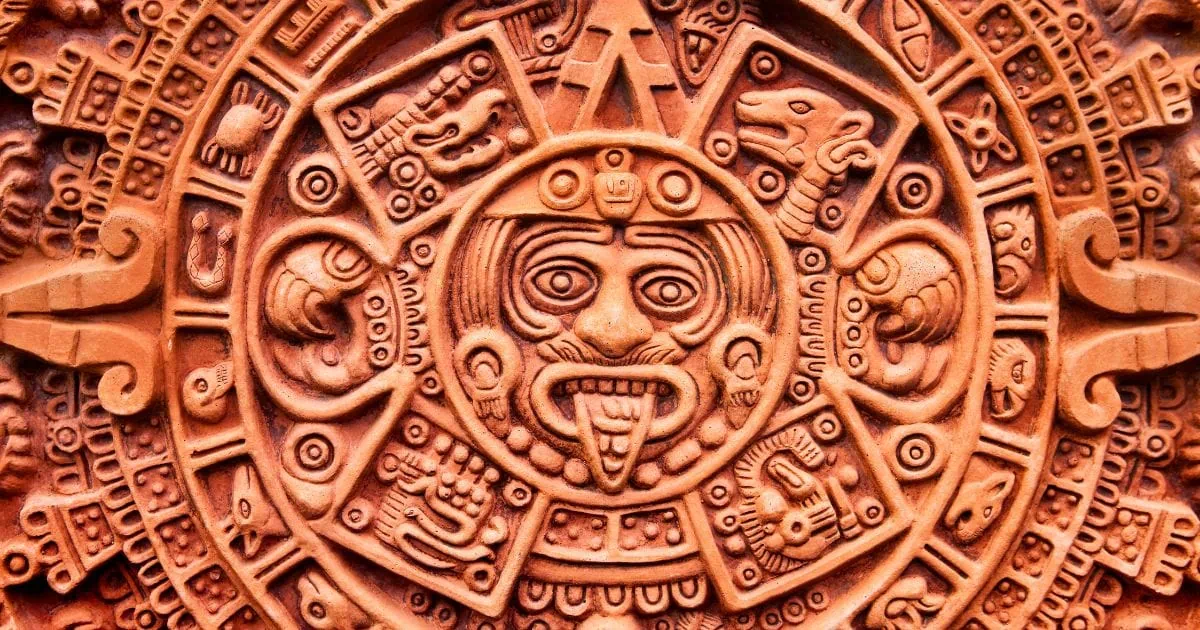
Wondering about the Aztec calendar meaning?
One of the most famous symbols of Mexico, the Aztec calendar is often misunderstood.
The giant carved stone most people call the “Aztec calendar” is actually the Aztec Sun Stone, and it wasn’t used to keep time.
I’ve visited the National Museum of Anthropology in Mexico City twice, and the Sun Stone is one of the things you can’t miss, but it’s not the Aztec calendar.
Below, you’ll discover what the Aztec calendar is, how the Aztec calendar worked, what the Sun Stone shows, and what the day signs mean.

What Is the Aztec Calendar?

The Aztecs (Mexica) used two calendars at the same time: the xiuhpohualli and tonalpohualli.
The xiuhpohualli was a 365-day solar calendar used for farming and festivals.
It had 18 months of 20 days each, plus five extra days at the end of the year.
The tonalpohualli (pictured above) was a 260-day ritual calendar that combined 20 day signs with the numbers 1 to 13.
Priests used it to name days, choose lucky dates and read people’s fates.
The two calendars lined up again only once every 52 years, a cycle called the xiuhnelpilli (binding of the years).
At the end of each cycle, the Aztecs held the New Fire Ceremony to keep the world from ending.
The Sun Stone (Piedra del Sol)
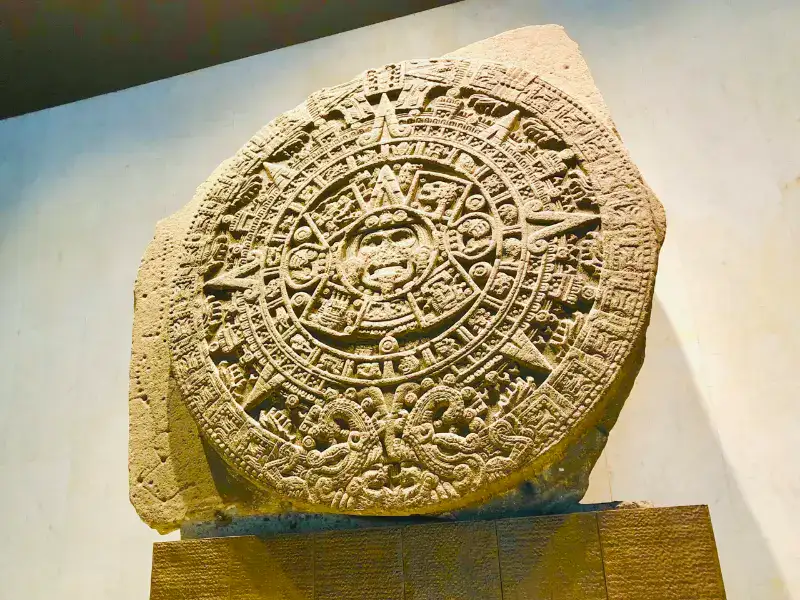
The Aztec Sun Stone is a giant basalt disk about 12 feet (3.6 m) across and 39 inches (98 cm) thick.
It weighs about 54,000 pounds (24,590 kg).
It was carved sometime between 1502 and 1521, then buried after the Spanish conquest.
Workers found it in Mexico City’s Zócalo (central square in downtown) on December 17, 1790, while repaving the square.
The face in the center is often identified as Tonatiuh, the Aztec sun god, and one of the most important Aztec gods.
Hotly debated, some scholars think it shows Tlaltecuhtli, the earth deity, instead.
Around the face are symbols of the four earlier “suns,” or world eras, and a ring with all 20 day signs.
The stone was once painted in bright red, blue, green and yellow.
Since 1964, it has been on display in the Mexica Hall of the National Museum of Anthropology.
The 20 Aztec Day Signs
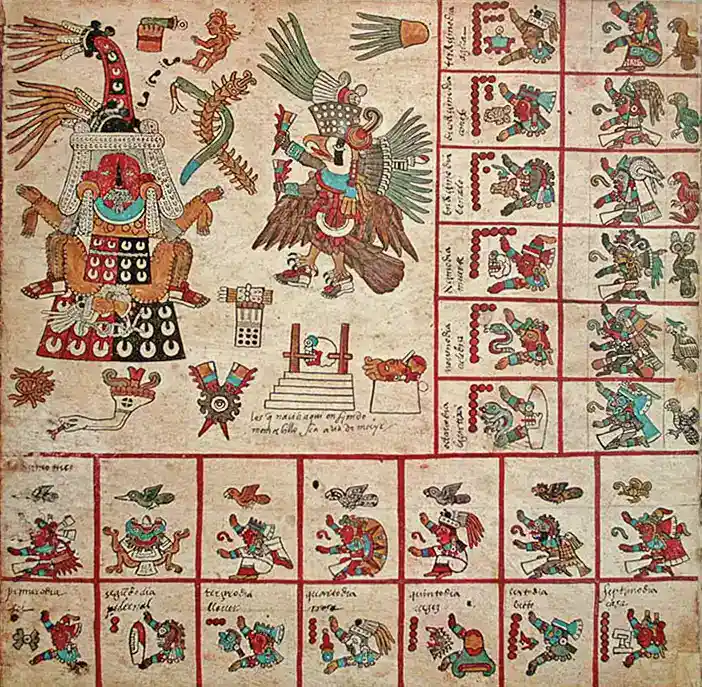
Each day in the tonalpohualli paired one of 20 day signs with a number from 1 to 13, like 1 Crocodile or 4 Movement.
Each 13-day period (trecena) was also linked to a patron god.
| # | Nahuatl Name | English | Trecena God |
|---|---|---|---|
| 1 | Cipactli | Crocodile | Tonacatecuhtli |
| 2 | Ehécatl | Wind | Chantico |
| 3 | Calli | House | Itzpapálotl |
| 4 | Cuetzpalin | Lizard | Itztlacoliuhqui |
| 5 | Cóatl | Serpent | Xiuhtecuhtli |
| 6 | Miquiztli | Death | Tonatiuh |
| 7 | Mázatl | Deer | Tepeyóllotl |
| 8 | Tochtli | Rabbit | Xiuhtecuhtli |
| 9 | Atl | Water | Chalchiuhtotolin |
| 10 | Itzcuintli | Dog | Xipe Tótec |
| 11 | Ozomatli | Monkey | Patécatl |
| 12 | Malinalli | Grass | Mayáhuel |
| 13 | Ácatl | Reed | Chalchiuhtlicue |
| 14 | Océlotl | Jaguar | Quetzalcóatl |
| 15 | Cuauhtli | Eagle | Xochiquétzal |
| 16 | Cozcacuauhtli | Vulture | Xólotl |
| 17 | Ollin | Movement, earthquake | Tlazoltéotl |
| 18 | Técpatl | Flint knife | Mictlantecuhtli |
| 19 | Quiáhuitl | Rain | Tláloc |
| 20 | Xóchitl | Flower | Huehuecóyotl |
Want more Aztec history? Meet the Aztec warriors known as Eagle and Jaguar Knights.
The 18 Months of the Aztec Year
The 365-day xiuhpohualli had 18 months (veintenas) of 20 days, and each one had its own festival.
| # | Month | Meaning |
|---|---|---|
| 1 | Atlcahualo | The water stops |
| 2 | Tlacaxipehualiztli | Flaying of men |
| 3 | Tozoztontli | Lesser vigil |
| 4 | Huey Tozoztli | Greater vigil |
| 5 | Tóxcatl | Dryness |
| 6 | Etzalcualiztli | Eating of maize and beans |
| 7 | Tecuilhuitontli | Lesser feast day |
| 8 | Huey Tecuilhuitl | Greater feast day |
| 9 | Tlaxochimaco | Giving of flowers |
| 10 | Xócotl Huetzi | The xocotl falls |
| 11 | Ochpaniztli | Sweeping |
| 12 | Teotleco | The gods arrive |
| 13 | Tepeílhuitl | Feast of the mountains |
| 14 | Quecholli | Roseate spoonbill |
| 15 | Panquetzaliztli | Raising of banners |
| 16 | Atemoztli | Descent of water |
| 17 | Títitl | Tightening |
| 18 | Izcalli | Sprout, new growth |
The last five days of the year, the nemontemi, didn’t belong to any month.
Their name means roughly “they fill up in vain,” and they were considered unlucky.
How to Find Your Aztec Day Sign

Your Aztec day sign is the tonalpohualli sign that fell on the day you were born.
Because the 260-day count ran nonstop, finding it means counting from a known date.
Scholars don’t fully agree on how Aztec dates line up with ours, so different converters can give different results.
The easiest way is a free converter like AztecCalendar.com. Enter your birth date, and it shows your day sign and number.
Where to See the Sun Stone

The real Sun Stone is in the Mexica Hall of the National Museum of Anthropology in Mexico City’s massive Bosque de Chapultepec Park.
It’s one of the best museums in Mexico City, so plan at least half a day to explore this massive museum with 23 exhibition halls.
In the same Mexica Hall, look for the giant statue of Coatlicue and other important Aztec gods and goddesses.
Aztec Calendar Replicas and Gifts
Want a piece of the Sun Stone at home? These are well-reviewed picks on Amazon.
Aztec Calendar Wall Plaque

This round wall plaque recreates the Sun Stone with its central face and ring of day signs.
It’s a great piece for a living room, office or entryway.
Aztec Calendar Canvas Wall Art
This framed canvas print shows the Aztec calendar in warm, earthy tones.
It’s an easy way to add a Mexican touch to a bare wall.
Handmade Aztec Calendar Figurine
This small, handmade Aztec calendar is about 3.7 inches (9 cm) across and made to look like green malachite.
It’s a nice souvenir-style gift that fits on a shelf or desk.
Sterling Silver Aztec Calendar Pendant
This round sterling silver pendant has the Aztec calendar design, and it comes in a few sizes.
Aztec Calendar FAQ
Is the Aztec calendar the same as the Maya calendar?
No, but they’re closely related since both use a 260-day ritual count and a 365-day solar year.
They used different names and day signs, though, and only the Maya used the Long Count.
What does the Aztec calendar predict?
The Aztec calendar doesn’t predict the end of the world.
Priests used the 260-day tonalpohualli to choose lucky days and read a person’s fate from their birth date.
The famous “doomsday” idea came from the Maya Long Count, which completed a cycle in December 2012.
Where is the real Aztec calendar?
The real Sun Stone is in the National Museum of Anthropology in Mexico City.
It has been on display there since 1964.
Is the Sun Stone actually a calendar?
Not really; most archaeologists say the Sun Stone isn’t a working calendar.
It uses calendar symbols to show Aztec ideas about time and the world’s eras.
It may have been a ceremonial basin or an altar used for sacrifices.
Get My FREE Guide: 5 Easy Ways to Save Money in Mexico
Insider tips from someone who’s lived in Mexico since 2018.
