
13 Aztec Gods and Goddesses So Fascinating You’ll Question Everything You Believe

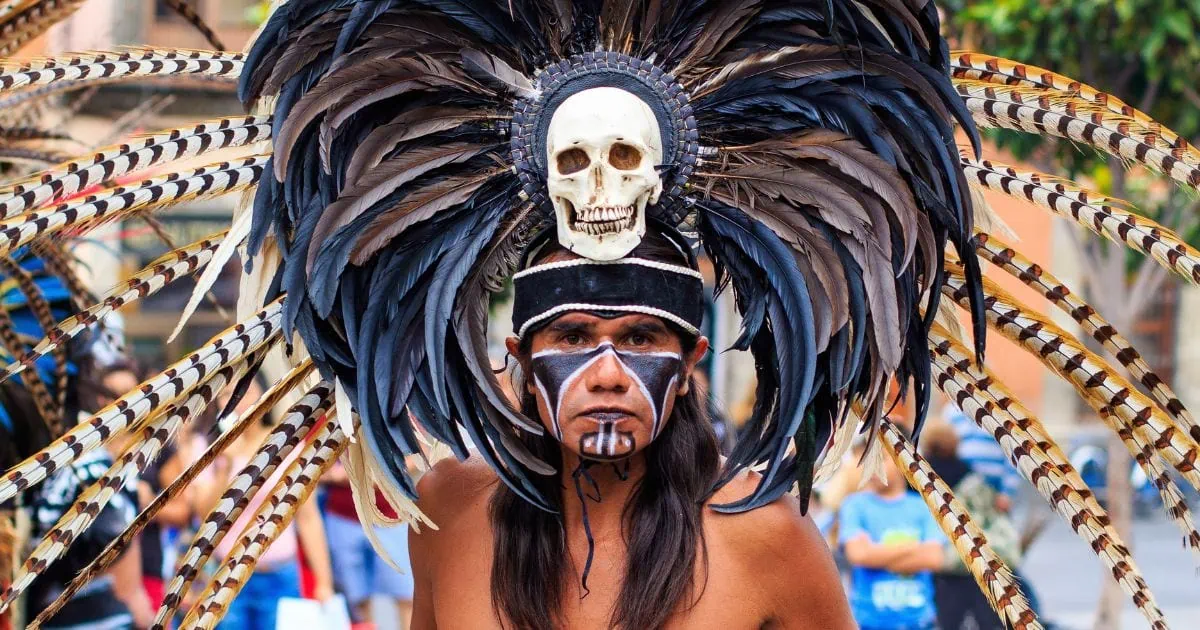
The Aztec civilization, flourishing in central Mexico from the 14th to the 16th centuries, was rich in mythology and religious traditions.
Their pantheon of gods and goddesses governed every aspect of life, from creation to agriculture, war, and death.
Understanding these deities offers a glimpse into the complex worldview of the Aztecs — and might even make you question what you think you know about the universe 🤯
1. Huitzilopochtli: The Aztec God of War and the Sun (Most Important Aztec God)

Huitzilopochtli (weet·see·luh·powch·tuh·lee), whose name means Hummingbird of the South, was the most important Aztec god (and central Mexica deity).
This important Aztec god embodied both the rising sun and the martial vigor needed to sustain it.
Born fully armed atop the sacred Coatepec mountain, his daily triumph over darkness symbolized the sun’s victory over night — a cosmic battle foundational to Aztec belief.
His temple, the Templo Mayor in Tenochtitlan (present-day Mexico City), was the empire’s spiritual and political heart.
This Aztec temple, located in Downtown Mexico City, was dedicated jointly to Huitzilopochtli and Tláloc. It united warfare and agriculture under one roof.
Military campaigns were justified as offerings to him, ensuring the sun would rise again and Aztec society would thrive.
Festivals such as the Tōxcatl Festival and Pānquetzaliztli Festival were elaborate rites involving blood, music, and pageantry.
In Tōxcatl, a youth would embody Huitzilopochtli for a year before symbolic sacrifice — a powerful reminder that cosmic renewal required human devotion.
Every captured warrior became part of the ritual ecosystem that sustained Aztec power and world order.
2. Quetzalcoatl: The Aztec Feathered Serpent God

Quetzalcoatl (ket·sahl·kuh·waah·tull), the Aztec feathered serpent god, was a multidimensional god of creation, knowledge, and morality.
Revered as inventor of the calendar, books, maize (corn) cultivation, metallurgy, and law, he was seen as a civilizer and moral exemplar, especially among priests and the elite.
Unlike war-driven deities, Quetzalcoatl promoted virtuous worship with flowers, incense, and self-discipline, offering a spiritual alternative to blood sacrifice.
His dual serpent-bird form symbolized a harmony of earth and sky, of material sustenance and celestial guidance.
Central to Aztec creation myth and Mayan mythology, he co-created the earth and resurrected human life by molding bones with his own blood.
His influence permeated education, art, and civic ideals across Mesoamerica, making him a unifying cultural force.
Kukulcán: The Mayan Equivalent of Quetzalcoatl

As you might imagine, there is a lot of overlap with Pre-hispanic and Mesoamerican deities. Case and point: Quetzalcoatl and Kukulcán (koo·kuhl·khan).
Both feathered serpents, Kukulcán is essentially the equivalent of Quetzalcoatl, but within the Mayan pantheon of gods.
There are temples throughout the country honoring this deity. Located at some of the most famous ruins in Mexico, these include:
- Chichen Itza Ruins in the Yucatán Peninsula
- Teotihuacan Ruins near Mexico City
- Mayapan Ruins near Mérida in Yucatán state
- Tula Ruins, which was once the capital of the Toltec Empire, and located in present-day Hidalgo state
3. Tláloc: The Aztec Rain God

Tláloc (tlah·lohk) was the ruler of rain, fertility and storms, making him indispensable to agriculture in a civilization reliant on predictable harvests.
He controlled both peaceful, nourishing rains — and also devastating hail, thunder, and floods.
Tláloc’s temple stood alongside Huitzilopochtli’s atop the Templo Mayor, underlining his power in sustaining life and supporting imperial legitimacy.
Festivals observed seasonal cycles and invoked his help for maize planting and crop growth.
To appease Tláloc, the Aztecs offered flowers, food, and even child sacrifices — believing that cosmic balance and food security were reciprocal gifts of worship.
His worship reflected a profound understanding of nature’s dual potential for both creation and destruction.
4. Chalchiuhtlicue: She of the Jade Skirt

A maternal figure linked to feminine fertility and purification, Chalchiuhtlicue (chal·chee·weet·lee·kway) was goddess of rivers, lakes, seas, and childbirth.
Ruler of the Fourth Sun (the Aztecs believed in Five Suns ☀️), her flood myth symbolized destruction preceding rebirth.
She presided over baptisms, domestic water rituals, and childbirth ceremonies — jewelry and jade signifying life’s precious, renewing waters.
As Tláloc’s consort, Chalchiuhtlicue (She of the Jade Skirt) completed the rain-water fertility cycle and embodied the life-giving aspects of water.
Worship of the Chalchiuhtlicue Aztec goddess extended to everyday life, including women in labor, farmers, and communities.
Here, people would invoke her presence during purification rites, connecting human cycles intimately with cosmic cycles.
5. Coatlicue: The Aztec Mother Goddess (Most Important Aztec Goddess)

The most important Aztec goddess, Coatlicue (kwah·tlee·kway) was the Aztec earth mother, progenitor of gods and the embodiment of primordial creation.
Her name and imagery of serpents, hearts and blood symbolize both fecund earth and its ravenous depths.
Mother of Huitzilopochtli, she represented the mystery and power of birth, from which both life (her son) and death emerged, reflecting the Aztec belief in cyclical transformation.
Her role was essential in temple cornerstone dedications, as her image underpinned the temple, which was the axis of spiritual power.
Human sacrifices to Coatlicue were acts of reciprocity, offering earth’s bounty back to her, trusting in her to continually regenerate crops and society.
6. Tezcatlipoca: The Smoking Mirror

Tezcatlipoca (tez·kuht·luh·pow·kuh) was a god of night, sorcery, fate, and power — seen as both omnipresent and omnipotent (all-present and all-powerful).
As a creator, he ruled the primordial Jaguar-Sun and helped forge the world with his brothers, playing a central role in the Legend of the Five Suns.
Worshiped as patron of kings, judges, warriors, and shamans, he legitimized authority through rituals at enthronement.
His obsidian mirror embodied divine judgment, as with it, he could see all and act with cosmic justice.
His rivalry with Quetzalcoatl over cosmic rulership was central to Aztec mythology — highlighting the tension between order and chaos, creation and destruction.
Both brothers alternately created and destroyed worlds, embodying moral duality kept in balance by perpetual conflict.
7. Xipe Totec: The Flayed One

Xipe Tótec (shee·pay toh·tek), meaning “Our Flayed Lord” or “Our Flayed God,” was god of agriculture, renewal, seasons, crafts, and war.
His image of flayed skin symbolized both the shedding of old layers and the birth of new life, reflecting how maize kernels 🌽 lose their husks before sprouting.
Also the inventor of war, he linked violence and cultivation, reminding society that sacrifice is intrinsic to transformation.
His festival involved priests donning flayed skins to reenact the rebirth cycle.
Patron of metalworkers and healers, his rituals addressed human illness and disease through symbolic transformation — further reinforcing how death fuels life and craft.
8. Mictlantecuhtli: The Aztec God of the Death & the Underworld

Mictlantecuhtli (muhkt·laan·tuh·koot·lee), the skeletal ruler of Mictlan, oversaw the deceased in their harsh afterlife journey.
As the Aztec death god and Lord of the Underworld, Mictlantecuhtli (aka Mictlan) governed cosmic balance by ensuring every life cycle culminated in death.
🐾 Fun Fact: Xoloitzcuintle Mexican hairless dogs help the souls navigate the underworld after death — like Dante in the movie Coco.
Mictlan featured prominently in funerary rites and seasonal rituals to honor deceased ancestors (a precursor to what we know as Day of the Dead).
Mictlan statues in ceremonies should instill respect and fear — his presence a reminder of mortality for the living, and a mandate to respect the dead.
9. Centeotl: The Aztec Corn God

Centeotl (sen·tay·ohtl) was the youthful Aztec maize deity (or Aztec corn deity 🌽), embodying sustenance and daily life.
As maize was staple food for pre-hispanic societies, Centeotl’s flourishing meant survival — not only physically, but culturally.
He was celebrated in spring festivals where indigenous women carried maize cobs and scattered pollen, symbolizing life’s abundance.
In the sacred Tonalpohualli Calendar, a 260-day ritual calendar, he governed specific days and nights tied to planting and harvest.
His union with Chicomecoātl, the Aztec agriculture goddess, represented the pairing of earth’s fertility with human gratitude.
Together, the two reinforced agricultural cycles as sacred social commitments to be undertaken with joy.
10. Ehecatl: The Aztec God of Wind and Air

Ehecatl (eh·heh·kah·tul), whose name simply means “wind” in Nahuatl (the Aztec language), was revered as the essential breath of life.
As the Aztec wind god whose invisible force both nurtures and moves the universe, temples dedicated to Ehecatl were always circular temples.
You can see examples at Guachimontones Ruins near Guadalajara, Calixtlahuaca Ruins near Toluca, the Ehecatl-Quetzalcoatl Temple in Mexico City, and more.
These ingeniously-designed temples welcomed winds from all directions — reflecting Ehecatl’s domain over all four cardinal directions.
As the wind aspect of the Aztec deity Quetzalcoatl, he’s known as Ehecatl-Quetzalcoatl in this form.
As Ehecatl-Quetzalcoatl, this deity is credited with helping to breathe the Fifth Sun and moon into motion, when neither would rise on their own.
In agricultural cycles, Ehecatl’s powers were invoked before planting to ensure pollination.
His breath was seen as both life-giving and capable of chaos, illustrating the dual nature of his domain.
Mythically, Ehecatl is credited with gifting the maguey plant 🌵 (the cactus used to make pulque, tequila and mezcal), maize 🌽 (corn), and music 🎶 to humanity.
These contributions tie his influence directly to daily sustenance, festive life, and artisan culture.
His figure often wears a duck-bill mask, and completes the bridge between creation and civilization.
11. Xolotl: Guardian of the Aztec Underworld and Quetzalcoatl’s Twin

Xolotl (shuh·luht) is a dog-headed psychopomp — which is a creature, spirit, or deity that helps guide newly deceased souls to the afterlife.
As a loyal companion, this canine deity helps guide souls through the treacherous realms of Mictlan (the Aztec Underworld), ensuring they reach the afterlife safely.
A twin of Quetzalcoatl, Xolotl represents the morning star (Venus), lightning, deformities, and trickery — essentially embodying the darker side of celestial balance.
In the myth of the Five Suns, when the other gods sacrificed themselves to ignite our Sun, Xolotl famously refused to do so.
Instead, he shape-shifted first into maize 🌽, then into maguey 🌵, and finally, into an axolotl 🦎 After doing so, he was able to escape (for a time).
Xolotl was ultimately found and sacrificed by Quetzalcoatl for cosmic renewal.
His broken eye sockets, a symbol of this myth, appear in art representing self-sacrifice and transformation.
Xolotl’s rituals were central to the New Fire Ceremony, a ritual held every 52 years to mark the end of a calendar cycle, and the continuation of the world.
Priests lit fresh fires and celebrated Xolotl’s power to regenerate — a powerful metaphor for societal and cosmic rebirth.
12. Mixcoatl: The Aztec God of the Stars, the Hunt, and the Patron of Warriors

Mixcoatl (meesh·koh·wahtl), meaning Cloud Serpent, is an Aztec deity associated with warfare, the hunt, and the Milky Way galaxy.
As a patron of hunters, he guided arrows and spears, protecting those who brought food or war trophies back to the community.
Connected to the Milky Way, known to the Aztecs as the “White Road,” Mixcoatl was thought to guide the souls of fallen warriors across the night sky to celestial realms — making him a starry pathway to the afterlife.
Iconographically, warrior priests adorned masks or body paint symbolizing his stealth and cosmic connection.
He is also credited, through complex myths, as a progenitor of gods — father to Quetzalcoatl, Xolotl, and the 400 Centzon Huitznahua (or, the 400 Brothers).
He may be an avatar or red variant of Tezcatlipoca, forging fire and bringing cosmic order through trials like the Mamalhuaztli (the Aztec Fire Drill Myth 🔥).
His festival, Quecholli, connected hunt, seasonal change, and martial readiness — linking celestial cycles with earthly duty, and weaving hunting, star lore, and cultural identity into one rich narrative.
13. Ometecuhtli and Omecihuatl: The Aztec Creator Gods (Ometeotl)

Ometecuhtli (oh·meh·teh·koot·lee) and Omecihuatl (oh·meh·see·wah·tull) are the primordial Aztec deities that represent duality and creation.
As the god and goddess of duality, Ometecuhtli is male and Omecihuatl is female, they reside in the highest heaven, Ōmeyōcān, and embody the cosmic balance.
Together, they are often seen as aspects of a singular, dual god, Ometeotl (oh·meh·teh·oh·tl).
From their union came the creation of other gods and, eventually, the universe and humankind. Some myths also say they’re the parents of Huitzilopochtli.
Unlike other Aztec deities, they were not actively worshipped through temples or sacrifices, reflecting their abstract, philosophical nature.
Their importance lies in symbolizing the origin of life, balance, and the divine harmony between opposites in Aztec cosmology.
Ancient Aztec Gods and Goddesses: FAQs
What roles did the four major Aztec gods play in daily life?

The Aztec gods weren’t just symbolic — they shaped every moment, from the sunrise to the harvest to the battlefield.
☀️ Huitzilopochtli, as the sun and war god, guided Aztecs through their legendary migration, inspired temple-building in Tenochtitlan, and demanded offerings to keep the sun moving.
This ensured both cosmic order and military success.
🪶🐍 Quetzalcoatl, the Feathered Serpent, was the god of wind, knowledge, and culture.
This central Aztec deity is credited with invention of the calendar, books, and the “civilized” way of life, symbolizing creation and spiritual introspection.
🪞 Tezcatlipoca, the Smoking Mirror, embodied power, conflict, magical justice, and destiny.
He served as a cosmic counterbalance to Quetzalcoatl and guided moral order through his unpredictable interventions.
🔪 Xipe Tótec, the Flayed One, oversaw agricultural renewal and seasons.
His ritual of priests wearing flayed skin symbolized the earth’s shedding and regeneration — a visceral reminder of death fueling future growth.
Why was human sacrifice so central in Aztec religion?

Human sacrifice was seen as a sacred debt the Aztecs paid to ensure cosmic stability.
The sun god needed nourishment in the form of human hearts and blood to rise each day, while rain gods like Tlaloc required offerings to bring rain for crops.
Far from being gratuitously cruel, this reciprocity was seen as profoundly spiritual, and also necessary.
A reciprocal contract seen throughout many religions (ie. “I give so that you may give back to me” from Luke 6:38) binds humans and deities in a fragile balance.
Did Aztec mythology include concepts of duality or multiple worlds?
The Aztec cosmos consisted of three realms — celestial, earthly, and underworld. Each of these were maintained by different gods.
- ☀️ The sun (Huitzilopochtli) ruled the sky
- 🌎 Earth contained the living and nature
- 💀 The underworld (Mictlan), led by Mictlantecuhtli, housed the dead
Many gods embodied dualities, like Coyolxauhqui (the moon) endlessly battling Huitzilopochtli (the sun), which echoed the tension between life and death.
Even one of the main Aztec gods, Quetzalcoatl, fused celestial (bird) and terrestrial (serpent) aspects together into one deity.
How diverse was the Aztec pantheon beyond the main eight gods?

The Aztec pantheon was vast with more than 200 deities, serving as patrons of stars, arts, healing, women, and more.
❤️ Xochiquetzal, considered one of the lesser Aztec gods, presides over beauty, fertility, arts and love, is a protector of young mothers, and a patroness of pregnancy, childbirth, and crafts practiced by women.
💫 Coatlicue, the Aztec Mother of the Gods, gave birth to celestial beings and symbolized earth’s generative power.
🌽 Centeotl, the Aztec maize god, directly tied into rituals ensuring food security.
🕺🏼 Trickster Huehuecoyotl, the Aztec god of music and dance, reminds us that prophecy and playfulness also shaped social life.
This complex pantheon reflects a civilization deeply attuned to the interwoven forces of nature, society, and spirit.
How did Aztec gods influence their calendar and festivals?

The Aztec calendar, a sophisticated combination of a 365-day solar cycle and a 260-day sacred cycle, structured time around deity-associated rituals.
Each day was under a particular god’s influence, and priests used it to schedule sacrifices, ceremonies, and seasonal festivals.
For instance, maize planting had Centeotl’s blessing, rainy seasons honored Tlaloc, and new fire ceremonies every 52 years realigned cosmic order — a direct tribute to the deities’ power over time and renewal.
What language did the Aztecs speak?

The Aztecs, more accurately called the Mexica (meh·shee·kah), spoke Classical Nahuatl, part of the Uto-Aztecan language family.
Used throughout their empire, Nahuatl became the lingua franca of trade, diplomacy, and administration.
It was written in a pictographic system and, post-conquest, using Latin letters introduced by Spanish missionaries.
More than 1.5 million Nahuatl speakers still exist in central and western Mexico today.
What’s the difference between Aztec and Mexica?
✅ Aztec is a modern umbrella term for various Nahua-speaking groups from Aztlán, the mythical homeland.
✅ Mexica refers specifically to the people who founded and ruled Tenochtitlan, the core of the Triple Alliance.
✅ The Mexica (meh·shee·kah) are the dominant group behind the so-called Aztec Empire, though not all Nahua peoples were Mexica themselves.
Where do Aztecs live today?

While the Aztec Empire no longer exists, its descendants survive in Mexico as the Nahua people, with many living in Mexico City and central Mexico.
Today, more than 1.6 million people in central and western Mexico speak the Nahuatl language, and proudly maintain traditions, weaving their ancestral heritage into modern Mexican identity.
What happened to the Aztecs?

The Mexica-led Aztec Empire was conquered by Hernán Cortés and allies between May and August 1521, with the fall of Tenochtitlan on August 13, 1521.
Contributing factors included military alliances with native rivals, superior Spanish arms, and a devastating smallpox epidemic that killed an estimated 80% of the population.
Afterward, the city was razed, and Mexico City established in 1524.
Political, religious, and economic systems were dismantled under Spanish colonial rule, but essential components like language and cultural practices survived through indigenous communities.
My Final Thoughts on the Most Important Aztec Gods and Goddesses

Exploring the pantheon of Aztec gods reveals a civilization deeply connected to nature, the cosmos, and the cycles of life and death.
Their deities embodied complex concepts, and their worship involved intricate rituals aimed at maintaining balance in the universe.
Understanding these gods offers insight into the rich tapestry of Aztec culture and belief systems.
Get My FREE Guide: 5 Easy Ways to Save Money in Mexico
Insider tips from someone who’s lived in Mexico since 2018.
