
Meet the Mexican Axolotl: The Coolest Creature You’ve Never Heard Of


Curious about the Mexican axolotl?
The axolotl is more than just an unusual amphibian — it’s a living emblem of Mesoamerican myth, resilience, and the fragile beauty of Mexico’s aquatic heritage.
Native only to the canals of Lake Xochimilco in Mexico City, this beloved creature with a perpetual grin is Critically Endangered on the IUCN Red List.
Yet, thanks to pioneering conservation efforts in habitat restoration, community engagement, and re-wilding projects, the future still holds hope.
How do you pronounce axolotl?
Let’s clear up the common question about axolotl pronunciation before we continue — though there is more than one way to say axolotl.
- 🇲🇽 In Spanish, the pronunciation is ahh·hoe·LOW·teh
- 🇺🇸 In English, the pronunciation is ACK·suh·laah·tull
Now, technically neither of these are right 🤪 As a Nahuatl (Aztec) word, check out the video above to hear the correct pronunciation of axolotl in Nahuatl.
What are axolotls?
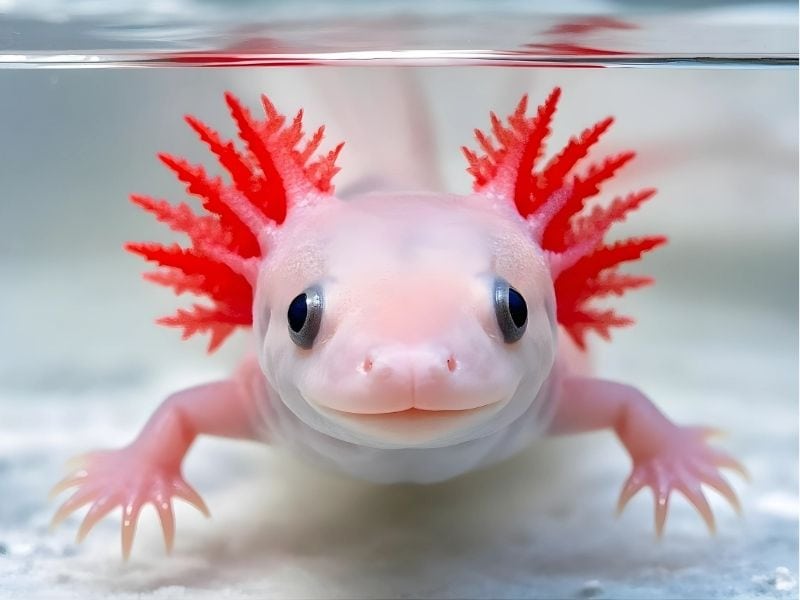
A neotenic salamander, the axolotl (Ambystoma mexicanum) retains juvenile features like external gills and an aquatic lifestyle, even into adulthood.
They never undergo full metamorphosis — a condition tied to an inactive thyroid axis that typically drives this transformation in other salamanders.
Once found across the Valley of Mexico, these aquatic “water monsters” now survive only in the canals of Xochimilco, having been displaced by urban expansion, pollution, and invasive species like tilapia and carp fish.
Meaning & Symbolism of the Axolotl

Named from the Nahuatl (Aztec language) word “atl” (water) and “Xolotl” (an Aztec god of fire and lightning), axolotl loosely translates to “water monster.”
Legend holds that the god Xolotl transformed into this creature to avoid sacrifice — making the axolotl a powerful symbol of transformation and rebirth.
Today, it represents both Mexican cultural identity and ecological resilience, and their ability to regrow organs has made them the subject of medical research.
They’ve also rose to pop culture fame outside of Mexico, with plenty of axolotl things you can buy on Amazon, and inclusion in the Minecraft video game.
Characteristics of Axolotls
Axolotl Appearance

Easy to spot because there aren’t other animals that look even remotely similar, axolotls have external feathery gills, lidless eyes, and underdeveloped limbs.
Perhaps the most unique (and cute) feature is that axolotls appear to have a constant smile on their face.
Axolotl Size

Typically, 8-12 inches (20-30 cm), with most adults maxing out at about 9 inches (23 cm).
Female axolotls are generally larger than males, as well as broader and rounder. Males axolotls are often slimmer than females, with longer tails.
Axolotl Color Variations


Wild axolotls are dark grey, and some have dark green speckles. This coloration helps them blend in with their natural environment in the wetlands.
Captive-bred axolotls come in a variety of colors and color patterns including leucistic, albino, melanoid, copper, and even the GFP glowing axolotls.
The most “internet famous” is the leucistic axolotl (though they’re commonly mistaken as the albino axolotl).
These leucistic pink axolotls have an otherworldly look with a light pink color and feathery bright pink gills. The albinos look similar, but have white eyes.
Axolotl Organ Regeneration
Capable of scar-free regrowth of limbs, spinal cord, heart, and even brain tissue via blastema formation — they are a true biological marvel.
They are the only animal ever discovered that can essentially re-grow their brain (well, parts of it 🧠), which is why axolotl regeneration is so unique.
Axolotl Metamorphosis & Neoteny

Unlike most amphibians, axolotls remain aquatic because they lack active thyroid-stimulating hormone (thyroxine) that would allow them develop the lungs necessary to live on-land for extended periods of time.
This neotenic trait makes them a compelling subject in developmental biology.
Now, when they’re administered thyroxine in a laboratory setting, they can be induced to develop lungs through metamorphosis.
However, doing so greatly reduces their ability to regenerate limbs and organs.
Scientific & Medical Importance of Axolotls

Axolotls are indispensable in current regenerative medicine research, which includes things like stem cells, gene therapy, and even salmon sperm facials.
They’re resistant to cancer and excel in tissue regeneration — and can even re-grow parts of their brain — something no other animal can do.
To date, scientists have made these exciting discoveries about how axolotls regrow limbs and tissue, which they’re hoping will one day benefit humans.
🔬 CYP26B1 Enzyme
They discovered that an enzyme called CYP26B1 creates a “map” along a limb by breaking down retinoic acid (a vitamin A derivative) at different rates.
This map helps regenerating cells know exactly what part of the limb needs regrowth (ie. thumb, forearm, or upper arm) based on the acid’s concentration.
🧬 Shox Gene
They also identified a gene called Shox, which acts like a construction foreman for the upper arm and forearm bones.
When this gene is missing, axolotls regrow these bones much shorter than normal.
💁♀️ What this means for humans
The exciting part? Both humans and axolotls have these same tools for regeneration — as we too have CYP26B1 and Shox.
The difference is axolotls activate these tools naturally to rebuild tissue without scarring (known as regenerative healing, scarless healing or scar-free healing).
While humans don’t yet regenerate limbs like axolotls do, understanding how they use these tools could help scientists eventually figure out ways to improve human healing, and maybe even regenerate tissues in new ways.
Conservation Status & Challenges

Classified as Critically Endangered by the IUCN, wild axolotl populations have crashed — and they’re now dangerously close to extinction.
By “crashed,” we’re talking going from an abundant 6,000 per km² in 1998, to just 36 per km² in 2014 — an alarming 99.4% drop in their population in 16 years.
In 2019, the International Union for the Conservation of Species found there were only 50-1,000 axolotls remaining in the wild.
Reasons for the sharp decline include habitat loss, polluted water from agricultural runoff and sewage, and predatory invasive species like tilapia and carp.
While the 2014 population study was the last one completed on axolotl populations, UNAM’s Ecological Restoration Laboratory is currently gathering new data.
One of the largest universities in the world, Universidad Nacional Autónoma de México, or UNAM, is scheduled to release their full findings in 2026.
Recent Developments in Axolotl Conservation
Re-Wilding Breakthroughs

This 2025 study published in the PLOS One Scientific Journal tracked 18 radio‑tagged, captive-bred axolotls released into Xochimilco and La Cantera Oriente.
All survived, gained weight, and behaved naturally — meaning scientists could help the species resurge in the wild through captive breeding and re-wilding.
Predator Awareness
One of the key concerns with re-wilding axolotls (and any animal) is that they have not had to develop critical survival skills.
In the study, two axolotls were actually lost to egrets, though there are certainly other avian predators and endemic Mexico birds that could have done this.
This led researchers to determine further study should be done on whether axolotls can be trained to avoid predators before being released into the wild.
Axolotl Census & Monitoring

At present, it is assumed there are between 50-1,000 axolotls in the wild. Sadly, many researchers believe that number is closer to 50 than 1,000.
UNAM scientists are currently conducting their first wild axolotls population census in a decade, using eDNA and traditional fishing to accurately assess current numbers.
The last study on their population was in done 2014, and found only 36 wild axolotls per km² in Mexico — so hopefully the new study by UNAM finds A LOT more 🤞
Community Engagement

Programs like Adopt-An-Axolotl from UNAM University and artificial wetland restoration are building local support and funding for conservation efforts.
There’s also the Chinampa Refugio Program, co-created by Luis Zambrano, a Mexican researcher at UNAM working to restore the axolotl population.
As its name states, this Refugio (meaning “refuge”) combines a chinampa (Xochimilco floating island used for farming) with a refuge space for axolotls.
The refuge will be a dedicated axolotl canal separated from the main Xochimilco canals by natural filtration mechanisms called bio-filters.
These bio-filters will block invasive species like carp and tilapia from entering the axolotl area, while also filtering contaminants from the water they live in.
Where to See Axolotls in Mexico: 5 Options
1. Xochimilco Eco‑Tours (Your Best Option)

Licensed operators offer guided tours via trajinera (colorful gondola boats) or canoes to sanctuaries called ajolotarios on Xochimilco’s chinampas (floating islands).
Here, you can see axolotl re-wilding projects in action, and talk to the people who are on the front lines of saving these fascinating “water monsters.”
→ I recommend this top-rated Xochimilco tour to see the axolotls
2. Axolotitlán CDMX
Located in Parque Tarango in Mexico City, Axolotitlán (Mexico’s National Axolotl Museum) has live specimens, exhibits, workshops, and breeding labs.
3. Mexico Aquariums with Axolotls
Acuario Michin in Mexico City, Acuario Michin in Guadalajara and Aquarium Cancún all feature axolotl exhibits tied to conservation education.
→ Check out the video above of the axolotls I saw at Acuario Michin
4. Anfibium at Chapultepec Zoo CDMX
This conservation center, opened in Chapultepec Park in 2023, showcases axolotls in educational programs.
⚠️ Ethical Axolotl Encounters: Avoid places with wild-caught specimens, support conservation projects at reputable universities and aquariums, and only visit the Xochimilco chinampas with licensed local guides.
On the 50 peso bill
After it’s release in October 2021, the 50 peso axolotl bill became the easiest place to see a real axolotl “in the wild” while in Mexico.
While this might be an unconventional place to see axolotls in Mexico — it is a real axolotl after all (keep reading to see what I mean).
The 50 Peso Axolotl Bill

Named “La Gorda” (the Chubby Lady), the axolotl on Mexico’s 50 MXN peso is a photo of a real animal.
A wild-caught female from Xochimilco, you’ll see both her portrait on the bill and her native ecosystem as she swims through the canals of Xochimilco.
Arguably the most beloved peso banknote of all time, La Gorda has also become an award-winning axolotl (see below), a pop culture icon, and possibly, one of the most famous Mexicans of all time.
The Axolotl Peso Wins Banknote of the Year
The design was named Banknote of the Year in 2021 from the International Bank Note Society for its cultural and ecological celebration.
These notes have become a collector’s item, with many people storing a few in their home (should the value increase one day), or keeping some in their wallet for good luck (me included).
Mexican Axolotl Fun Facts & FAQs
Where do axolotls come from?

Axolotls are said to have evolved from the tiger salamander roughly 10,000 years ago during the drying out of the lakes in central Mexico.
They developed a unique adaptation living in the country’s high-altitude freshwater lakes, like Lake Xochimilco, by retaining their juvenile traits into adulthood.
This distinct evolution is why the axolotl remains a separate species from the salamander.
Why are axolotls only found in Mexico?

Wild axolotls are native exclusively to Lake Xochimilco because their biology is only suited to its high-altitude wetland environment.
They can’t survive outside the specific conditions found in this area, though they used to be found in other lakes nearby, like Lake Chalco.
However, when nearby lakes were drained or became polluted, their wild range became limited, and axolotls now only live in Xochimilco Lake.
Are axolotls friendly?
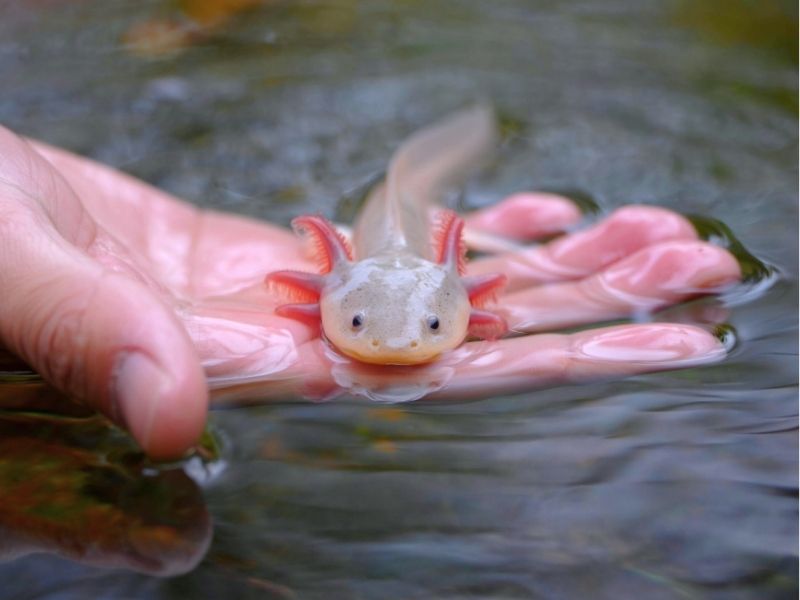
Axolotls are curious and relatively calm creatures. They’re not aggressive, but also not social. So in short — ✅ Friendly: Yes; ❌ Social: No.
They don’t really enjoy being handled, and can get stressed if they’re over-touched, which can also cause damage to their delicate skin.
In captivity, they do best living alone, with plenty of hiding places to feel secure. If you have one as a pet, it should be kept in a tank on its own.
Are axolotls good pets?

They can be — But they require specialized care, including cool water (57-68°F or 14-20°C), excellent filtration, and spacious tanks (15-20 gallons).
They aren’t particularly social, and should be in their talk alone. This mean no other species, like fish, and no other axolotls because they can be cannibals.
How long do axolotls live?
With proper upkeep and care, axolotls pets in captivity can live 10-15 years. Their lifespan in the wild is much shorter, at just 5-10 years.
However, wild axolotls are less studied than captive axolotls, so that number may prove incorrect one day after more studies are conducted in the wild.
What do axolotls eat?

The require a protein-heavy diet of insects, insect larvae, worms, slugs, snails, small fish, other salamanders, tadpoles, and they may even eat other axolotls.
As pets, you can feed your captive axolotl things like worms, daphnia and fresh or freeze-dried brine shrimp (ideally rehydrated before consumption).
Can axolotls live with fish in their tank?
No — Fish may nip at their delicate gills and eggs, and axolotls may prey on small fish. Simply put, axolotols are not social animals.
Can axolotls regenerate organs?

Yes — Incredibly, they have regeneration powers of their limbs, spinal cord, heart, and parts of their brain. This occurs through scarless healing.
Though the process is still being studied as to how they do so, axolotl organ regeneration is possibly guided by gene regulation and epigenetics.
Why are axolotls endangered?

Their main threats include habitat degradation, polluted waterways, invasive species, and urban development in Xochimilco.
While the canals of Xochimilco are a UNESCO World Heritage Site, development in the surrounding borough of Xochimilco has caused pollution issues.
What are some axolotl nicknames?
Their scientific name is Ambystoma mexicanum, but axolotls also go by several names and nicknames.
- Mexican salamanders
- Mexican walking fish
- Water dragons
- Water dogs
My Final Thoughts on the Mexican Axolotl

The axolotl is more than just a quirky salamander — it’s a living relic embodying Mexican culture and ecological resilience.
With revolutionary conservation strides, particularly captive breeding, artificial wetlands, and re-wilding trials, hope blooms anew.
However, their ultimate success will rely on restoring Xochimilco’s fragile waterways and nurturing community support.
By visiting responsibly, donating to conservation efforts, and spreading awareness, each of us can help ensure that this “water monster” continues to enchant and inspire for generations to come.