
16 Day of the Dead Dishes So Good, You’ll Want to Celebrate All Year


You’ve landed on the right article because I have been living in Mexico since 2018, and I will tell you all about the best Day of the Dead foods and drinks I’ve enjoyed while traveling the country.
This list is the most comprehensive list of traditional Day of the Dead foods you’ll find in Mexico — and also delicious food for Day of the Dead from other countries.
Disclosure: This article may contain affiliate links, meaning when you make a purchase, I earn a small commission. Affiliate links cost you nothing to use, and help keep my content free. It’s a win-win for us both. For more info, see the Disclosure Policy.
1. Pan de Muerto: The Day of the Dead Bread

Pan de muerto (bread of the dead) is a bread roll or pastry traditionally made from about mid-September to mid-November for the Day of the Dead.
It is known as the most famous food in Mexico for the Day of the Dead, and most peoples’ favorite food associated with the holiday.
The pan de muerto recipe and preparation can vary depending on where you are in Mexico.
In many parts of Mexico, the pan de muerto dough has a cross shape on the top of the roll, and it’s topped with sugar — similar to a hot cross bun.
🥖 Different types of pan de muerto in mexico

Depending on where you are, the pan de muerto will look different. There are several types of pan de muerto in Mexico.
In Oaxaca, unlike many other places in the rest of Mexico, there’s a small candy face in the bread’s center. This is said to represent a departed soul.
During the festivities for Day of the Dead in Oaxaca, you’ll see street vendors selling this type of pan de muerto.
Since this type isn’t very sweet, you’ll find that many people enjoy their Oaxaca pan de muerto dipped in a cup of hot chocolate, one of the most delicious Mexican drinks.
2. Tamales

For savory El Dia de los Muertos foods, opt for tamales.
A tamal (spelled as tamale in English) is a traditional Mexican dish often served by street vendors. It is also a staple at Day of the Dead Mexico gatherings and at many Mexican holidays.
Tamales are a pre-hispanic food made from masa, which is the same maize dough (corn dough) used to make corn tortillas.
The masa mixture is then wrapped in a corn husk or banana leaf, and steamed — and the leaf can then act as a plate for eating the tamales.
Tamales are the ultimate Mexican comfort food and come in a wide variety of flavors and can be filled with meats, cheeses or vegetables. There are also sweet tamales, called tamales dulces.
🤔 Why are tamales eaten on the Day of the Dead?
While they’re one of the most prominent holiday foods in Mexico, it seems no one knows for sure — other than to say tamales have been around for so long that they’re now just part of many Mexican holiday meals.
One of the most important cultural foods in Mexico, you will also find tamales on tables during Mexican Christmas celebrations and on the Día de la Candelaria holiday on February 2nd.
3. Pib (Mucbipollo or Mukibil)
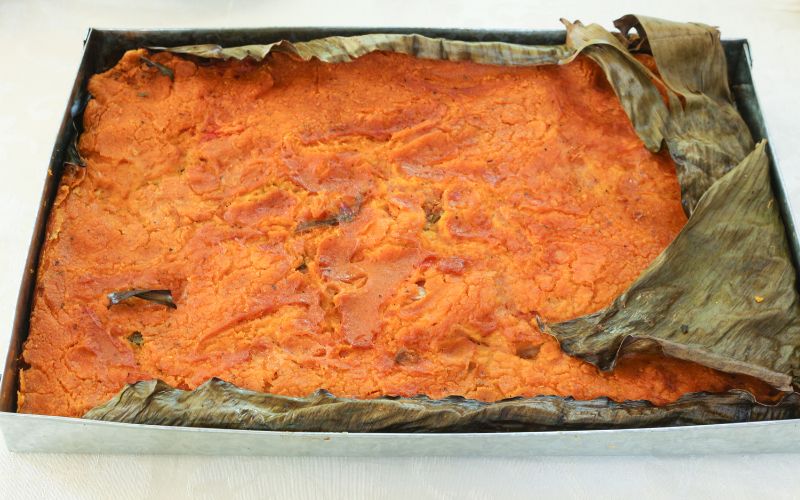
Day of the Dead food traditions vary in different parts of Mexico, and this one something you will only find in Mexico’s Yucatan Peninsula.
If you’re traveling to Yucatan during Hanal Pixan, the Mayan Day of the Dead holiday, don’t pass up the chance to try pib (AKA mucbipollo, or chicken mukibil).
Though it is made of masa, the same as a standard tamale, this Mexico holiday food is a crispy, baked tamale that looks more like a casserole than a tamale.
Yucatecan pib is a locals’ favorite — and something you’ll rarely (if ever) see outside of Yucatan Peninsula.
It is only made and sold from about mid-October to early-November to coincide with the Día de Muertos holiday, so don’t miss the chance to try this special occasions food if you see it.
4. Day of the Dead Sugar Skulls (Calaveras de Azucar)

Among the most common and most festive Day of the Dead traditional food offerings, the calaveras de azúcar, or Day of the Dead sugar skull, has become one of the icons of the entire holiday.
Ironically enough, these confectionery treats don’t have Mexican or even pre-Hispanic roots; they come from Europe when Italian Catholic missionaries brought sugar art to Mexico in the 1600s.
Unlike Europe, Mexico is abundant in sugar and sugarcane, so it became a natural place for these molded sugar figures to take root and form their own traditions.
Nowadays, they are the most popular Day of the Dead candy, and also, the most beloved Mexican halloween food because you’ll definitely see them at American-style Halloween parties in Mexico.
5. Black Mole (Mole Negro)

Not only is Mexican mole (pronounced moe-lay) the National Dish of Mexico, it’s also an important and popular food for Dia de los Muertos.
One of the best things to eat in Mexico, you’ll find mole both during Day of the Dead, and all year-long.
Mole is one of the most traditional foods from Oaxaca Mexico, but you can find it in other parts of the country as well, like Puebla Mexico. In this state, you have to try their famous mole poblano.
There are actually seven moles of Oaxaca: mole negro, mole poblano, mole verde, mole amarillo, mole coloradito, mole manchamantel and mole chichilo.
For Day of the Dead, mole negro (black mole) is the one you’ll want to try. It gets its black color from combining Oaxacan chocolate and roasted chili peppers, creating a sweet and savory flavor combo.
6. Enmoladas & Enfrijoladas

You don’t need to have visited Mexico to have heard of an enchilada — which are tortillas that are rolled like a cigar, often stuffed with meat, cheese or veggies, and then covered in salsa.
However, have you heard of the enchilada’s lesser-known siblings: enmoladas and enfrijoladas?! Popular Dia de los Muertos foods, you can also enjoy them year-round, especially at breakfast time.
🍽 Enmoladas
Like enchiladas, the enmolada dish is made with rolled corn tortillas, sometimes stuffed, sometimes not, that are smothered in mole instead of salsa — hence the “mol” in the name enmoladas.
There are these 7 moles of Oaxaca, but enmoladas are usually served with mole negro, mole poblano or mole coloradito.
Traditional Mexican enmoladas are also often served with queso fresco (fresh cheese) on top, as well as crema (sour cream) and sliced onion. These additions help cut through that rich mole sauce.
🫘 Enfrijoladas
Another popular variation is enfrijoladas. The word frijol means “bean” in Spanish, and as the name might have cued you into, these enchiladas are covered with a bean puree instead of salsa or mole.
For those who don’t want the richness and sweetness of mole negro enmoladas, make sure to add enfrijoladas to your list of great Day of the Dead food ideas.
If it’s easy Day of the Dead food recipes you want, this one fits the bill.
7. Pozole Rojo (Red Pozole Soup)

Like tamales, pozole (pronounced po-zo-lay) is a staple during many Mexican holiday meals, so it’s no surprise that it’s also a popular Day of the Dead Mexico food during this holiday as well.
Traditional Mexican pozole is made with hominy and meat, and cooked in broth. Then, plenty of spices are added in, such as garlic, cumin, chili powder, and more.
Pozole has a spicy, rich taste to it, and can even be made vegetarian with beans instead of meat.
You can garnish your pozole with different things, including diced white onion, lime juice, avocado, shredded lettuce, radishes, chili powder and dried oregano. It is often served with tostadas on the side.
There are three different types of pozole, though pozole rojo is the most common during Day of the Dead, but here is a brief explanation of them all:
- Pozole blanco (White pozole): This is the basic broth which doesn’t have any added green or red chilis
- Pozole verde (Green pozole): Made by adding tomatillos (green tomatoes) and green chilis to the pozole blanco broth
- Pozole rojo (Red pozole): Made by adding red chilis, like chili ancho and chili piquín, to the pozole blanco broth
The stew is pre-colonial, and dates all the way back to the 1300s, and has Aztec origins.
Today, pozole is popular all throughout Mexico, and is eaten as a regular dish, but also on holidays as a festive meal. 🎄 Check out these other Mexican Christmas and holiday foods!
8. Chalupas
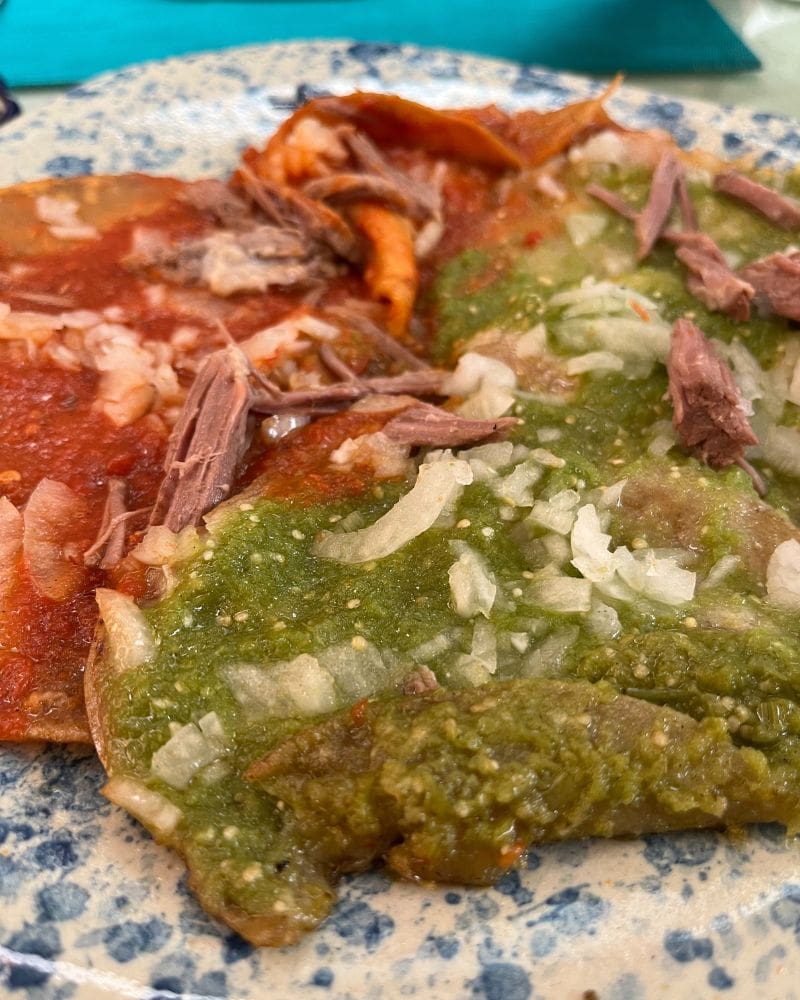
Right off the bat: These are not the same as Taco Bell chalupas!
A traditional food from Mexico that’s most commonly found in Puebla State, but you can find them with different preparations in different places.
A beloved Puebla Mexico street food, the chalupas you’ll find here are cooked on a comal and made with thin corn tortillas that get topped with salsas (usually red and green), a bit of shredded pork and cheese.
Like many things on this list, it’s impossible to say why these rank among the popular Dia de los Muertos food traditions, but nowadays you’ll find traditional Mexican chalupas on ofrendas (altars) and tables alike.
9. Sopa Azteca (Tortilla Soup)
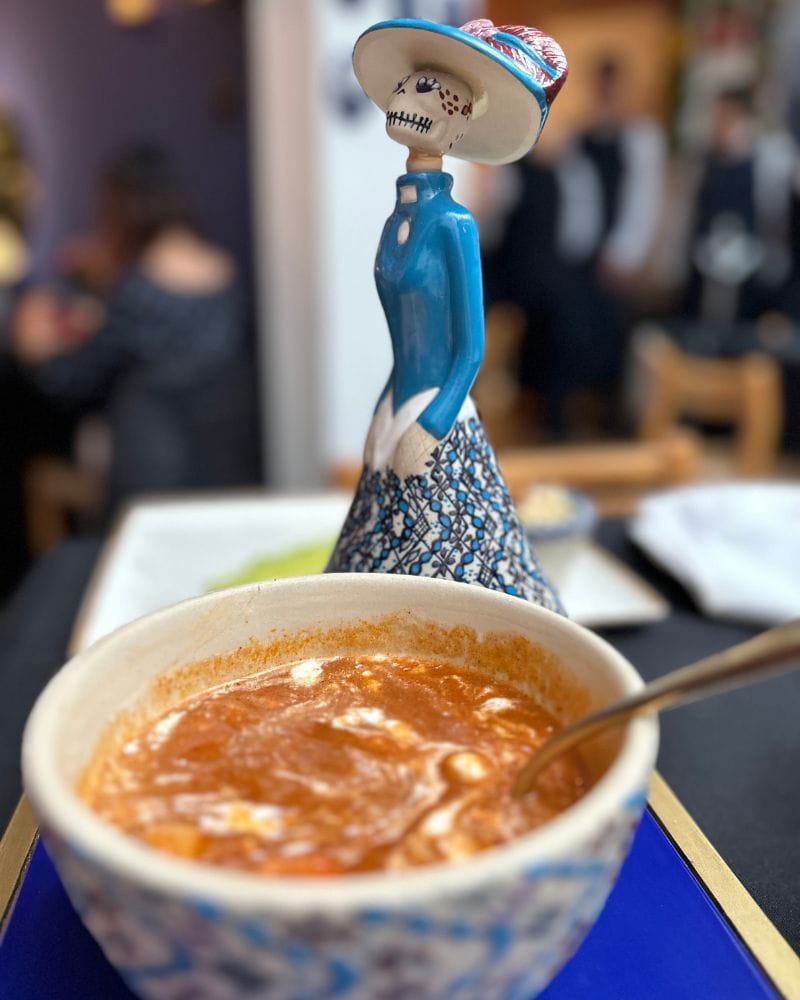
No list of the Top Day of the Dead food and drink staples is complete without talking about sopa Azteca, also known as Sopa de tortilla or “tortilla soup.”
Mexico City, formerly called Tenochtitlan, was the seat of the Aztec Empire — and this dish is said to originate in Mexico City. It has deep Aztec roots, hence the name sopa azteca.
Sopa azteca soup is made with chicken broth and many Mexican staple ingredients like corn, beans, chilis, tomatoes, tortillas, garlic, onion and spices like Mexican oregano.
It is served with toppings that include avocado, crema (sour cream), chunks of a soft cheese called queso panela, or queso oaxaca (Oaxaca cheese), chicharrón (fried pork skin) and strips of fried tortillas.
The end result is a dish not only rich in flavor, but one that also provides a textural experience.
In sopa azteca, the gooeyness of the cheese as it melts in the hot broth, juxtaposed with the crunchiness of the tortilla strips, makes for a delicious combo and an unforgettable Day of Dead food meal.
10. Sopes
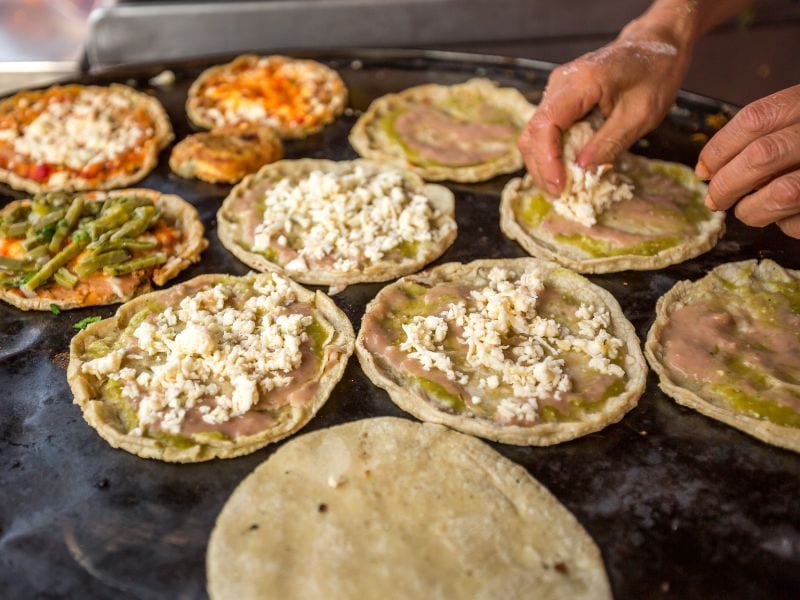
Not only is this food eaten on the Day of the Dead, but you will find it all year long when traveling to Mexico.
Mexican sopes are made with smaller-sized, thick tortillas that have a bit of a tall edge to them, which holds all the fillings inside. They are usually topped with meat, beans, veggies and cheese, but that can vary.
Personally, sopes are one of my favorite traditional Mexican foods, so I look forward to being in Mexico in October and November when they become more abundant than usual.
11. Chapulines (Mexican Grasshoppers)

Looking for snack ideas to add to your must-try Day of the Dead food and drink list?!
If you have adventurous foodie friends, or have friends you want to freak out by having edible bugs in your home, these make for great Day of the Dead party food ideas.
You can actually buy chapulines from Amazon so you don’t have to travel all the way to Mexico to get them.
🦗 What are chapulines?
If you are strolling the streets of Mexico City for Day of the Dead or Oaxaca City, you might encounter a peculiar-looking street food — chapulines, or grasshoppers in English.
These bite-sized snacks are toasted on a cooking comal, a type of flat griddle popular in Mexico, and then seasoned with garlic, lime juice, salt and chilies.
Though not a food in Mexico most will gravitate towards, after some pepople try chapulines for the firs time, they say these actually taste like salt and vinegar chips.
However, compared to chips, chapulines have a lot more protein so many consider them a healthier snack.
In terms of texture, they are a bit crunchy on the outside and soft on the inside.
Though you can find chapuline grasshoppers throughout Mexico (and even some places in Guatemala), they are very abundant in Central Mexico, especially Oaxaca Mexico.
12. Conchas

A great addition to any Day of the Dead foods list, and a perennial crowd favorite for those who have a sweet tooth, the concha is among the most beloved Mexican pastries.
There are a lot of variations of sweet breads, or pan dulce in Mexico. Of them all, there is none more popular than the concha, meaning “shell.”
This traditional breakfast pastry gets its name from a shell-shaped pattern made with sugar that’s on top of the bread.
Conchas are one of those Mexico food items that have made their way across the border into the United States.
In big cities and small towns that have a large Mexican and Mexican-American population, like LA, San Francisco, Texas and New York, you can often find conchas at panaderías (bakeries) and in restaurants.
An especially popular Dias de los Muertos food, you’ll likely find conchas in abundance from mid-October and early-November.
13. Caramel Flan

One of the foods Day of the Dead celebrations in Mexico are known to always have is flan. How this became so popular during the holiday, no one knows for sure, as flan isn’t exactly a Mexican food.
Flan is consumed in a few European countries, like France, where it’s called crème caramel and Spain. In fact, flan was brought to Mexico by the Spanish.
It is a simple dish, with only a few ingredients — egg, milk and sugar — though it requires some technique to perfect.
Essentially a custard dessert topped with caramel sauce, there are a few variations of traditional flan in Mexico, including jericalla and flan de cajeta, which replaces the standard caramel with cajeta.
However, for Mexico Day of the Dead parties, it’s all about the standard caramel flan.
14. Candied Pumpkin (Calabaza en Tacha)
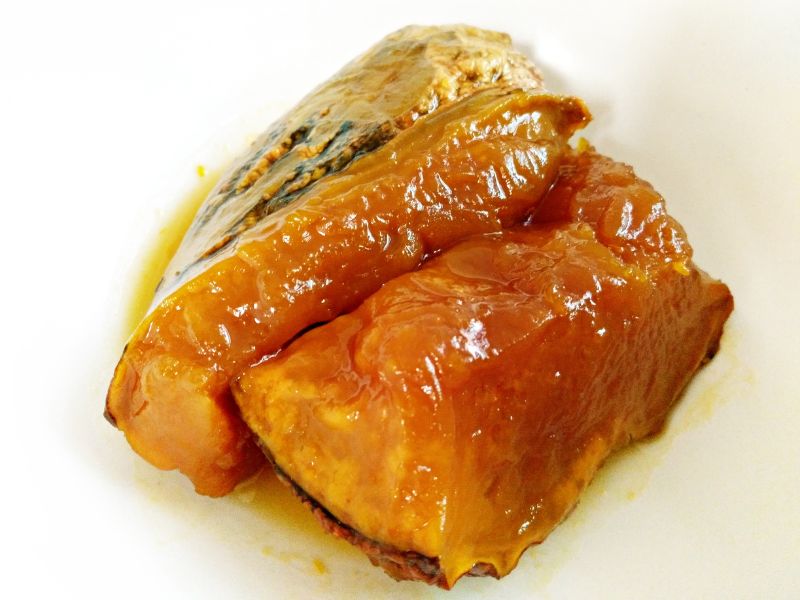
In many places throughout the world, the pumpkin is one of the most recognizable foods associated with the autumn season.
Day of the Dead is no different, and calabaza en tacha is a must-try for pumpkin lovers.
Calabaza en tacha, which translates to “pumpkin in molasses” or “pumpkin in syrup,” is a traditional Day of the Dead dessert treat you’ll find throughout Mexico.
Different regions in Mexico have a special way to make their calabaza en tacha variation — but essentially, it’s pumpkin cooked in piloncillo syrup (cane sugar syrup), cinnamon, cloves, star anise, and more.
This is one of those Day of the Dead foods you must try — if you can get your hands on it!
If not, this calabaza en tacha recipe from the Mexico In My Kitchen food blog is a great option.
15. Amaranth Candy (Alegria de Amaranto)

Amaranth (amaranto) is a grain that’s very popular in Mexico. It is found in everything from smoothies and yogurt at breakfast, to candy.
Of the most popular Mexican amaranto candies, there’s also alegria de amaranto, meaning “joy of amaranth” — which needs to be on your must-try Day of the Dead food list.
During the holiday, you’ll see Day of the Dead amaranto candy skulls sold by street vendors. You can eat them, or use them to decorate an ofrenda (Día de los Muertos altar) because they don’t spoil quickly.
Alegria candy is made with, of course, amaranto, but also Mexican peanuts, walnuts, pepitas (pumpkin seeds), raisins, and other dried fruits.
The ingredients are toasted and combined with honey or piloncillo (raw cane sugar), and finally, packaged for sale.
Alegria de amaranto is closely associated with the town of Santiago Tulyehualco in Xochimilco Mexico City, where it has been made since the 16th Century.
16. Your ancestors’ favorite food
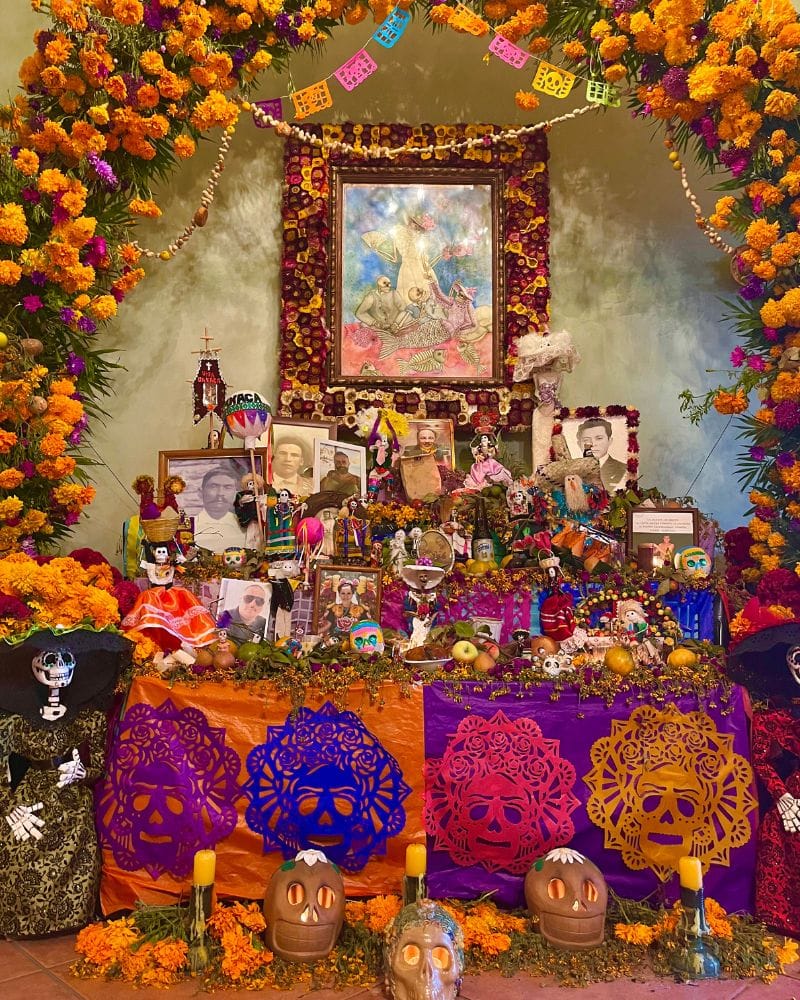
While there are traditional Day of the Dead foods in Mexico (and other countries) you might find at group gatherings, it’s important to keep in mind the meaning of the holiday: Honoring your departed loved ones.
For this, many people will construct an ofrenda, or altar, that you’ll have in your home. On this altar, you can incorporate things your loved ones enjoyed the most, including their favorite foods and drinks.
You can also make their favorite dishes and drinks, and enjoy a dinner indulging in what they most loved to indulge in while Earth-side.
In short: The Day of the Dead food meanings and traditions that should be most important are the ones you create yourself to honor your departed loved ones.
Traditional Day of the Dead Food Across Latin America
While Mexico is the country most associated with Day of the Dead, there are a few countries that also celebrate this holiday, like these:
- In the towns of Sumpango and Santiago Sacatepéquez, Guatemala, you’ll find a unique Day of the Dead celebration called the Festival de Barriletes Gigantes (Giant Kite Festival).
- The Aymara people in the Bolivian Andes have the Day of Skulls.
This is just a few examples, as there are Day of the Dead celebrations across Latin America. At these, the food and traditions are different, but the holidays themselves do all center around death.
Final Thoughts: Best Day of the Dead Foods & Drinks
One of the most important Mexican holidays, Día de Muertos is as much a celebration of life as it is a celebration of death and the departed.
For many Mexicans, death is a somber affair, but also a natural part of life — so it should be celebrated as such.
While people do also mourn their departed, the Day of the Dead holiday is a time to remember them fondly with food, drinks, in-home parties and city-wide celebrations.
As someone who has lived in Mexico since 2018, and celebrated Day of the Dead in several cities throughout the country, it has been an honor to experience death in such a joyful way.
If you’re planning to visit Mexico during Day of the Dead, there are amazing celebrations in Mexico City, Oaxaca City, Morelia, Merida, Guanajuato City, and the small town of Patzcuaro, Michoacan.
Additional Day of the Dead Blogs
I hope this article helped you understand food and Day of the Dead drinks. For additional info on this holiday and Day of the Dead fun facts, check out these related articles:
- Attending Day of the Dead in Oaxaca Mexico
- Ultimate Guide to Day of the Dead in Mexico City
- Mexico City Day of the Dead Parade Guide
- Hanal Pixan: The Mayan Day of the Dead Festival
- 17 Best Day of the Dead Celebrations in Mexico
- Day of the Dead in Mexico: Ultimate Holiday Guide
- 13 Iconic Day of the Dead Symbols & Customs