
25 Beautiful Mexican Flowers You’ll Want in Your Garden (#13 Blooms for Just One Night)

Looking for the most beautiful Mexican flowers?
I’ve called Mexico home since 2018, and the flowers here never stop amazing me.
From bright orange cempasúchil to the dahlia (Mexico’s national flower), many of the world’s favorite garden flowers actually come from Mexico.
Here are 25 Mexican flowers to know, plus where to see them on your trip.
The 25 Most Beautiful Mexican Flowers
1. Cempasúchil (Mexican Marigold)

- 🌸 Native to: Mexico and Central America
- 🗓️ Blooms: Late summer to fall (peak in late October)
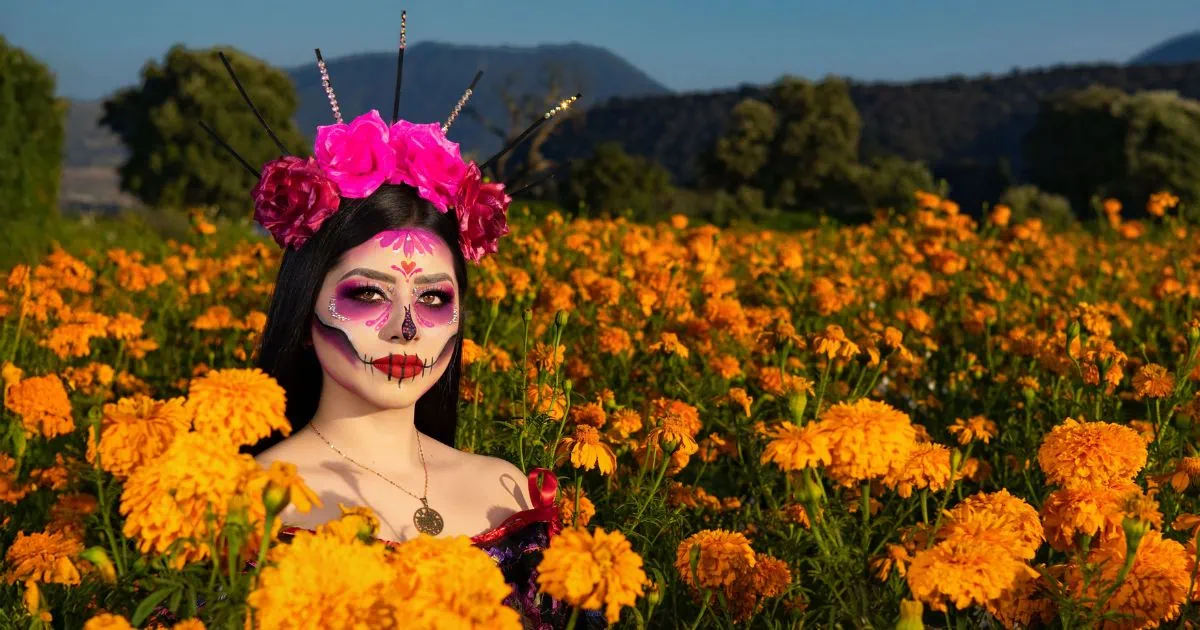
The cempasúchil is a big, pom-pom-shaped marigold in bright orange and golden yellow.
Its name comes from the Nahuatl word cempōhualxōchitl, often translated as “twenty flowers” for its many petals.
During Day of the Dead, families use the petals to make paths that guide the souls of loved ones home to their altars.
I’ve celebrated Day of the Dead in Mexico every year since 2018, and the cempasúchil is everywhere.
It’s one of the most important Day of the Dead symbols, and you’ll see it on every ofrenda.
Learn more in my guide to the marigolds used for Day of the Dead.
2. Dahlia

- 🌸 Native to: Mexico’s central highlands
- 🗓️ Blooms: Summer to fall
The dahlia is the national flower of Mexico, declared in 1963.
The Aztecs grew dahlias long before the Spanish arrived, and they called them acocoxóchitl.
Today there are thousands of dahlia varieties, from tiny pom-poms to blooms as big as dinner plates.
Look for them in parks, gardens and flower markets in central Mexico, especially in late summer.
3. Poinsettia (Nochebuena)

- 🌸 Native to: Mexico’s Pacific slopes, including Guerrero
- 🗓️ Blooms: Late fall to winter
The poinsettia is native to Mexico, where it’s called the nochebuena (Christmas Eve flower).
The Aztecs called it cuetlaxóchitl and used it to make a red dye.
It’s named after Joel Poinsett, the first American minister to Mexico, who sent plants home to South Carolina in the 1820s.
Those bright red “petals” are actually leaves called bracts.
Every Christmas season, Mexico City lines Avenida Reforma with huge displays of red nochebuenas.
See them for yourself on a holiday trip with my guide to Christmas in Mexico City.
4. Tuberose (Nardo)
- 🌸 Native to: Mexico
- 🗓️ Blooms: Summer to early fall
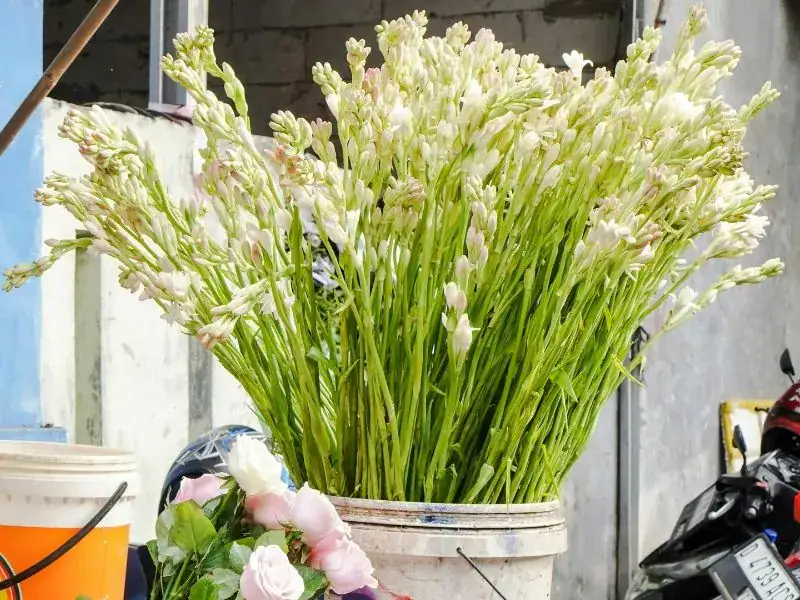
The tuberose is a tall stem of waxy white flowers with one of the strongest scents in the plant world.
It’s native to Mexico, where the Aztecs called it omixóchitl (bone flower).
Today, tuberose oil is a prized ingredient in perfumes.
In Mexico, look for bunches of nardos at flower markets like Mexico City’s Mercado Jamaica.
5. Tiger Flower (Oceloxóchitl)

- 🌸 Native to: Mexico and Central America
- 🗓️ Blooms: Summer
The tiger flower has three big petals around a spotted center that looks like a jaguar’s coat.
Its Nahuatl name, oceloxóchitl, means “jaguar flower.”
Each bloom lasts about one day, but the plant keeps opening new flowers through the summer.
The Aztecs also roasted and ate its bulbs.
6. Aztec Lily

- 🌸 Native to: Mexico and Guatemala
- 🗓️ Blooms: Spring to early summer
The Aztec lily (Sprekelia formosissima) has deep red petals shaped a bit like a fleur-de-lis.
It’s also called the Jacobean lily or St. James lily.
In the wild, it grows on rocky slopes in Mexico’s highlands.
It’s a garden favorite because one bulb gives you a bloom that looks almost like an orchid.
7. Mexican Sunflower

- 🌸 Native to: Mexico and Central America
- 🗓️ Blooms: Summer to fall
The Mexican sunflower (Tithonia rotundifolia) has bright orange petals around a yellow center.
It can grow taller than 6 feet (2 m) in one season.
Butterflies love it, including monarchs, so it’s a favorite in pollinator gardens.
It’s easy to grow from seed, which makes it a great choice for beginners.
8. Cosmos

- 🌸 Native to: Mexico
- 🗓️ Blooms: Late summer to fall
Cosmos have simple, daisy-like flowers in pink, white and magenta on tall, feathery stems.
They’re native to Mexico, where they grow wild in fields and along roads in the central highlands.
Spanish priests in Mexico gave them the name cosmos, from the Greek word for order and harmony.
In early fall, fields in central Mexico turn pink with wild cosmos, called mirasol.
9. Chocolate Cosmos

- 🌸 Native to: Mexico
- 🗓️ Blooms: Summer to fall
The chocolate cosmos has deep maroon-brown flowers that really do smell like chocolate.
It’s native to Mexico but is now considered extinct in the wild.
Most garden plants come from a single clone that has been grown from cuttings for more than a century.
Plant one near a patio, and you’ll catch the scent on warm afternoons.
10. Zinnia

- 🌸 Native to: Mexico
- 🗓️ Blooms: Summer to fall
Zinnias are bright, sturdy flowers in almost every color except blue.
Most zinnia species are native to Mexico, including the common garden zinnia.
The Spanish reportedly found the wild flowers so plain that they called them mal de ojos (sickness of the eyes).
Breeders later turned them into one of the easiest, most cheerful flowers you can grow.
11. Plumeria (Frangipani)

- 🌸 Native to: Mexico, Central America and the Caribbean
- 🗓️ Blooms: Spring to fall
Plumeria has thick, waxy flowers in white, yellow, pink and red, with a sweet tropical scent.
Many people think of it as a Hawaiian flower, but it’s native to Mexico, Central America and the Caribbean.
The Aztecs called it cacaloxóchitl, and today many Mexicans know it as flor de mayo.
Look for plumeria trees in the Yucatán Peninsula and along the Pacific coast.
12. Vanilla Orchid

- 🌸 Native to: Mexico and Central America
- 🗓️ Blooms: Spring
Vanilla comes from the pale yellow-green flowers of the vanilla orchid, which is native to Mexico.
The Totonac people of Veracruz grew vanilla long before the Aztecs, who later used it to flavor chocolate.
Papantla, Veracruz, is still famous for its vanilla, and it calls itself “the city that perfumed the world.”
Each flower opens for just one day, so growers outside Mexico pollinate them by hand.
13. Queen of the Night

- 🌸 Native to: Southern Mexico, Central America and South America
- 🗓️ Blooms: Summer nights
The queen of the night (Epiphyllum oxypetalum) is a cactus with huge, fragrant white flowers.
Each flower opens after dark and wilts by morning, so it blooms for just one night.
In Mexico, it’s often called the reina de la noche.
The flowers can be about 12 inches (30 cm) long, and their perfume fills a whole patio.
14. Mexican Bush Sage

- 🌸 Native to: Central and eastern Mexico
- 🗓️ Blooms: Late summer to fall
Mexican bush sage (Salvia leucantha) has long, velvety spikes of purple and white flowers.
It grows wild in the pine and oak forests of central and eastern Mexico.
Hummingbirds and butterflies love it, and it’s easy to grow in warm, dry gardens.
15. Mexican Hat

- 🌸 Native to: Northern Mexico, the United States and Canada
- 🗓️ Blooms: Summer
The Mexican hat gets its name from its tall center cone and drooping petals, which look like a sombrero.
The petals are red with yellow edges, or sometimes all yellow.
It’s a favorite in drought-friendly gardens because it needs very little water.
16. Mexican Petunia

- 🌸 Native to: Mexico, the Caribbean and South America
- 🗓️ Blooms: Spring to fall
The Mexican petunia (Ruellia simplex) has purple, trumpet-shaped flowers that last about a day each.
Despite its name, it isn’t a true petunia.
It spreads fast and is considered invasive in Florida, so choose a sterile variety if you plant it there.
17. Pink Evening Primrose

- 🌸 Native to: Northeastern Mexico and the south-central United States
- 🗓️ Blooms: Spring to early summer
The pink evening primrose (Oenothera speciosa) has soft pink, cup-shaped flowers.
Despite its name, many of these plants open their flowers in the morning.
It’s a tough wildflower that loves heat and dry soil, and it can spread to cover whole fields.
In spring, it carpets roadsides from northern Mexico to Texas.
18. Mexican Orange Blossom

- 🌸 Native to: Mexico
- 🗓️ Blooms: Spring, sometimes again in fall
The Mexican orange blossom (Choisya ternata) is an evergreen shrub with clusters of small, white, star-shaped flowers.
It’s a cousin of citrus, which explains its sweet orange-blossom scent.
Its glossy leaves smell spicy when you crush them.
It comes from Mexico, and it’s now a popular hedge plant in gardens around the world.
19. Mexican Honeysuckle (Muicle)

- 🌸 Native to: Mexico and Central America
- 🗓️ Blooms: Most of the year in warm areas
Mexican honeysuckle (Justicia spicigera) has bright orange, tube-shaped flowers that hummingbirds love.
It isn’t a true honeysuckle, but the flowers look a lot like one.
In Mexico, it’s called muicle, and it has been used in traditional remedies since Aztec times.
Its leaves can also be used to make a natural blue dye.
20. Firebush

- 🌸 Native to: Mexico, Florida, Central America and South America
- 🗓️ Blooms: Spring to fall
Firebush (Hamelia patens) has clusters of red-orange, tube-shaped flowers.
Hummingbirds and butterflies flock to it, and birds eat its small dark berries.
It’s a traditional medicinal plant in the Yucatán and Central America.
It thrives in heat and humidity, so it’s common in gardens along the Yucatán coast.
21. Agave Flower

- 🌸 Native to: Mexico and the southwestern United States
- 🗓️ Blooms: Once in its lifetime, after many years
The agave grows for years before sending up one huge flower stalk, which can be taller than a house.
Most agaves bloom only once, and then the plant dies.
Agaves give Mexico its most famous spirits: tequila comes from blue agave, and mezcal can be made from many types.
On farms that grow agave for tequila, workers cut off the flower stalk so the plant keeps its sugars in its heart.
Learn more in my guide to the best Mexican drinks.
22. Yucca Flower (Flor de Izote)

- 🌸 Native to: Mexico and Central America
- 🗓️ Blooms: Spring
The yucca plant sends up tall clusters of creamy white, bell-shaped flowers called flor de izote.
In parts of Mexico, people eat the flowers, often cooked with eggs or tomatoes.
The flowers can taste a little bitter, so cooks usually remove the centers first.
Flor de izote is also the national flower of El Salvador.
23. Prickly Pear Cactus Flower

- 🌸 Native to: Mexico and the Americas
- 🗓️ Blooms: Spring
The nopal, or prickly pear cactus, has bright yellow, orange or pink flowers on the edges of its paddles.
The flowers later turn into sweet fruit called tunas.
The nopal is on Mexico’s flag, which shows an eagle perched on a cactus, eating a snake.
According to Aztec legend, that sign told them where to build Tenochtitlan, today’s Mexico City.
24. Jacaranda
- 🌸 Native to: South America (but everywhere in Mexico)
- 🗓️ Blooms: Late winter to spring
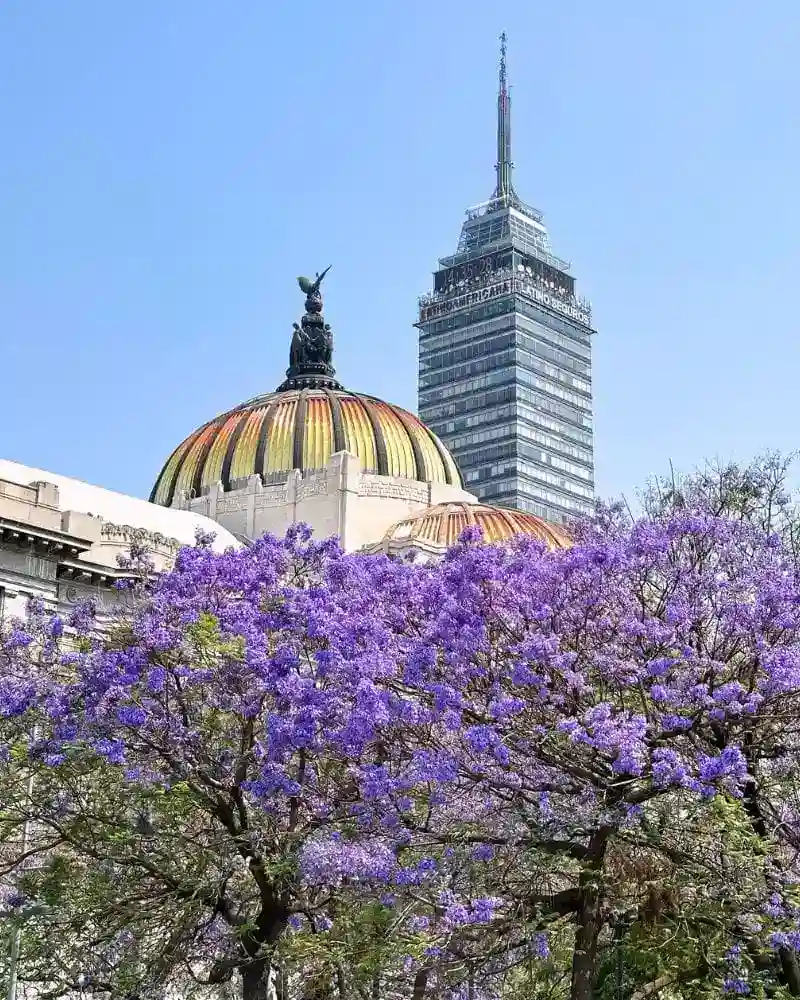
Every spring, jacaranda trees turn Mexico City’s streets purple.
They aren’t native to Mexico, but they’re so common that many people think of them as a Mexico City symbol.
Japanese gardener Tatsugoro Matsumoto is often credited with bringing them to Mexico City in the early 1900s.
For the best views, walk along Paseo de la Reforma or through Roma and Condesa in March.
25. Bougainvillea
- 🌸 Native to: South America (but everywhere in Mexico)
- 🗓️ Blooms: Most of the year in warm areas
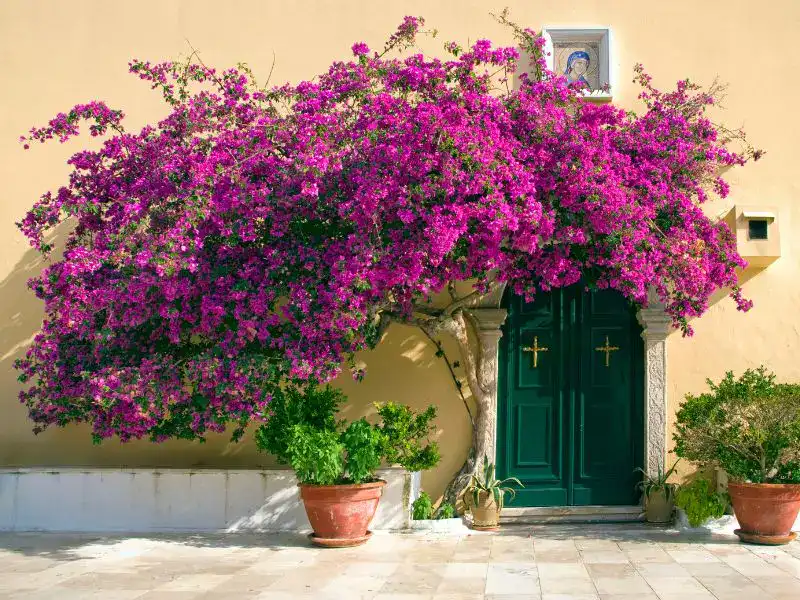
Bougainvillea spills over walls and doorways all over Mexico, in hot pink, purple, orange and white.
In Mexico, it’s called bugambilia.
Like the poinsettia, its bright “petals” are actually bracts around tiny white flowers.
It isn’t native to Mexico, but it’s everywhere in colonial towns like San Miguel de Allende and Oaxaca.
If you love Mexico’s nature, don’t miss my list of native Mexican animals too.
Mexican Flowers FAQ
What is the national flower of Mexico?
The dahlia is the national flower of Mexico.
It was named the national flower in 1963, and it’s native to Mexico’s central highlands.
What flower is used for Day of the Dead?
The cempasúchil (Mexican marigold) is the main Day of the Dead flower.
Families use its bright orange petals to decorate altars and make paths for the souls of loved ones.
Is the poinsettia from Mexico?
Yes. The poinsettia is native to Mexico, where it’s called the nochebuena.
Joel Poinsett, the first American minister to Mexico, brought it to the United States in the 1820s.
What flowers are native to Mexico?
Flowers native to Mexico include the cempasúchil, dahlia, poinsettia, tuberose, tiger flower, cosmos, chocolate cosmos, zinnia and vanilla orchid.
Which Mexican flower blooms only at night?
The queen of the night (reina de la noche) is the Mexican flower best known for blooming at night.
Each flower opens after dark and wilts by morning.
Get My FREE Guide: 5 Easy Ways to Save Money in Mexico
Insider tips from someone who’s lived in Mexico since 2018.
