
20 Traditional Mexican Games Kids and Adults Love to Play (#20 Is Over 3,000 Years Old)

Looking for traditional Mexican games?
I’ve called Mexico home since 2018, and I’ve played la lotería and dominoes more times than I can count — but that’s just the tip of the games iceberg.
Mexican kids that grow up on these games, from schoolyard toys to party and wedding games, become the adults that still enjoy them.
Here are 20 games played in Mexico, how each one works, and where you’ll see it.

20 Most Popular Traditional Mexican Games
1. Balero (Cup-and-Ball)

- 🎲 What it is: A wooden cup-and-ball toy
- 👧 Who plays: Kids and adults
- 📍 Where you’ll see it: Artisan markets and toy stalls all over Mexico
- 🛒 Buy it on Amazon
A balero is a wooden handle tied by a string to a barrel-shaped piece with a hole in it.
You swing the barrel up and try to land it on the stick. It takes a lot of patience and practice.
Kids compete to see who can land it the most times, sometimes all the way to 100.
México Desconocido says the toy has French roots, and some sources date it to the late 1500s.
🛒 Buy Mexican balero toys on Amazon
2. Trompo (Spinning Top)

- 🎲 What it is: A wooden spinning top with a metal tip and a string
- 👧 Who plays: Kids, and plenty of adults who still show off tricks
- 📍 Where you’ll see it: Markets, toy stalls and parks
- 🛒 Buy it on Amazon
You wrap the string tightly around the top, then throw it hard at the ground so it spins, or “dances.”
Skilled players can scoop it up and make it spin on their palm, or even on one finger.
In one popular version, players draw a circle and try to knock each other’s tops out of it.
It’s one of Mexico’s classic skill toys, made of wood or plastic.
🛒 Buy trompos (Mexican toy tops) on Amazon
3. Canicas (Marbles)

- 🎲 What it is: Small glass marbles you flick at each other
- 👧 Who plays: Mostly kids
- 📍 Where you’ll see it: Schoolyards, sidewalks and dirt patches
- 🛒 Buy it on Amazon
Marbles arrived in Mexico during the colonial period. Archaeologists even found stone, clay and glass marbles in an 18th-century Mexico City home.
In the classic game of hoyito, players dig a small hole about 10 to 16 feet (3 to 5 m) from a starting line.
You knock other players’ marbles out of the way and try to sink your own.
Kids even have names for each type, like agüitas (single-color) and ágatas (with faint colored lines inside).
🛒 Buy canicas (marbles) on Amazon
4. Pirinola (Six-Sided Top)

- 🎲 What it is: A six-sided spinning top for a betting game
- 👧 Who plays: Kids and families
- 📍 Where you’ll see it: Family gatherings and parties
- 🛒 Buy it on Amazon
Each player puts a token, like a coin or a piece of candy, into the pot, then takes turns spinning the pirinola.
Its six sides say Toma uno (take one), Toma dos (take two), Toma todo (take all), Pon uno (put one), Pon dos (put two) and Todos ponen (all put in).
Whoever lands on Toma todo takes the whole pot, which is why it’s also called toma todo.
🛒 Buy Mexican pirinolas on Amazon
5. Matatena (Jacks)

- 🎲 What it is: Jacks, played with a small rubber ball
- 👧 Who plays: Mostly kids
- 📍 Where you’ll see it: Schoolyards, sidewalks and front steps
- 🛒 Buy it on Amazon
Players scatter the jacks on the ground and toss the ball into the air. While it’s up, you grab as many jacks as you can.
Then you catch the ball, and each round you need to pick up more jacks.
The jacks were once metal and later plastic, but kids also played with beans or small stones.
It’s been a Mexican schoolyard classic since the early 1900s.
🛒 Buy matatenas (jacks toys) on Amazon
6. Yoyo

- 🎲 What it is: A wooden or plastic disc on a string
- 👧 Who plays: Kids and adults
- 📍 Where you’ll see it: Toy stalls and artisan markets
A Mexican yoyo is a wooden or plastic disc with a deep groove where the string wraps around.
You make it roll down and back up the string with a flick of your hand.
Basic tricks have fun names, like el perrito (the little dog) and el columpio (the swing).
Brightly painted wooden yoyos are a classic at Mexican artisan markets.
7. La Lotería (Mexican Bingo)
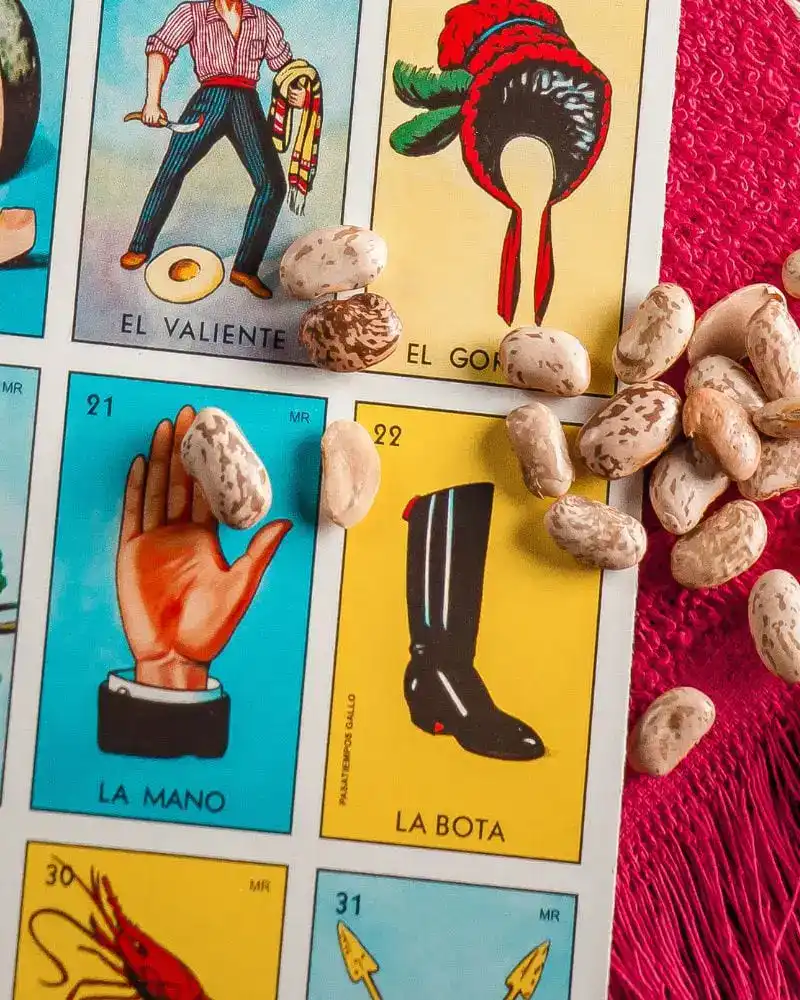
- 🎲 What it is: A bingo-style game with picture cards
- 👧 Who plays: Families, from kids to grandparents
- 📍 Where you’ll see it: Family gatherings, fairs and town festivals
- 🛒 Buy it on Amazon
I’ve played la lotería many times at parties in Mexico, and it’s always a good time.
The game is played like bingo, but with pictures instead of numbers, and the iconic artwork on the cards is beautiful.
A caller draws cards from a deck of 54 and calls out each picture, often with a funny rhyme.
Players mark their tabla, a 4×4 grid, with beans until someone completes the pattern and loudly exclaims “Lotería.”
Learn all 54 cards and what they mean in my post on the lotería cards from Mexico.
🛒 Buy the Mexican La Loteria game on Amazon
8. Piñata

- 🎲 What it is: A decorated container filled with candy that you break with a stick
- 👧 Who plays: Kids first, then everyone
- 📍 Where you’ll see it: Birthday parties and Las Posadas in December
I’ve taken my turn at the piñata at plenty of parties.
You’re blindfolded, spun around and handed a stick, while someone moves the piñata up and down with a rope.
Everyone sings while you swing, and when the song ends, it’s the next person’s turn.
Augustinian monks used the piñata to teach Christianity in Acolman, near Mexico City, in 1586.
The classic seven-pointed piñata stands for the seven deadly sins, which is why it’s a must at Las Posadas.
It’s usually stuffed with fruit and Mexican candy, so the scramble after it breaks is half the fun.
9. La Víbora de la Mar (The Sea Snake)
- 🎲 What it is: A singing chain game
- 👧 Who plays: Kids at school, and adults at weddings
- 📍 Where you’ll see it: Schoolyards, parties and Mexican weddings
Two players join hands to make an arch, and everyone else runs under it in a line while singing.
When the song ends, the arch drops and traps a player, who then picks a side.
At weddings, the bride and groom stand on chairs while the guests form a snake and try to knock them off.
Family members hold the couple up, a symbol of supporting them through life’s obstacles.
10. Doña Blanca

- 🎲 What it is: A circle song game, similar to Ring Around the Rosie
- 👧 Who plays: Young kids
- 📍 Where you’ll see it: Schoolyards and preschools
Kids hold hands in a circle around Doña Blanca, while one player, the jicotillo (bumblebee), waits outside.
The circle sings that Doña Blanca is protected by pillars of gold and silver.
The jicotillo goes around asking what each pair of joined hands is made of. When someone answers “paper,” it breaks through and chases Doña Blanca.
If Doña Blanca gets caught, she becomes the next jicotillo.
11. La Gallinita Ciega (Blind Man’s Bluff)

- 🎲 What it is: A blindfold tag game
- 👧 Who plays: Kids
- 📍 Where you’ll see it: Birthday parties and schoolyards
One player, the “little blind hen,” is blindfolded and spun around a few times. Then they try to catch the others by touch.
The other players dodge around them, often while singing a rhyme. Whoever gets caught is the next gallinita ciega.
It’s a birthday party favorite, since all you need is a blindfold. In English, it’s known as blind man’s bluff.
12. Las Escondidillas (Hide-and-Seek)

- 🎲 What it is: Mexico’s version of hide-and-seek
- 👧 Who plays: Kids
- 📍 Where you’ll see it: Homes, patios and parks
It’s the same idea as hide-and-seek, with a few local twists.
One player covers their eyes and counts while everyone else hides.
When the seeker spots someone, they race back to the counting spot and call out that player’s name.
If a hider gets back to base without being seen, they save the others, and the seeker has to count again.
13. Los Encantados (Freeze Tag)

- 🎲 What it is: Mexico’s version of freeze tag
- 👧 Who plays: Kids
- 📍 Where you’ll see it: Schoolyards and parks
Kids usually pick who’s “it” with a short counting song.
One player is “it” and chases everyone else. Anyone they tag is encantado (enchanted) and has to freeze in place.
A free teammate can touch them to break the spell. The game ends when everyone is frozen.
Some groups play it in two teams. If one whole team gets frozen, the other team wins.
14. Resorte (Chinese Jump Rope)

- 🎲 What it is: A jumping game with a long elastic band
- 👧 Who plays: Mostly girls
- 📍 Where you’ll see it: Schoolyards and sidewalks
Two players stand about 10 feet (3 m) apart with a long elastic band stretched around their ankles.
A third player jumps in, out and on the band in a set pattern, often to a song.
After each round, the band goes higher, and steps at knee height were for the experts.
If you miss, you swap places with one of the players holding the band.
15. Avión (Hopscotch)

- 🎲 What it is: Mexico’s version of hopscotch
- 👧 Who plays: Kids
- 📍 Where you’ll see it: Sidewalks, schoolyards and patios
Kids draw a chalk grid shaped like an airplane, numbered 1 to 10.
Players toss a small stone onto the grid and hop through on one or two feet without stepping on the lines.
Balance is the real challenge, since you have to hop on one foot. The name means “airplane,” after the shape of the grid.
It’s also known as rayuela in other Latin American countries.
16. El Burro (Leapfrog)

- 🎲 What it is: A leapfrog game, often with a counting chant
- 👧 Who plays: Kids and teens
- 📍 Where you’ll see it: Schoolyards and streets
It’s Mexico’s version of leapfrog.
One player bends over as the burro (donkey), and the others take turns jumping over their back.
In burro 16, players chant a count from 1 to 16, and each number comes with its own challenge.
Anyone who messes up becomes the next burro. A rougher team version, burro castigado, was a middle school classic.
17. Basta (Stop)

- 🎲 What it is: A paper-and-pencil word game
- 👧 Who plays: Kids and adults
- 📍 Where you’ll see it: Classrooms, road trips and family tables
Everyone draws columns for categories like name, animal, fruit, color and country or city.
Someone picks a letter, and everyone races to fill in each category with a word that starts with it.
The first player to finish shouts “¡Basta!” and everyone stops writing. Unique answers score 10 points, and shared answers score 5.
Teachers also use it to help kids practice reading and writing.
18. Serpientes y Escaleras (Snakes and Ladders)
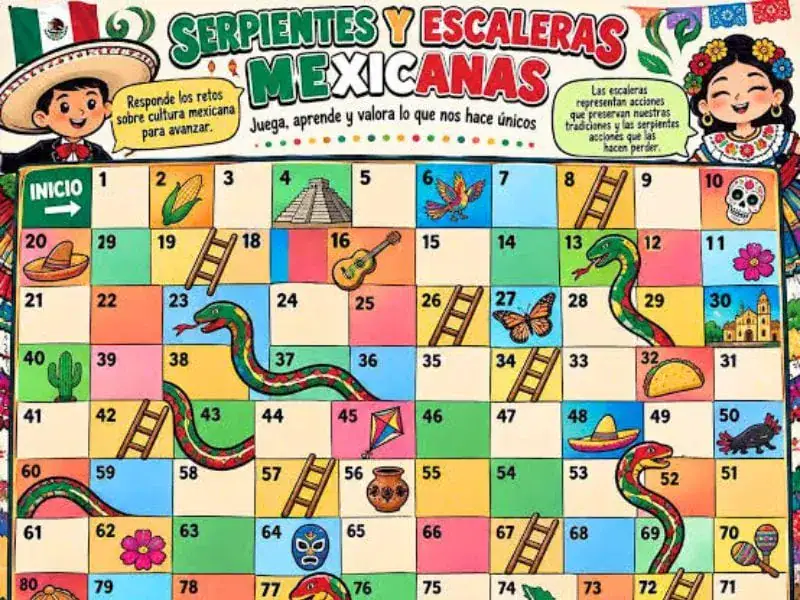
- 🎲 What it is: A dice board game
- 👧 Who plays: Families and kids
- 📍 Where you’ll see it: Homes and family game nights
- 🛒 Buy it on Amazon
Players roll a die and move up a numbered board.
Land at the bottom of a ladder and you climb up, but land on a snake’s head and you slide down.
The first one to reach the last square wins.
The game started in ancient India as Moksha Patam, a board that taught moral lessons.
In Mexico, Don Clemente, the company behind the classic lotería set, sells its own version.
🛒 Buy Serpientes y Escaleras on Amazon
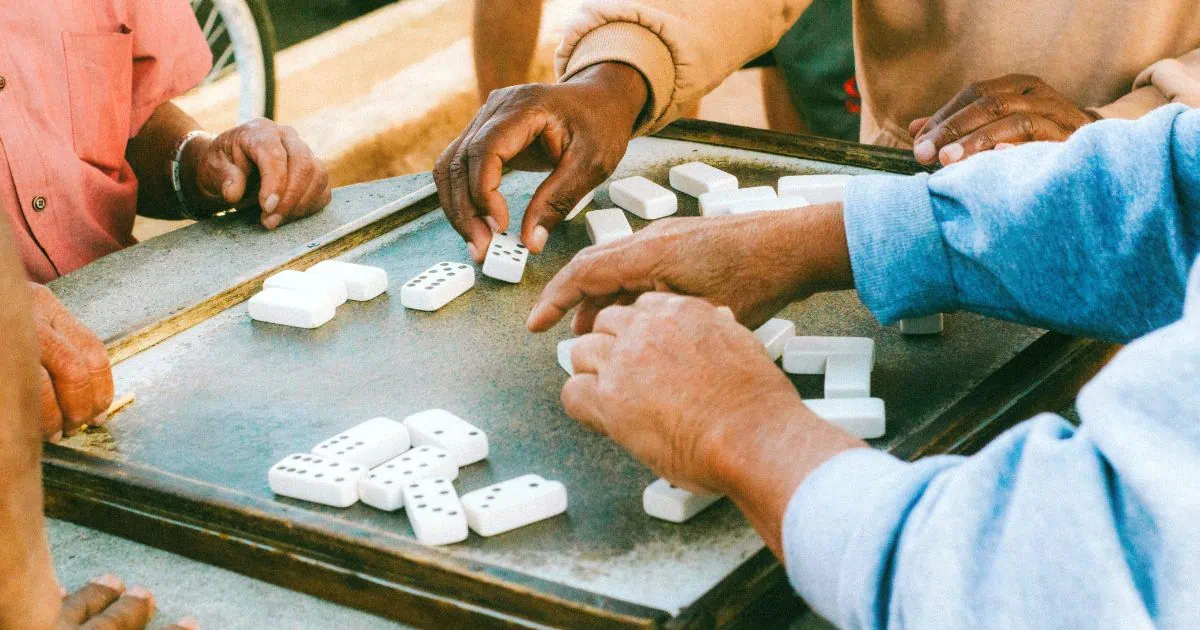
19. Dominó (Dominoes)

- 🎲 What it is: A tile game with 28 dominoes
- 👧 Who plays: Mostly adults, but kids learn young
- 📍 Where you’ll see it: Family tables and souvenir shops
- 🛒 Buy it on Amazon
I’ve played dominoes many times, and while it might seem intimidating, it’s just some basic arithmetic, strategy, and ultimately, luck.
A standard double-six set has 28 tiles, and each end shows 0 to 6 dots.
Players take turns matching their tiles to the open ends of the line on the table.
The first player to get rid of all their tiles wins the round.
In Mexico, you’ll also find dominoes in carved, hand-painted wooden boxes, a popular souvenir.
🛒 Buy your dominoes set on Amazon
20. Ulama (The Ancient Ball Game)

- 🎲 What it is: The modern version of the ancient Mesoamerican ballgame
- 👧 Who plays: Teams of players
- 📍 Where you’ll see it: A few communities in Sinaloa
Ulama is a modern form of the Mesoamerican ballgame, which goes back over 3,000 years.
Archaeologists have found rubber balls from around 1600 BC and a ball court from about 1400 BC.
In hip ulama, players can only hit the heavy rubber ball with their hips. The ball weighs about 7 to 9 pounds (3 to 4 kg).
Today, it’s still played in a few communities in Sinaloa, including around Mazatlán and Escuinapa.
I saw a demonstration of pok-ta-pok, the Mayan version of the game, played in downtown Mérida, Mexico (pictured above).
Pok-ta-pok (pokolpok) is the Yucatec Maya word for the same ancient Mesoamerican ballgame as ulama, though there are other names for it as well.
These include: Pitz (Classic Maya), Tlachtli (Classical Nahuatl), Taladzi (Zapotec), Uárukua (Purépecha), and Batú or Batey (Taíno/Caribbean).
Traditional Mexican Games FAQ
What are traditional Mexican games?
They’re the toys, party games and street games Mexicans have played for generations, like balero, trompo, lotería, the piñata and la víbora de la mar.
What games do Mexican kids play at parties?
The piñata is the big one, along with games like la víbora de la mar, la gallinita ciega and los encantados.
What is the oldest Mexican game?
Ulama, a modern form of the Mesoamerican ballgame, which goes back over 3,000 years.
What game is played at Mexican weddings?
La víbora de la mar, where guests form a chain and try to knock the bride and groom off their chairs.
How is lotería different from bingo?
La Lotería uses picture cards instead of numbered balls, and the caller often recites a rhyme for each card.
My Final Thoughts on the Best Mexican Games
From la lotería to la víbora de la mar, these games are a fun way to see everyday Mexican life up close.
For more, check out my list of 25 Mexican traditions and customs you should know.
Get My FREE Guide: 5 Easy Ways to Save Money in Mexico
Insider tips from someone who’s lived in Mexico since 2018.
