
🦋 Here’s How to See the Mexico Butterflies Migration Like a Pro

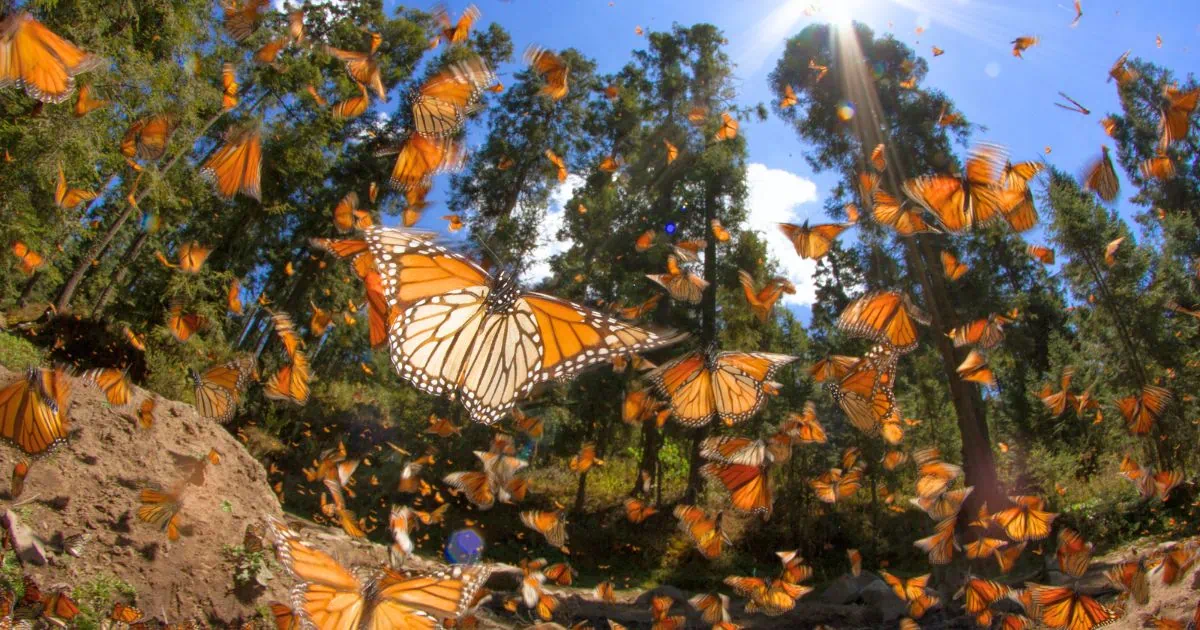

WANT TO see THE BUTTERFLIES in MEXICO?
You’re in the right place, as this Ultimate Mexico Butterflies Migration Guide covers everything you need to know about the monarch butterflies of Mexico!
Every fall, monarch butterflies fly from Canada and the U.S. to the fir forests of Michoacán and the State of Mexico.
They arrive in late October and November, cluster in the trees all winter and leave in March.
I’ve lived in Mexico since 2018 and have had the amazing opportunity to see this migration a few times — and trust me, it’s a once in a lifetime experience.
Ready to learn more about the migration of butterflies to Mexico?
From which Mexico butterfly sanctuary is the best, to the best Mexico butterfly tours and what to pack for your visit — it’s all in this article, so let’s get to it!
What is the monarch butterfly migration in Mexico?
The Mexican butterfly migration is an annual journey where millions of monarchs travel more than 3,000 miles from Canada to Mexico, and back, in about two months.

Arriving in Mexico by November, these butterflies spend the winter months in the Oyamel fir forests of Central Mexico. This is known as overwintering.
As these butterflies migrate, they rely on the sap from the milkweed plant to assist them in laying eggs.
This flowering plant serves as a crucial food source for the larvae, and a breeding ground for the next generation.
In March, the monarchs start their return northward to Canada. Upon arrival, their lifecycle will be complete.
Monarch Butterfly Migration Cycle

Remarkably, the migratory generation of monarchs responsible for this epic journey has an extended lifespan of up to 8-9 months.
The average lifespan of most monarch butterflies is significantly shorter, ranging from 2-6 weeks for adults.
These non-migratory generations hatch, mature, mate, and die within these few weeks, completing several generations within a year.
The migratory generation, born in late summer and early fall, benefits from an extended lifespan.
This adaptation allows them to reach Mexico and survive the winter, mate, and start their journey back north, where they lay the next generation’s eggs.
This cycle is crucial for their survival and serves as an indicator of environmental health and biodiversity.
Monarch Butterfly Migration Map

🦋 Mexico Butterflies Fun Facts
One of the most unique Mexican animals, the majority of butterflies you see in Mexico are monarchs. However, Mexico has 2,045 species of butterflies!
These include endemic butterflies like the White-tipped ghost-skipper and Mexican Kite-Swallowtail, as well as the Nabokov’s Satyr and Carousing Jewelmark.
What is the Monarch Butterfly Biosphere Reserve in Mexico?
Mexico’s Monarch Butterfly Biosphere Reserve is a critical conservation area in Central Mexico that spans more than 56,259 hectares (about 140,000 acres).

Established to protect the Mexican butterfly migration, it’s a key wintering site and breeding ground location for the millions of monarch butterflies Mexico has.
The Mexico Monarch Butterfly Reserve is located in various regions across Michoacán State and the State of Mexico, and includes several butterfly sanctuaries.
Designated a UNESCO World Heritage Site in 2008, this reserve is known for its biodiversity. It is also vital for the study of monarch butterfly conservation.
The UNESCO Monarch Butterfly Reserve in Mexico showcases the importance of habitat preservation in the face of climate change and deforestation.
Through local and international efforts, the reserve aims to ensure the sustainability of the monarch migration for future generations.
Where do the monarch butterflies go in Mexico?
In Mexico, the monarch butterflies gather in the Oyamel fir forests located within the Transvolcanic Belt of Central Mexico.

Monarch butterflies migrate to the forested mountains in the Mexican states of Michoacán and the State of Mexico.
Oyamel fir trees, which only grow at high altitudes of 7,800-11,800 feet above sea level (2,400-3,600 m), offer the ideal microclimate for monarchs to survive the winter.
The cool temperatures at these high altitudes slow the butterflies’ metabolism, allowing them to conserve energy.
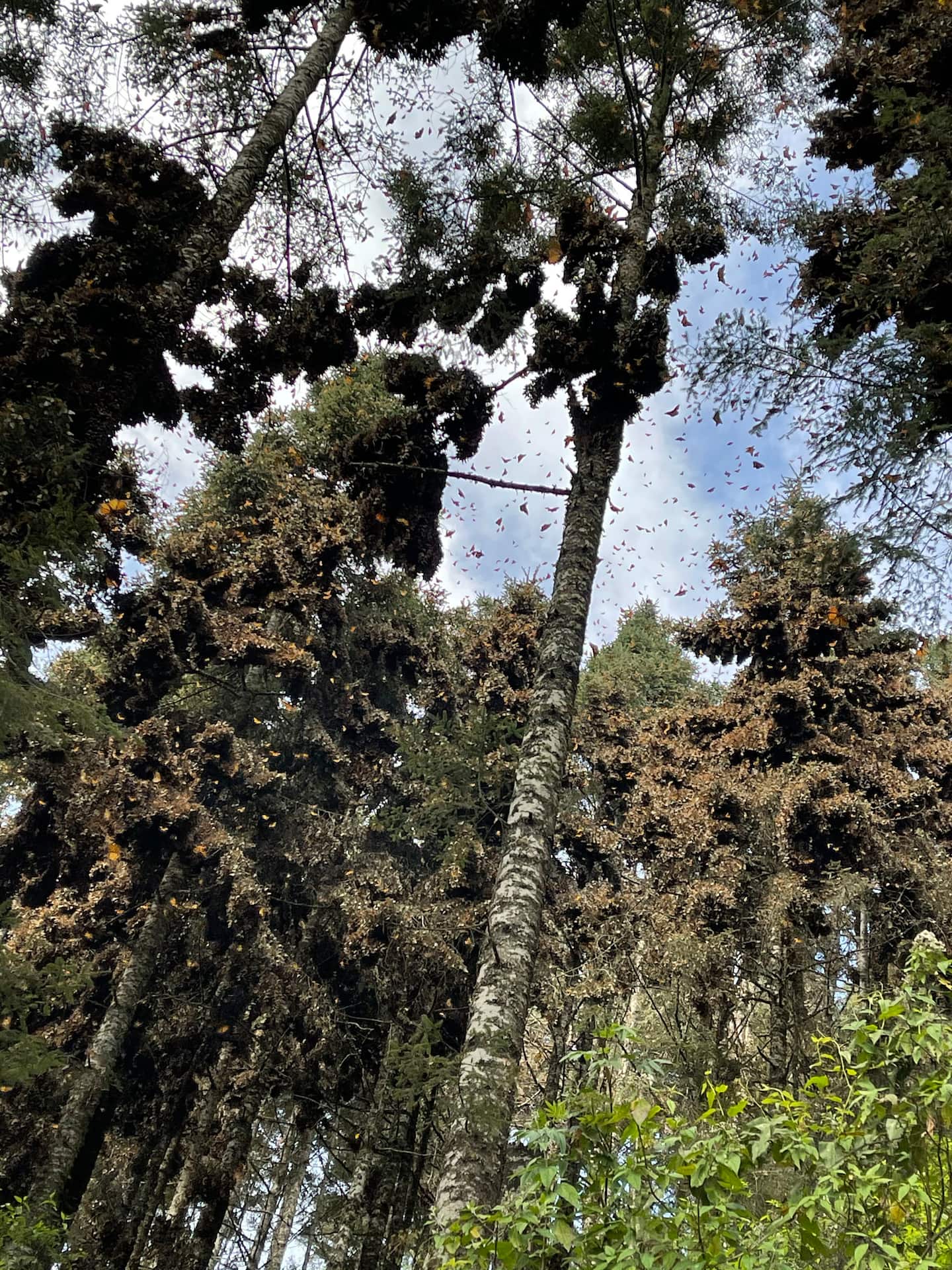
This unique habitat provides the necessary conditions for monarchs to cluster together on the branches of the Oyamel trees (Abies religiosa), creating a spectacular sight.

The peak viewing season, when the butterflies are most active and the forests are dense with monarchs, is usually from late January to early March.
This timing aligns with the warmer days of late winter when the monarchs cluster less and fly more, making them easier to observe.
I recommend planning your trip around these months for the most incredible views of the monarchs in their winter habitat.
Where is the best place to see monarch butterflies in Mexico?
You can explore four primary Mexican Monarch butterfly sanctuaries to experience the migration of monarch butterflies in Mexico.
1. El Rosario Butterfly Sanctuary in Michoacán State

💰Price: 80 pesos (about $5 USD) | ⏰ Hours: Daily 8am to 5pm | 🥾 Guides available but not needed
While each sanctuary offers a unique vantage point of this natural wonder, El Rosario Sanctuary near Ocampo is the most popular monarch butterfly sanctuary Mexico has.
Seeing these Michoacan monarchs involves a steep hour-long trek, although many visitors are greeted by butterflies much closer to the entrance.
Given its popularity, visitors are typically given about 20 minutes at each viewing area to accommodate the large numbers, especially during peak times.
For a less crowded experience, I recommend going during the weekdays, although you should be mindful of potential school groups.
This Michoacan butterfly sanctuary has one of the most substantial roosts of monarch butterflies, making it a top pick for anyone who only has time for one sanctuary visit.
🚘 HOW TO GET TO EL ROSARIO SANCTUARY

Getting there can be as simple as hiring a taxi from Angangueo, a nearby town.
If you are coming from Zitácuaro, options range from rental cars for convenience to colectivos (local mini buses) for a more budget-friendly approach.
The latter involves a change in the town of Ocampo Michoacan, and then a short ride to El Rosario.
Minibuses are available for the return trip to Zitácuaro, with the last one departing at around 6pm for a fare of 50 pesos (about $3 USD).
Although there are many tours to this particular sanctuary, this is one of the easiest sanctuaries to get to if you want to do it independently.
2. Sierra Chincua Butterfly Sanctuary in Michoacán State

💰 Price: 80 pesos (about $5 USD) | ⏰ Hours: Daily, 8am to 5pm | 🥾 Note: Guide needed
Sierra Chincua Sanctuary offers a more intimate experience with the monarch butterflies near Angangueo.
Entrance fees are set at 80 pesos for foreigners, and unlike El Rosario, hiring a guide here is recommended.
Travelers can take an hour-long guided walk uphill through the park, or hop on a horse if you prefer not to walk.
Like El Rosario, time at the butterfly viewing areas is about 20 minutes so that all visitors get a chance to spend some time in the forest.
Although less visited and quieter, there is no shortage of monarch Mexico butterflies here. The trail is also less difficult as it is mostly flat for most of the hike.
Why come to Sierra Chincua? It has a lot of monarch butterflies — but receives fewer visitors than El Rosario, and has one of the easiest hikes of any sanctuary.
🚘 HOW TO GET TO SIERRA CHINCUA SANCTUARY

⚠️ Fair Warning: Getting here can be an adventure in itself!
Taxis from Angangueo can take you, and if you’re coming from Zitácuaro, you have a few options, but be prepared for a bit of a journey.
While it might cost more to travel from Zitácuaro because of the distance, once you’re there, the challenge of arriving will feel like it was all part of the adventure.
Just remember, there’s no easy way back to town waiting for you, so getting the phone number of your taxi driver is smart.
A much more convenient option is booking this tour to Sierra Chincua Butterfly Sanctuary with a local guide.
Hiring a guide enriches the experience and solves the transport issue, as some guides also offer rides back to your accommodation.
3. Piedra Herrada Butterfly Sanctuary in México State

💰 Price: 100 pesos (about $7 USD) | ⏰ Hours: Daily, 9am to 4pm | 🥾 Note: Guide needed
Piedra Herrada is popular due to its proximity to major cities like Mexico City and Valle de Bravo.
From the entrance, the path leads you on a hike through the forest, lasting 45 minutes to an hour.
You’ll then reach the summit of the trail, where most butterflies gather.
Upon reaching the top, visitors are allowed a 15-minute stay to experience the butterflies before making their way back down.
What makes Piedra Herrada special is the road you take before you ascend.
On a sunny February and March afternoon, you might see thousands of monarchs descending from the mountain searching for water.
🦋 Pro Tips: This sanctuary is one of the closest sanctuaries to Mexico City, and is full of bus tours during the weekend, so try to avoid weekends if possible.
Also, avoid Wednesdays and Thursdays, the busiest days for school trips.
🚘 HOW TO GET TO PIEDRA HERRADA SANCTUARY

The Piedra Herrada Sanctuary is about two hours from Mexico City, and can be easily visited. In fact, it makes for a great Mexico City day trip option.
Another option is an overnight stay at Valle de Bravo, about 19 miles (30 km) away.
Whether coming from Mexico City or Valle de Bravo, you can rent a car, take a guided trip, book a tour, or arrange a taxi.
Always arrange a pick-up with your taxi driver, and never assume that taxis will be waiting for you when you finish your experience unless you plan this in advance.
4. Cerro Pelón Butterfly Sanctuary in México State

💰 Price: 80 pesos (about $5 USD) | ⏰ Hours: Daily, 8am to 5pm | 🥾 Note: Guide needed, and many go via horse
Cerro Pelón, straddling Michoacán State and Estado de Mexico (Mexico State), is one of the least visited and untouched sanctuaries out of the four.
However, this particular flying monarch butterfly sanctuary is not for the faint of heart!
It requires physical fitness and a lot of preparation — so bring plenty of water and snacks, as no vendors are on-site.
Its challenging terrain, filled with steep, rocky paths, makes horseback rides a recommended way to explore.
It takes about two hours to get up and two hours to go down, so if you want to visit other sanctuaries, make this the last one on your list.
🚘 HOW TO GET TO CERRO PELÓN SANCTUARY
One unique option is to go to Macheros and stay at the Cerro Pelón Butterfly B&B.
Located about five minutes from the sanctuary’s entrance, it is one of the only places in Mexico where you can stay in the butterfly sanctuary.
Other options are renting a car, booking this guided tour, and trying to get there independently from Zitácuaro via public transportation.
To do this, you’ll use a combination of minibus and taxi. Of course, this can be a bit tricky, especially if you don’t speak at least some Spanish.
5 Top Rated Mexico Butterfly Tours
If you’re looking for a Mexico Butterfly tour, there are many to choose from — whether you want a day trip or something longer.
Below, you’ll find a list of a couple of my favorite tours to check out, which are all well-rated so you know you’ll have a great time.
1. Seven Day Monarch Butterfly Tour in Mexico

⭐️ Rating: 5 out of 5 Stars | ⏳ Tour Length: 7 days | 🦋 Check Rates and Availability
Want to book one of the top monarch butterfly tours from Mexico City? This 7-Day Tour checks all the prime boxes.
(Note: If a weeklong tour is too much, opt for this 1-Day Mexico City Butterfly Tour instead.)
On the 7-Day Tour, you’ll get to see the monarchs in two different sanctuaries, and enjoy several other great stops.
You’ll learn about the Mexican colonial era, Aztec history, Mexican wildlife and so much more.
Clemente could not have been more helpful, fun, knowledgeable, easy to understand and all in all was the highlight of our trip making this adventure so enjoyable!
-michael (SEE MORE REVIEWS)
You’ll also get one free day on this tour to explore the area around Valle de Bravo.
Never heard of Valle de Bravo? This posh lakeside pueblo magico (magic town) is known as “the Hamptons of Mexico City.”
Let your guide take the lead by having him arrange boat tours and farm tours or ask him to set up something specific. One traveler raved about parasailing at Monte Alto.
One thing’s for sure, the monarchs were the highlight for most of the travelers on this tour. They called the experience “spectacular” and “absolutely amazing.”
They also loved their knowledgeable and attentive guide, who made the trip out-and-out incredible.
2. Best Mexico City Butterfly Tour with Pueblo Magico Visit

⭐️ Rating: 4.5 out of 5 Stars | ⏳ Tour Length: 12 hours | 🦋 Check Rates and Availability
Head to Sierra Chincua Monarch Butterfly in Mexico Sanctuary on one of the best Mexico City monarch butterfly tours available.
This day trip will take you directly from your hotel to the mountains. Once there, you’ll hike for about 5.25 miles (8.5 km) until you reach the butterflies.
Having been on my bucket list for some time, seeing one of the monarch butterfly overwintering sites was fantastic!
-noel (SEE MORE REVIEWS)
All the sweat will be worth it because nothing compares to the slight of millions of monarchs swishing through the trees. Wow!
After hiking back down, enjoy a fun visit to the magical town of El Oro. Re-fuel with a delicious lunch before making the three hour drive back to your hotel.
This tour includes a local guide, transport in a private vehicle, lunch, and hotel pickup and drop-off from Reforma Avenue, Polanco and the Mexico City Zocalo in Downtown Mexico City.
3. Mexico City Monarch Butterflies Sanctuary Tour
⭐️ Rating: 4.88 out of 5 Stars | ⏳ Tour Length: 13 hours | 🦋 Check Rates and Availability
If you’re looking for the top monarch butterfly day tours Mexico City has to offer, this Mexico City Monarch Butterfly Tour is it!
The adventure begins with pickup from your CDMX hotel or Airbnb, a quick Mexican breakfast, and then transport to the butterfly sanctuary.
We had a great experience & I’m so happy we booked this tour! I would recommend it to anyone. The tour company was very professional… the food was great, everything was highly organized.
-Lucy (see more REVIEWS)
Wear good shoes, because you’ll have to hike for a while! But don’t worry, seeing the monarch butterfly Mexico migration is absolutely worth the effort.
Nothing compares to standing among millions and millions of flying butterflies. Trust us; pictures and videos can’t capture it.
Hike back down, then eat a delicious lunch of traditional Mexican fare. The tour ends with a drop off back at your hotel in Mexico City.
4. Mexico City to Monarch Butterfly Sanctuary Piedra Herrada
⭐️ Rating: Be the first to review it! | ⏳ Tour Length: 12.5 hours | 🦋 Check Rates and Availability
If you’re looking for a once-in-a-lifetime experience, check out this Piedra Herrada Butterfly Sanctuary Mexico Excursion.
With a super-storytelling host, several great stops, and delicious food included, this is definitely one of the best monarch butterfly tours Mexico City has on offer.
Start off with convenient hotel pickup, followed by a yummy breakfast, and comfortable transportation.
Next, you’ll get to spend some magical time in Piedra Herrada Monarch Sanctuary, the closes butterfly sanctuary to Mexico City.
Hike for an hour, then watch the butterflies fluttering and coating the trees with their brilliant orange wings.
After enjoying the top monarch butterfly sanctuary Mexico City has available, you’ll visit the Valle de Bravo magic town.
Eat a yummy lunch, visit Velo de la Novia waterfall, the Lake Avandaro Pier, picturesque town center, and Museo de Arte Popular (Folk Art Museum).
Although this tour makes for a long day, travelers will love having a guide and driver in Valle de Bravo, eating some delicious food, and seeing the amazing butterflies.
5. Mexico City to Butterfly Sanctuary Cerro Pelon Tour

⭐️ Rating: 4 out of 5 Stars | ⏳ Tour Length: 7-12 hours | 🦋 Check Rates and Availability
Looking for something unique? If so, you’ll want to book this incredible Monarch Butterfly Day Trip from Mexico City.
What sets this sanctuary of monarch butterfly in Mexico tour apart is that it takes you to Cerro Pelón Sanctuary, one of the lesser-known Mexican butterfly sanctuaries.
We rode horses up the mountain to where the butterflies were… and were amazed at the site of thousands of butterflies flying around in every direction.
-david (SEE MORE REVIEWS)
Not many tourists come to this area, but your guide will have everything worked out and running smoothly.
Relax during the drive, then ride a horse for two hours up to a stand-out monarch butterfly forest in Mexico.
Spend time at the top drinking in the awe-inspiring sight and learning fascinating data points from a forest ranger.
Finish off the tour with a visit to the town of Zitácuaro for a bit of sightseeing, and a yummy lunch in the market.
Travelers called this experience “memorable,” “unforgettable,” and “authentic.”
7 Things to Bring for Mexico Monarch Butterfly Watching
1. Hiking Shoes

Durable hiking shoes are essential for you visit to any monarch butterfly reserve Mexico has.
The terrain varies from flat paths to steep, rocky trails, so quality hiking shoes provide the support and grip needed for a comfortable trek through the forests.
2. Warm Clothes

Despite Mexico’s generally warm climate, the microclimate in the monarch butterfly reserves can be quite cool, especially at higher elevations.
Warm, layered clothing is advisable to adjust comfortably to the changing temperatures throughout the day.
3. Reusable Water Bottle

Staying hydrated is key during your hike to the Mexico butterfly forests.
Bring a reusable water bottle to refill as needed. Many sanctuaries have refill stations, making it easier to keep water on hand without carrying excessive weight.
🏆 My recommendation is this Water-To-Go Bottle, which I own and use myself! Get 15% OFF your purchase with code SOLO15.
As many know, Mexican water is not potable — meaning you can’t safely drink Mexican tap water.
This Water-To-Go Bottle has a three-stage built-in filter that ensures you’re always drinking clean water wherever you are.
4. Snacks

Energy-boosting snacks like these are great for keeping your stamina up during the hike.
Nuts, energy bars, and fruit are lightweight, nutritious options that fit easily into your backpack.
Remember that necessities like water and food might not be available during your experience, so bring everything you need.
5. Bug Spray
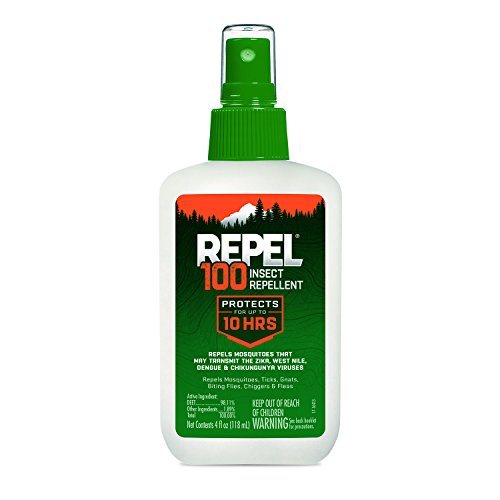
Though the focus may be watching butterflies, other insects can be a nuisance while you experience the butterfly migration to Mexico.
A good bug spray like this one helps keep mosquitoes and other insects at bay, making your experience with the Mexican butterflies more enjoyable.
6. Sun Protection

Sun exposure can occur even in cooler forested areas, especially on clearer days. A hat, sunglasses, and sunscreen are important to protect against UV rays.
7. Travel Insurance

Considering the nature of the activity and its location, travel insurance that covers outdoor activities is highly recommended.
🏆My recommendation? I love AND use SafetyWing Travel Insurance.
It provides peace of mind, covering everything from medical emergencies to trip cancellations, and more.
The Legend of the Monarch Butterflies of Mexico

In Mexico, many stories surround the monarch butterfly migration, showing how special these butterflies are to the people.
Some believe the butterflies are souls of family members who have died, and are coming back to visit.
Others think of them as spirits of the forest or as messengers from the Aztec and Mayan gods, connecting the heavens and the earth.
There’s also a belief that these butterflies help guide the souls of the deceased, helping them in the afterlife.
No matter the story, everyone agrees that monarch butterflies are very important and are treated with great respect.
They are often considered sacred, representing ancestors and loved ones who have passed away.
This deep respect makes the butterflies’ return every year meaningful, especially during Mexico Day of the Dead celebrations, adding a rich layer to Mexico’s cultural heritage.
Mexico Butterflies Migration: Frequently Asked Questions
How long is the monarch butterfly migration to Mexico?
4 months — Mexico’s migration season runs from November to March.
Where is the best place to see monarch butterflies in Mexico?
The best places to see monarch butterflies in Mexico are the Monarch Butterfly Biosphere Reserve Sanctuaries in Michoacán and Estado de México.

El Rosario and Sierra Chincua in Michoacán State are the most popular and accessible, offering significant sightings of monarchs in Mexico.
However, Piedra Herrada in Estado de México (Mexico State) is popular because it’s the closest butterfly sanctuary to Mexico City.
While January and February are known as the best months to see the Mexico monarch butterflies, December is a popular time as many are in town for the Mexican Christmas celebrations.
What season do monarch butterflies migrate to Mexico?
Winter — To escape the freezing cold winters in the U.S. and Canada, monarch butterflies migrate to Mexico in winter because it’s much warmer.

When do monarch butterflies migrate to Mexico?
They usually arrive in Mexico in early-November, and stay until March — but the best time to see them is January and February.
How do you see the monarch butterfly migration in Mexico?
To see the monarch butterfly migration, you can visit the sanctuaries during their open hours, which are generally between 8am-6pm.
Hiring a guide can enhance your experience, and considering the terrain, horse rentals are also an option for easier access on the difficult hikes.
How many butterfly sanctuaries are there in Mexico?
Mexico has four official sanctuaries dedicated to the monarch butterfly migration across Michoacán and Estado de México states.
These sanctuaries are El Rosario and Sierra Chincua Reserve in Michoacán state, and Cerro Pelón and Piedra Herrada in Estado de México state.
Each sanctuary offers visitors a unique opportunity to witness the awe-inspiring migration and congregation of monarch butterflies in their natural habitat.
Is the butterflies in Mexico migration worth it?
Yes — As one of the largest insect migrations on Earth, don’t pass up the chance to see the Mexico butterflies.
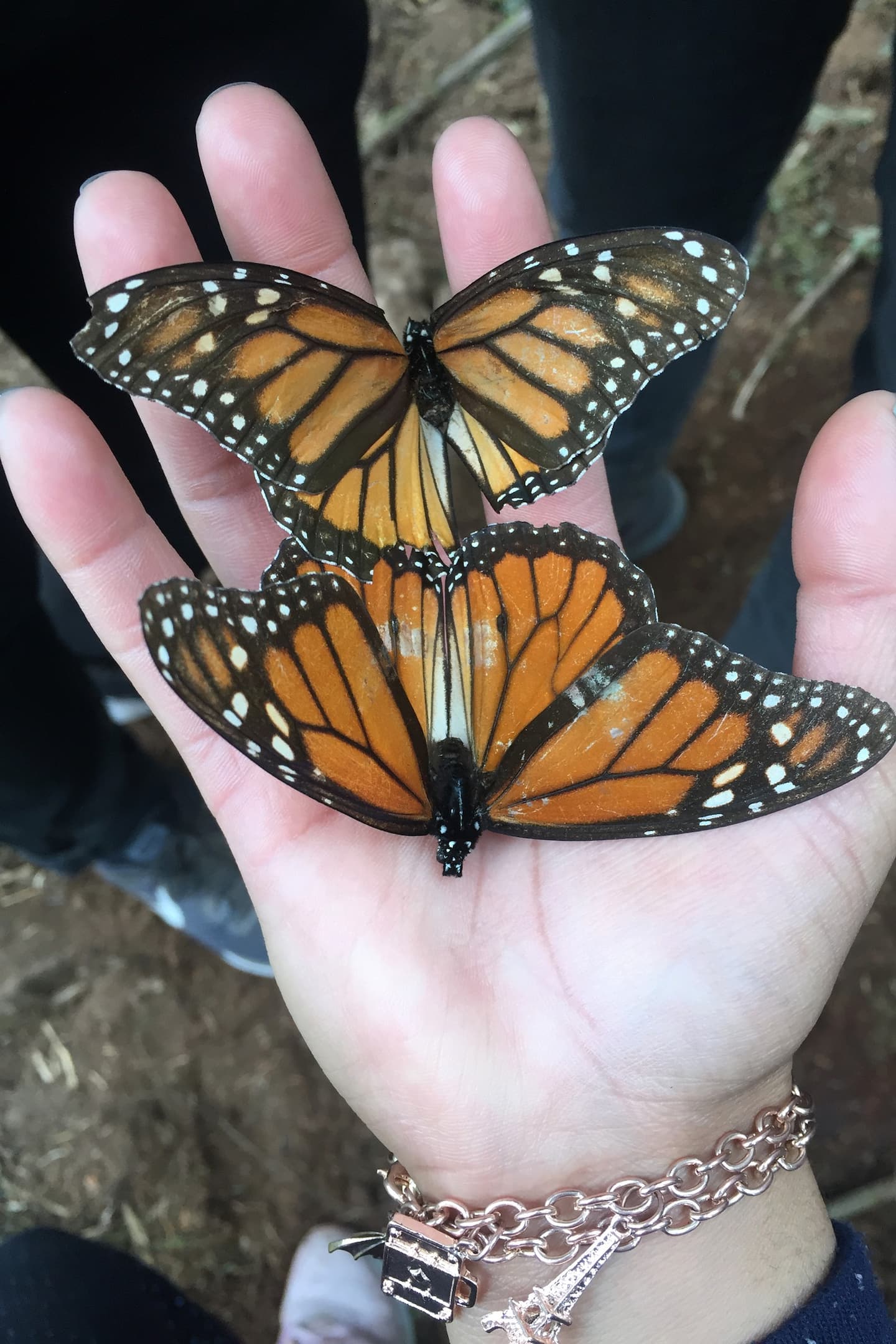
During the annual Mexico monarch butterfly migration, you’ll be surrounded by THOUSANDS of orange and black monarchs fluttering all around you.
A sight like no other, the migrating butterflies to Mexico gather in clusters on tree branches that get so heavy they reach the ground.
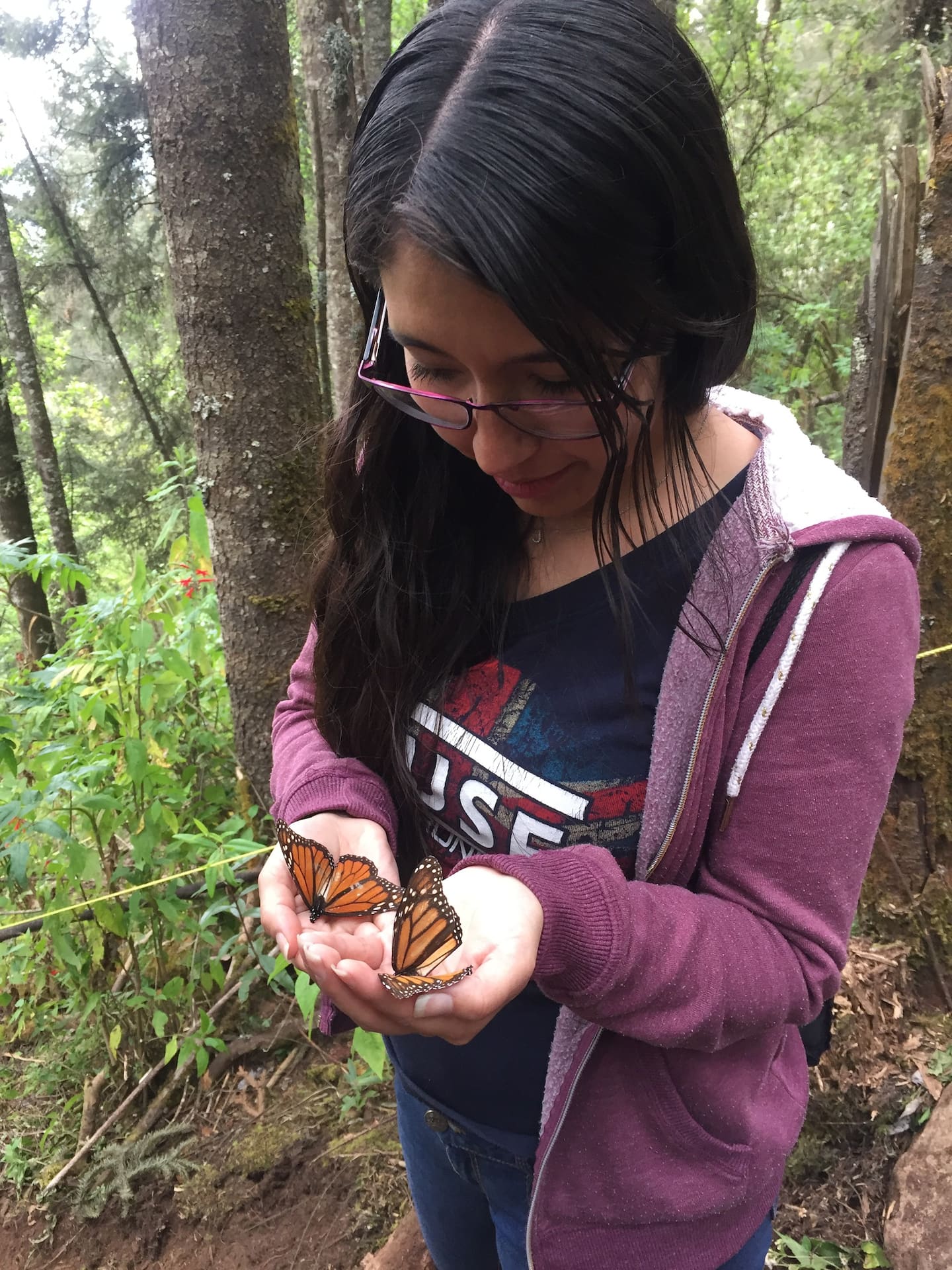
When you visit on monarch butterflies Mexico tours or independently, you’ll see them flutter around you, and many will land right on you as well.
Is there a Monarch Butterfly Festival in Mexico?
Yes — The Municipality of Angangueo hosts the annual Festival de la Mariposa Monarca (Monarch Butterfly Festival Mexico) in February or March of each year.
The small mining town of Mineral de Angangueo, Michoacan, is located near the Mexico butterfly sanctuaries of El Rosario and Sierra Chincua.
Where do the butterflies go when they leave Mexico?
After wintering in Mexico, the monarch butterflies return north to the United States and Canada in the spring to breed, completing their migratory cycle.
What are the butterflies that migrate to Mexico?
Though there are many different types of butterflies from Mexico, monarchs are the famous Mexico butterflies from the annual migration.

Why do monarch butterflies migrate to Mexico?
They migrate to escape the cold weather and find suitable breeding grounds.
Where do monarch butterflies migrate to in Mexico?
The butterflies “overwinter” (or, spend the winter) in the Oyamel fir forests of Central Mexico.
This is a giant area located a few hour’s drive from Mexico City. The most-visited places include the sanctuaries in Mexico State and Michoacan State.
- The best place to see monarch butterflies in Michoacan Mexico is El Rosario Butterfly Sanctuary
- The best place to see monarch butterflies in Mexico State is the Piedra Herrada Butterfly Sanctuary
Are there any Mexico City monarch butterflies sanctuaries?
No — The closest monarch butterflies Mexico City has are located in the Piedra Herrada Sanctuary.
It is located in Estado de México (Mexico State), and about three hours away from Mexico City by rental car.
How many butterfly and moth species are there in the world?
There are approximately 17,500 species of butterflies, and 160,000 species of moths identified worldwide.
Final Thoughts: Mexico Butterflies Migration Guide

Witnessing the monarch migration Mexico has is a travel experience often listed on many a bucket list.
The monarchs’ journey from the Rocky Mountains to the fir-covered tree trunks of Michoacán and Estado de México is a testament to the remarkable migration of monarchs.
These delicate creatures travel across continents from North America to South America, where they overwinter before returning home.
This incredible journey underscores our ecosystems’ interconnectedness and the natural world’s enduring wonder, inviting travelers to participate in one of the most magical travel experiences.
