
This Mexican Celebration Is Nothing Like Halloween

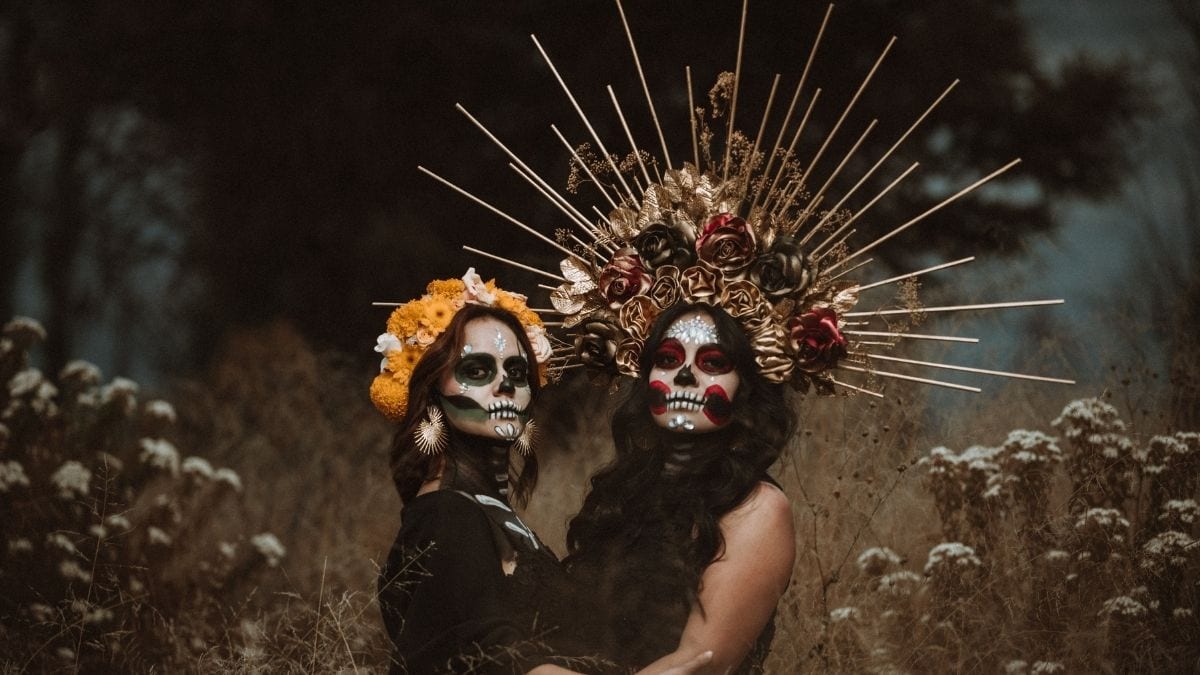
The Day of the Dead, or Día de Muertos, is a meaningful 🇲🇽 Mexican tradition that honors the memories of departed loved ones.
Unlike 🎃 Halloween, this holiday is a joyous celebration that blends ancient Aztec rituals with Catholic influences. It is a unique and colorful festival that spans from October 31st to November 2nd.
As families come together to welcome back the spirits of their ancestors, they engage in various customs, from building elaborate altars to decorating with marigolds and papel picado.
Let’s explore the history, significance, and rituals that make the Day of the Dead one of Mexico’s most cherished traditions.
Disclosure: This article may contain affiliate links, meaning when you make a purchase, I earn a small commission. Affiliate links cost you nothing to use, and help keep my content free. It’s a win-win for us both. For more info, see the Disclosure Policy.
What is Day of the Dead?
The first thing you need to know about Dia de los Muertos — it is not Mexican Halloween. However, Day of the Dead is one of the most important and best Mexican holidays, with traditions dating back thousands of years.

Unlike many present-day rituals around death, Day of the Dead is not a somber funerary event. On the contrary, Dia de Muertos is a celebration, one so grand that even the deceased return to the party held in their honor.
🤔 What does dia de muertos mean?
In case you didn’t know, both día de muertos and día de los muertos mean Day of the Dead in Spanish.
The Day of the Dead celebration holds great significance in the life of Mexico’s indigenous communities. The fusion of pre-Hispanic religious rites and Catholic feasts brings together two universes…
Source: UNESCO
The most correct way to say it is día de muertos; without “los” before the word “muertos.” However, you will see it written as both día de muertos and día de los muertos.
History of Day of the Dead in Mexico

The holiday’s origins date back to the Aztec celebration of the goddess Mictecacihuatl, the Aztec Queen of the Underworld.
Much like the current incarnation of Day of the Dead, the Aztec festival was a celebratory affair.
After Mexican colonization by the Spanish, who brought with them Christianity, the Spanish forcibly moved the festival’s dates.
The Aztec holiday originally took place in early-summer, but was moved to the fall season by the Spanish.
These new fall dates coincided with what Christians called Allhallowtide. This is another multi-day holiday commemorating the deceased but from the Christian pantheon.
Allhallowtide took place on October 31 to November 2. The first day, October 31, was known as All Saints Eve; November 1 was All Saints Day; and November 2 was All Souls Day. Day of the Dead uses these same dates.
💀 A Journey to Míctlan: The Underworld
As mentioned, Day of the Dead is by no means a gloomy festival. In fact, for pre-Columbian Mexicans, death was simply a trip to Mictlán, which is the Underworld in Aztec mythology.
You can get an idea of what Mictlán is said to look like by watching the movie Coco.
For the Aztecs, this was a blessing, not a curse. They viewed death as little more than a transition, and their Underworld was actually a place to party.
If the notion that death is a paradise sounds strange, it’s something you find in most religions and ancient cultures.
In Christianity, it’s called heaven; for the Vikings, it was Valhalla; for Muslims, it’s called Jannah; and for ancient Greeks, it was Elysium.
When is the Day of the Dead in Mexico?
It depends, as different places have different celebrations. Officially, Day of the Dead is November 2nd, but in some places, it’s a is a two-day holiday that takes place November 1st and 2nd.

However, in the cities that have the most elaborate Day of the Dead Celebrations in Mexico, preparations can begin 7-10 days prior.
In some places, Día de los Muertos takes over entirely. Bright orange marigold flowers blanket the streets, colorful papel picado (craft paper) gets hung across streets, and comparsas (parades or processions) take over the streets.
October 31: All Saints Eve

Wondering, When does Day of the Dead start?
The first day is November 1 at midnight, which is why many say Day of the Dead begins on October 31. At midnight, the spirits of the departed children are said to return.
Though technically the “eve” of Dia de Muertos, much like Christmas Eve, many consider it a festival day.
You may see people putting the final touches on their ofrendas (altars), or at the cemetery decorating the gravestone of their deceased loved one.
November 1st: Day of the Little Angels

What was formerly known as All Saints Day, is present-day Día de los Angelitos, or the Day of the Little Angels. This day honors the children who have passed.
You may also see this day called the Día de los Inocentes, or Day of the Innocents. However, make sure not to confuse it with Day of Holy Innocents, which is on December 28th.
November 2nd: Day of the Dead

Formerly known as All Souls Day, November 2nd is the actual Day of the Dead day. On this day, family members and loved ones celebrate the adults in their life who no longer walk the Earth.
The spirits of all adults returned the night before, at midnight, but parties will continue all day.
Of the three days of Day of the Dead, this is usually the most tranquil, as celebrations begin to wrap up in most places.
What are the differences between Day of the Dead and Halloween?
At first glance, the spooky iconography both holidays share might make them look identical. However, calling Day of the Dead simply “Mexico Halloween” denies its unique connection to the pre-Hispanic and Aztec people.
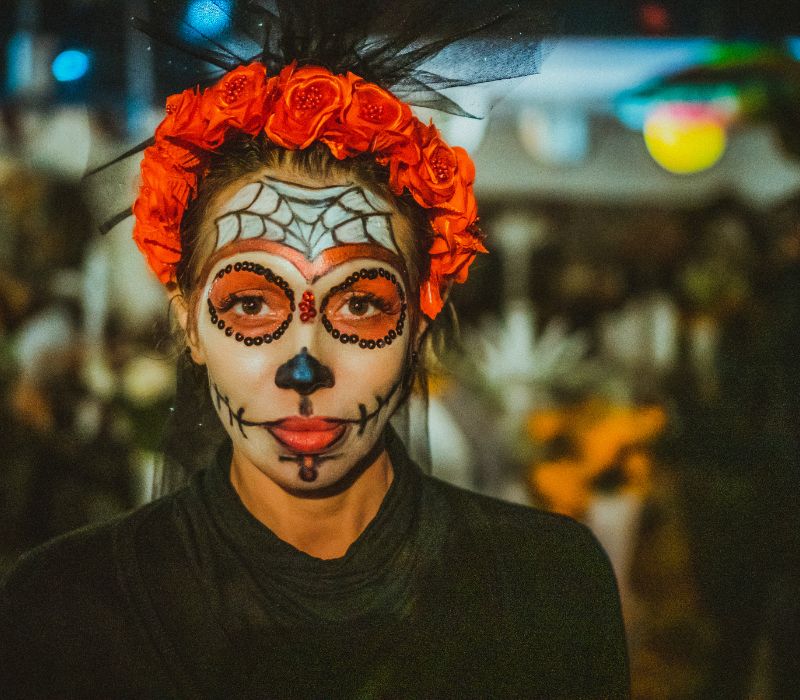
While present-day Halloween is mostly about costumes and trick or treating, Day of the Dead is explicitly about the afterlife and remembrance of your departed loved ones.
However, Halloween was very much a holiday about the deceased.
The tradition of Halloween costumes arose because the Europeans considered the spirits that returned to Earth to be evil. (Note: Halloween comes from the European Pagan holiday called Samhain.)
They dressed their children in costumes so these malevolent spirits wouldn’t recognize them. They feared the spirits would capture the kids, or worse, kill them.
Within Day of the Dead traditions, the dead are peaceful, joyful and welcomed guests.
In fact, all the parties during Day of the Dead are held in their honor, and the elaborate ofrendas (altars) contain their favorite foods and beverages.
What are the similarities between the Day of the Dead and Halloween?
That being said, the holidays do share quite a few similarities, like these:
- They both stem from ancient traditions — Halloween from European Paganism, and Day of the Dead from the Aztecs.
- They were both morphed with Christianity into the holidays we know today.
- They are both based on the idea that spirits return to Earth once a year.
As the United States and Mexico share thousands of miles of a land border, cultures and customs continue to mix.
Halloween is just as popular in Mexico today as in some cities as in Day of the Dead.
Let’s face it: Everyone loves dressing up. Halloween parties in Mexico with American-style costumes are becoming the norm.
Young children dress up in costumes for Calaverita, the equivalent of trick-or-treating.
Final Thoughts: Day of the Dead
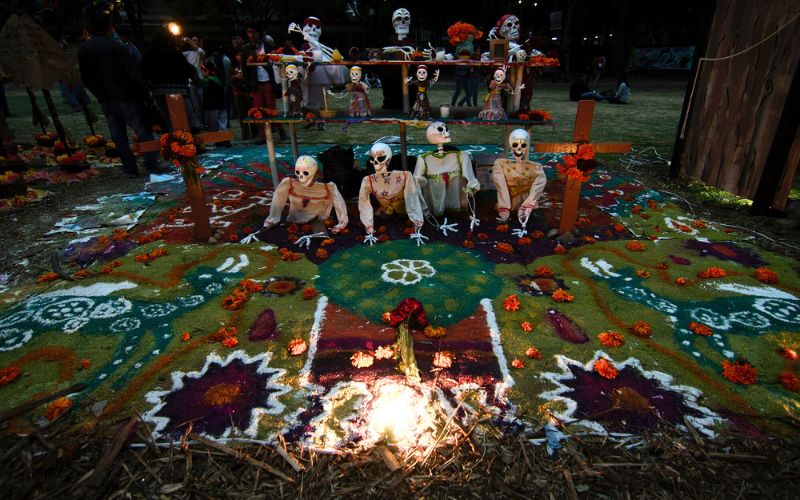
The Day of the Dead is more than just a holiday—a profound cultural expression that celebrates life, love, and remembrance.
Rooted in ancient traditions and adapted over time, Día de Muertos continues to bring families together to honor their ancestors and keep their memories alive.
By blending indigenous beliefs with Catholic practices, this unique holiday serves as a beautiful reminder that death is not an end but a part of the journey.
As Mexico’s streets fill with colors, music, and heartfelt tributes, the Day of the Dead continues to captivate and inspire, ensuring that those we’ve lost are never truly gone.