
What Day of the Dead Symbols Really Mean—Prepare to Be Surprised!


Day of the Dead, or Día de los Muertos, is a vibrant Mexican celebration that honors and remembers departed loved ones.
🇲🇽 This centuries-old tradition combines indigenous beliefs with Catholic influences, creating a unique fusion of culture, rituals, and symbols.
From colorful sugar skulls to marigold flowers and intricate altars, each element tells a story and holds deep significance.
Let’s explore the most iconic symbols and traditions that make this celebration so special.
Disclosure: This article may contain affiliate links, meaning when you make a purchase, I earn a small commission. Affiliate links cost you nothing to use, and help keep my content free. It’s a win-win for us both. For more info, see the Disclosure Policy.
1. Day of the Dead Sugar Skulls

One of the icons of this holiday is the Day of the Dead sugar skull. Ironically enough, these confectionery treats don’t really have Mexican (or even pre-Hispanic) roots, and come from Europe.
Italian Catholic missionaries brought sugar art to Mexico in the 1600s.
Unlike Europe, Mexico is abundant in sugar and sugarcane, so it became a natural place for these molded sugar figures to take root and form their own traditions.
💀 Small sugar skulls vs large sugar skulls

During Día de Muertos, sugar skulls will be made in two sizes: Large and small.
The larger ones are often placed on a gravestone to honor and remember the departed children.
These bite-sized ones can also be eaten, used for in-home ofrenda (altar) decoration, and taken home as souvenirs.
The larger ones represent departed people, and their names are written on the forehead of the skull.
You’ll usually see these more elaborate, larger sugar skulls placed on an ofrenda or gravestone for that person’s returning spirit.
These larger sugar skulls are not meant to be eaten.
2. Marigold Flowers (cempasuchil)

The marigold flower, or cempasuchil (pronounced sem-pa-souch-ill), has been a part of this celebration dating back to its Aztec origins.
Throughout Mexico, marigolds are often called flor de los muertos (flower of the dead) because of their close associations with Day of the Dead.
According to Aztecs beliefs, the flower’s bright color and strong scent served a sensory guide for the spirits.
They believed the marigold flowers let our departed know exactly where they should return to meet us.
Nowadays, no Day of the Dead ofrenda (altar) is complete without some cempasuchil flowers on it. You’ll also see marigolds and terciopelo rojo flowers (cockscomb) decorating cities and cemeteries all over Mexico.
3. La Catrina: Day of the Dead Skeleton Woman

Besides Frida Kahlo, La Catrina might be the woman most commonly associated with Mexico.
This elegant skeletal lady, who everyone paints their faces to look like, was born in 1910 when Mexican illustrator José Guadalupe Posada first drew her.
He named this figure, La Calavera Garbancera (The Elegant Skull), and she was drawn as satirical social commentary.
His dapper woman with her fancy feathered-hat was a critique of Mexican society at the time, when many Mexicans were aspiring to dress and act more European.
Posada saw this as a snub to the more humble, and traditional style of Mexican dress.
He created his Calavera Garbancera character as a skeleton who would serve as a reminder that we all eventually die one day — whether we’re wearing fancy clothing or not.
History of La Catrina, Day of the Dead Icon

La Catrina’s transition into the official grand dame of Day of the Dead came after Mexican artist Diego Rivera (Frida’s husband) painted her with a full-body and Victorian dress.
Using a similar face, he took Posada’s La Calavera Garbancera illustration and created who would become known as La Catrina.
Rivera’s 50-foot-long (15 m) painting, Sueño de una tarde dominical en la Alameda Central (Dream of a Sunday Afternoon in Alameda Central Park), is the first-ever depiction of La Catrina.
🎨 Want to see the painting in real life? You’ll need to head to the Diego Rivera Mural Museum in Downtown Mexico City. This is one of the best museums in Mexico City.
In the painting, La Catrina is placed in the dead center (pun very much intended). Diego Rivera, who’s depicted a young boy, stands by her side, and just behind them, you’ll see Frida Kahlo.
4. Ofrendas (Day of the Dead Altars)
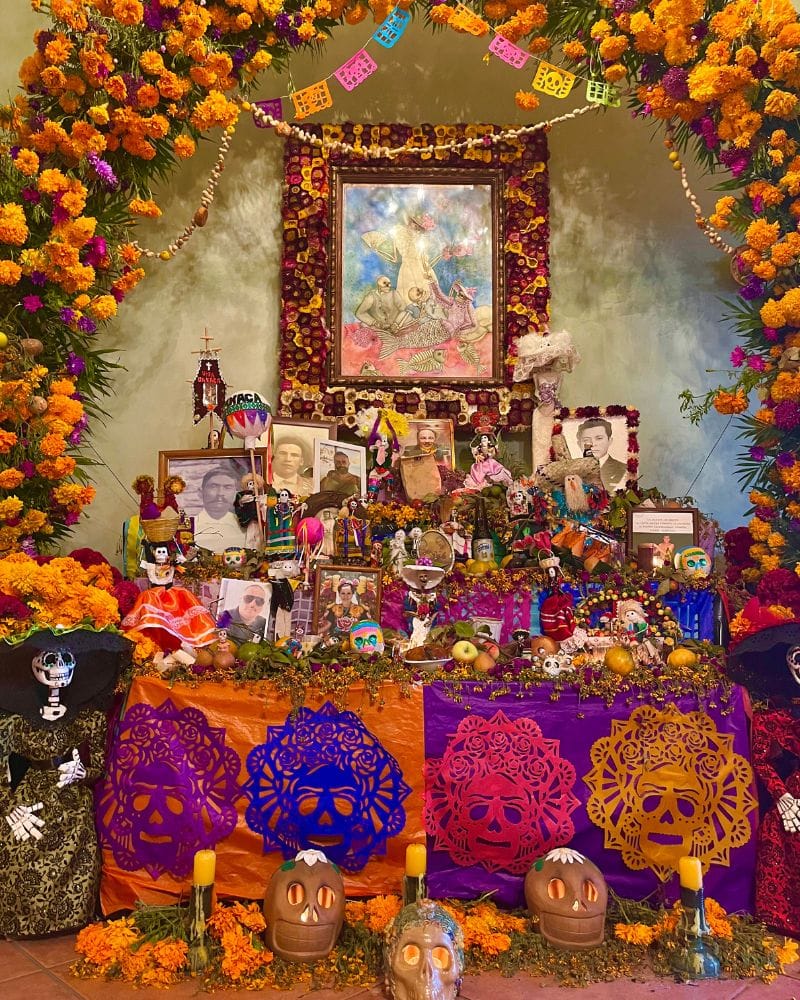
Walking the streets and alleyways of many towns in Mexico reveals a plethora of ofrendas (altars).
In fact, these ofrendas are among the most important Day of the Dead symbols and also hold some of the most important Day of the Dead symbols!
They are usually decorated with marigold flowers, candles, sugar skulls, copal incense and/or colorful paper flags called papel picado.
You’ll also see photos of the departed in a frame, and whatever food and drink they would want to consume on their arrival.
They say when the dead return, they will be hungry and thirsty from the journey — so we have to prepare accordingly.
5. Pan de Muerto (Day of the Dead Bread)

Pan de muerto, or “Dead Bread,” is a type of bread roll or pastry traditionally made from about mid-September to mid-November.
It is the food most associated with Day of the Dead, though there are others like mole negro (black mole), tamales and sugar skulls.
Unlike the rest of Mexico, Oaxaca’s bread isn’t very sweet and has a small candy face in the center to represent a departed soul. It is topped with sesame seeds.
However, in many other parts of Mexico, pan de muerto has a cross shape on the top of the roll, and is topped with sugar.
They also have orange zest or orange blossom water added, so they taste similar to a morning bun.
6. Alebrijes: Day of the Dead Art

Mexican artist Pedro Linares first made alebrijes in Mexico City. At age 30, he suffered a terrible illness, and even had fever dreams at night.
One night, he saw a chimera (hybrid animal) screaming the word “alebrije,” a word that has no real meaning.
From this vision, he made an artistic representation of this colorful chimera, and the first alebrije was born.
7. Mojigangas: Giant Puppets

Mojigangas (pronounced moe-he-gawn-gahs) come from Spain, but were brought to Mexico in the 1600s.
They stand about 15-feet-tall (4.5 m), and are a part of many celebrations in Central Mexico.
You can see mojigangas everywhere from festivals in Oaxaca to weddings in San Miguel de Allende. You’ll also see mojiganga puppets during Mexico Day of the Dead in several cities.
Final Thoughts: Day of the Dead

The Day of the Dead is a beautiful blend of ancient customs and modern practices, where every detail carries profound meaning.
It’s a time to honor loved ones, celebrate life, and embrace the reality of death with joy and reverence.
Whether it’s the sweetness of pan de muerto, the vibrant marigolds, or the elegant presence of La Catrina, these symbols bridge the living and the dead, ensuring that the memories of those we’ve lost remain alive.