
This Mexican Forest Turns Orange Every Fall (And You Won’t Believe Why it Happens)


🦋 Picture yourself in a forest surrounded by a sea of fluttering orange, black, and white wings. The air is filled with the gentle rustle of millions of monarch butterflies.
This is the amazing sight you can see in the forests of Michoacan and Estado de Mexico every fall.
Every fall, the forests of Michoacan and Estado de Mexico turn into a colorful display of orange, black, and white as millions of monarch butterflies finish their 2,800-mile journey from Canada and the United States.
This incredible event, which ends in the Monarch Butterfly Biosphere Reserve, is something every nature lover should see at least once in their life.
Disclosure: This article may contain affiliate links, meaning when you make a purchase, I earn a small commission. Affiliate links cost you nothing to use, and help keep my content free. It’s a win-win for us both. For more info, see the Disclosure Policy.
The Epic Journey

The monarch butterfly’s journey is truly epic. Starting in late summer, these delicate creatures travel 2,800 miles from Canada and the United States to the warmer climates of Central Mexico.
Monarchs make several important stops during their migration, including the Great Lakes region, the Appalachian Mountains, and the Gulf Coast.
Each stop provides essential resources like nectar and places to rest.
Scientists believe that monarchs find their way by combining the sun’s position, the Earth’s magnetic fields, and genetic memory:
- Sun Navigation: Monarchs use the sun as a compass, adjusting their flight path based on the sun’s position in the sky.
- Magnetic Fields: Some studies suggest that monarchs can sense the Earth’s magnetic fields, which helps them stay on course.
- Genetic Memory: Amazingly, the monarchs who finish the migration are not the same ones who started it. The journey spans multiple generations, each new generation instinctively knowing to continue the migration.
Along the way, they face many challenges. Monarchs must navigate through storms, avoid predators, and find enough food to keep going.
Despite these challenges, their survival instincts and biological mechanisms guide them to their destination.
Monarch Butterfly Migration Cycle

Remarkably, the migratory generation of monarchs responsible for this epic journey has an extended lifespan of up to 8-9 months.
The average lifespan of most monarch butterflies is significantly shorter, ranging from 2-6 weeks for adults.
These non-migratory generations hatch, mature, mate, and die within these few weeks, completing several generations within a year.
The migratory generation, born in late summer and early fall, benefits from an extended lifespan.
This adaptation allows them to reach Mexico and survive the winter, mate, and start their journey back north, where they lay the next generation’s eggs.
This cycle is crucial for their survival and serves as an indicator of environmental health and biodiversity.
Monarch Butterfly Migration Map

🦋 Mexico Butterflies Fun Facts
One of the most unique Mexican animals, most butterflies you see in Mexico are monarchs. However, Mexico has 2,045 species of butterflies!
These include endemic butterflies like the White-tipped ghost-skipper and Mexican Kite-Swallowtail, as well as the Nabokov’s Satyr and Carousing Jewelmark.
What is the Monarch Butterfly Biosphere Reserve in Mexico?
Mexico’s Monarch Butterfly Biosphere Reserve is a critical conservation area in Central Mexico that spans more than 56,259 hectares (about 140,000 acres).

The Mexico Monarch Butterfly Reserve is located in various regions across Michoacán State and the State of Mexico, and includes several butterfly sanctuaries.
Designated a UNESCO World Heritage Site in 2008, this reserve is known for its biodiversity. It is also vital for the study of monarch butterfly conservation.
Established to protect the Mexican butterfly migration, it’s a key wintering site and breeding ground location for the millions of monarch butterflies Mexico has.
The UNESCO Monarch Butterfly Reserve in Mexico showcases the importance of habitat preservation in the face of climate change and deforestation.
Through local and international efforts, the reserve aims to ensure the sustainability of the monarch migration for future generations.
Where do the monarch butterflies go in Mexico?
In Mexico, the monarch butterflies gather in the Oyamel fir forests located within the Transvolcanic Belt of Central Mexico.
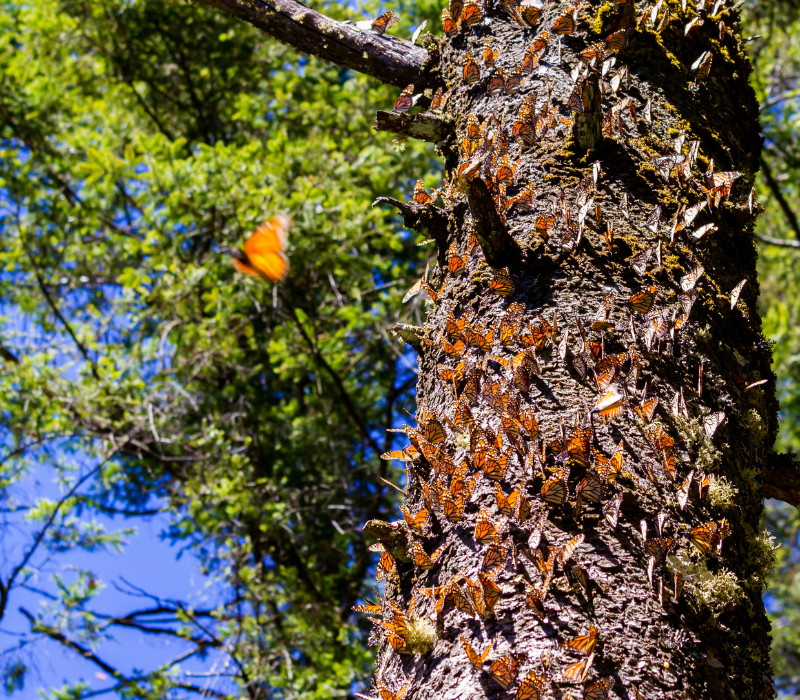
Monarch butterflies migrate to the forested mountains in the Mexican states of Michoacán and the State of Mexico.
Oyamel fir trees, which only grow at high altitudes of 7,800-11,800 feet above sea level (2,400-3,600 m), offer the ideal microclimate for monarchs to survive the winter.
The cool temperatures at these high altitudes slow the butterflies’ metabolism, allowing them to conserve energy.
This unique habitat provides the necessary conditions for monarchs to cluster together on the branches of the Oyamel trees (Abies religiosa), creating a spectacular sight.

The peak viewing season, when the butterflies are most active and the forests are dense with monarchs, is usually from late January to early March.
This timing aligns with the warmer days of late winter when the monarchs cluster less and fly more, making them easier to observe.
I recommend planning your trip around these months for the most incredible views of the monarchs in their winter habitat.
🦋 I recommend booking this 7 Day-Monarch Butterfly Ecofriendly Tour in Mexico so you don’t have to worry about the logistics.
Where is the best place to see monarch butterflies in Mexico?
You can explore four primary Mexican Monarch butterfly sanctuaries to experience the migration of monarch butterflies in Mexico.
1. El Rosario Butterfly Sanctuary in Michoacán State

While each sanctuary offers a unique vantage point of this natural wonder, El Rosario Sanctuary near Ocampo is the most popular monarch butterfly sanctuary Mexico has.
Seeing these Michoacan monarchs involves a steep hour-long trek, although many visitors are greeted by butterflies much closer to the entrance.
Given its popularity, visitors are typically given about 20 minutes at each viewing area to accommodate the large numbers, especially during peak times.
For a less crowded experience, I recommend going during the weekdays, although you should be mindful of potential school groups.
This Michoacan butterfly sanctuary has one of the most substantial roosts of monarch butterflies, making it a top pick for anyone who only has time for one sanctuary visit.
You can visit this sanctuary on this Monarch Butterfly Tour departing from Morelia.
🚘 HOW TO GET TO EL ROSARIO SANCTUARY

Getting there can be as simple as hiring a taxi from Angangueo, a nearby town.
If you are coming from Zitácuaro, your options range from rental cars for convenience to colectivos (local minibuses) for a more budget-friendly approach.
The latter involves a change in the town of Ocampo Michoacan, and then a short ride to El Rosario.
Minibuses are available for the return trip to Zitácuaro, with the last one departing at around 6pm for a fare of 50 pesos (about $3 USD).
Although there are many tours to this particular sanctuary, it is one of the easiest to access independently.
2. Sierra Chincua Butterfly Sanctuary in Michoacán State

Sierra Chincua Sanctuary offers a more intimate experience with the monarch butterflies near Angangueo.
Entrance fees are set at 80 pesos for foreigners, and unlike El Rosario, hiring a guide here is recommended.
Travelers can take an hour-long guided walk uphill through the park, or hop on a horse if you prefer not to walk.
Like El Rosario, time at the butterfly viewing areas is about 20 minutes so that all visitors get a chance to spend some time in the forest.
Although less visited and quieter, there is no shortage of monarch Mexico butterflies here. The trail is also less difficult as it is mostly flat for most of the hike.
Why come to Sierra Chincua? It has a lot of monarch butterflies — but receives fewer visitors than El Rosario, and has one of the easiest hikes of any sanctuary.
You can visit this sanctuary worry-free by booking this Monarch Butterfly Tour (Departing from Morelia).
🚘 HOW TO GET TO SIERRA CHINCUA SANCTUARY

⚠️ Fair Warning: Getting here can be an adventure in itself!
Taxis from Angangueo can take you, and if you’re coming from Zitácuaro, you have a few options, but be prepared for a bit of a journey.
While it might cost more to travel from Zitácuaro because of the distance, once you’re there, the challenge of arriving will feel like it was all part of the adventure.
Just remember, there’s no easy way back to town waiting for you, so getting the phone number of your taxi driver is smart.
A much more convenient option is booking this tour to Sierra Chincua Butterfly Sanctuary with a local guide.
Hiring a guide enriches the experience and solves the transport issue, as some guides also offer rides back to your accommodation.
3. Piedra Herrada Butterfly Sanctuary in México State

Piedra Herrada is popular due to its proximity to major cities like Mexico City and Valle de Bravo.
From the entrance, the path leads you on a hike through the forest, lasting 45 minutes to an hour.
You’ll then reach the summit of the trail, where most butterflies gather.
Upon reaching the top, visitors are allowed a 15-minute stay to experience the butterflies before making their way back down.
🦋 Pro Tips: This sanctuary is one of the closest sanctuaries to Mexico City, and is full of bus tours during the weekend, so try to avoid weekends if possible.
Also, avoid Wednesdays and Thursdays, the busiest days for school trips.
For a full butterfly migration experience, book this 7 Day-Monarch Butterfly Ecofriendly Tour in Mexico that takes you to 2 sanctuaries.
🚘 HOW TO GET TO PIEDRA HERRADA SANCTUARY

The Piedra Herrada Sanctuary is about two hours from Mexico City, and can be easily visited. In fact, it makes for a great Mexico City day trip option.
Another option is an overnight stay at Valle de Bravo, about 19 miles (30 km) away.
Whether coming from Mexico City or Valle de Bravo, you can rent a car, take a guided trip, book a tour, or arrange a taxi.
Always arrange a pick-up with your taxi driver, and never assume that taxis will be waiting for you when you finish your experience unless you plan this in advance.
4. Cerro Pelón Butterfly Sanctuary in México State

Cerro Pelón, straddling Michoacán State and Estado de Mexico (Mexico State), is one of the four least visited and untouched sanctuaries.
However, this particular flying monarch butterfly sanctuary is not for the faint of heart!
It requires physical fitness and a lot of preparation — so bring plenty of water and snacks, as no vendors are on-site.
Its challenging terrain, filled with steep, rocky paths, makes horseback rides a recommended way to explore.
It takes about two hours to get up and two hours to go down, so if you want to visit other sanctuaries, make this the last one on your list.
🚘 HOW TO GET TO CERRO PELÓN SANCTUARY
One unique option is to go to Macheros and stay at the Cerro Pelón Butterfly B&B.
Located about five minutes from the sanctuary’s entrance, it is one of the only places in Mexico where you can stay in the butterfly sanctuary.
Other options are renting a car, booking this guided tour, and trying to get there independently from Zitácuaro via public transportation.
To do this, you’ll use a combination of minibus and taxi. Of course, this can be a bit tricky, especially if you don’t speak at least some Spanish.
Ready to Book Your Mexico Vacation? Here Are Some Resources To Look At

Mexico is a large country — the 14th largest country on Earth by size — and the 6th most biodiverse diverse country in the world.
Though it’s mostly known for beaches, there’s a lot more to Mexico than that. Check out these Mexico articles to discover parts of the country you never knew existed.
- The 30 Most Beautiful Cities in Mexico (#7 Will Shock You)
- Mexico Off the Beaten Path Places for Your Bucket List
- 20 Hot Springs in Mexico That are Calling Your Name
- Hidden Beaches in Mexico You’ve Never Heard Of
- Best Waterfalls in Huasteca Potosina Mexico
- The Coolest Mayan Ruins in Mexico’s Yucatan Peninsula
⚠️ Before You Go — Get Your FREE Guide!
Head here and enter your email address to download your FREE Mexico guide (5 Things You Don’t Want to Forget to Pack for Mexico) and get Mexico travel tips, tricks and more sent straight to your inbox.
