
What Are Alebrijes? Discover Mexico’s Most Magical Art Form

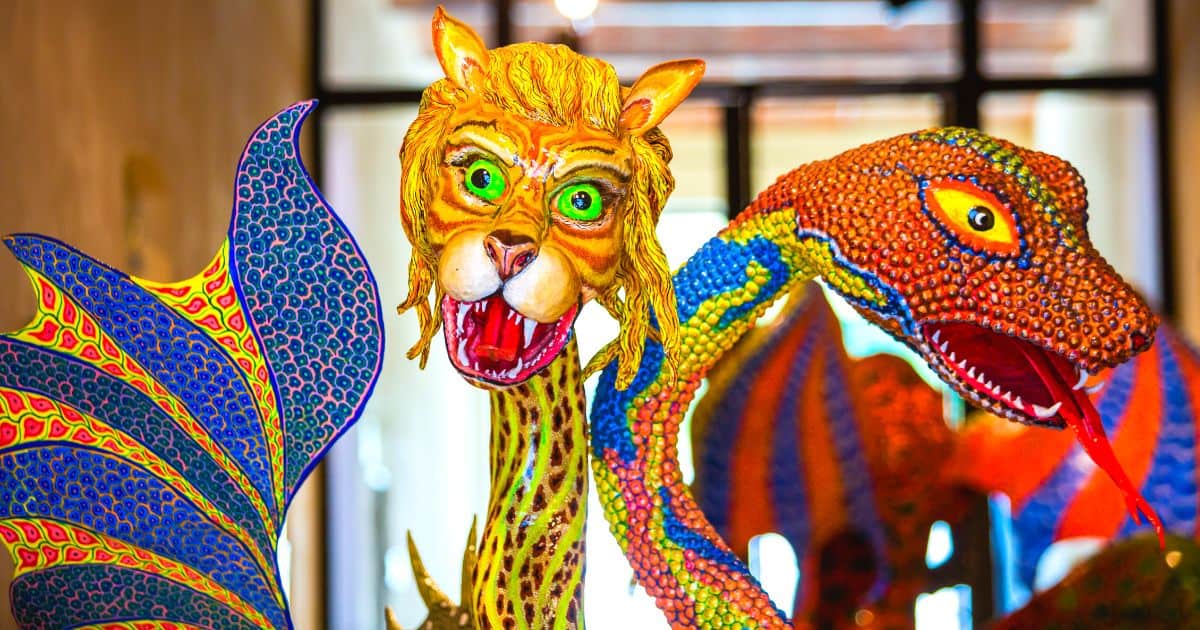
While some see alebrijes as Mexican spirit animals, similar to a Native American totem, others say these famous Oaxacan wood carvings are little more than decorative Mexican folk art.
This article covers everything from their history and symbolism, the first man to make an alebrije, their prevalence in popular culture today, and everything else you want to know about alebrijes.
Ready to discover the fantastical Oaxacan alebrijes? Let’s dive in!
Disclosure: This article may contain affiliate links, meaning when you make a purchase, I earn a small commission. Affiliate links cost you nothing to use, and help keep my content free. It’s a win-win for us both. For more info, see the Disclosure Policy.
What are Alebrijes?
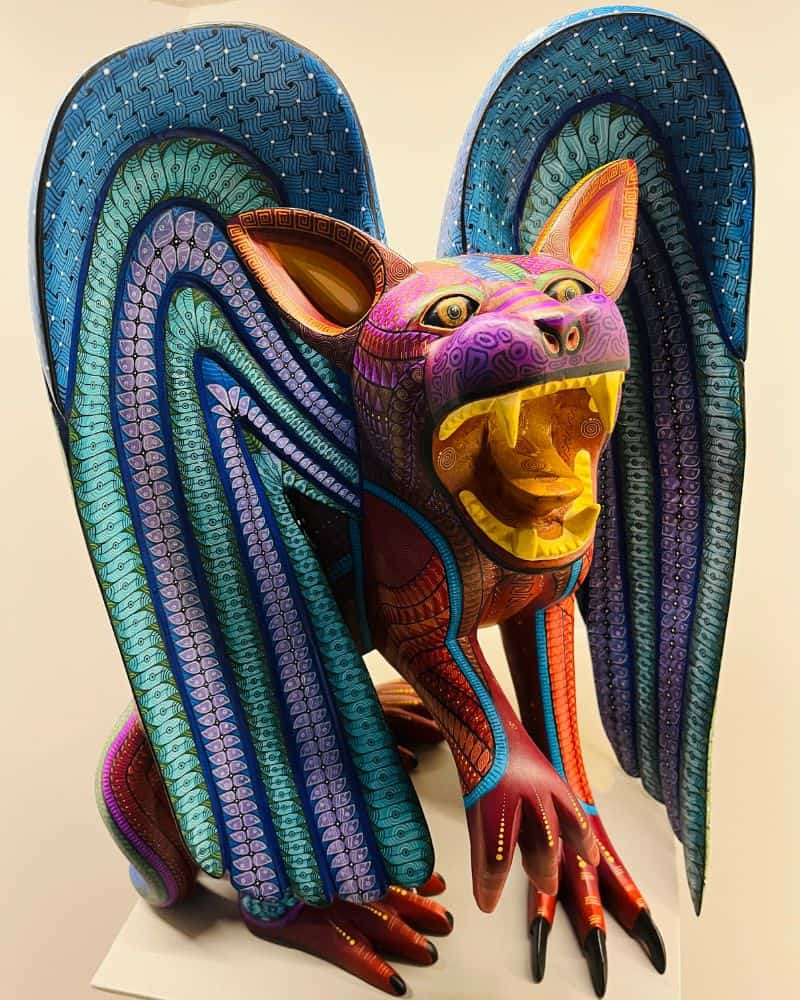
Alebrijes are brightly-colored Mexican folk art sculptures of fantasy creatures, and no two are alike.
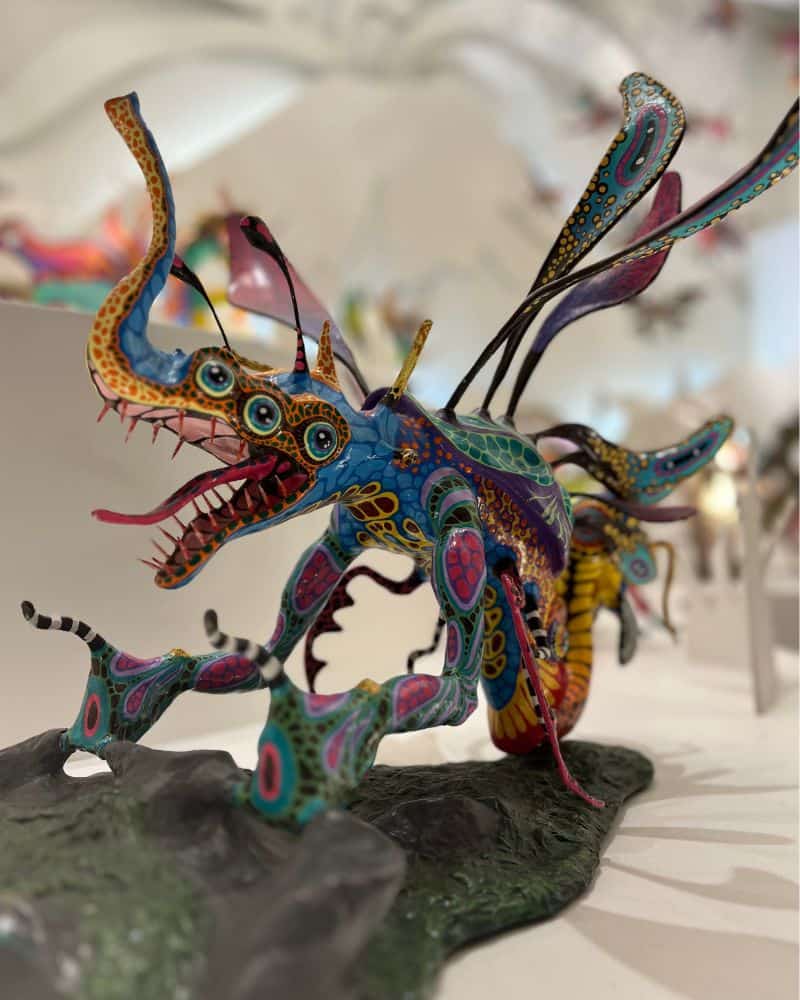
There are many different types of folk art from Mexico, but alebrijes come from the state of Oaxaca, located in Southern Mexico, to the south of Mexico City.
What is my Alebrije?
Some say alebrijes are spirit animals or otherworldly guides, akin to a Wiccan familiar or Native American totem.
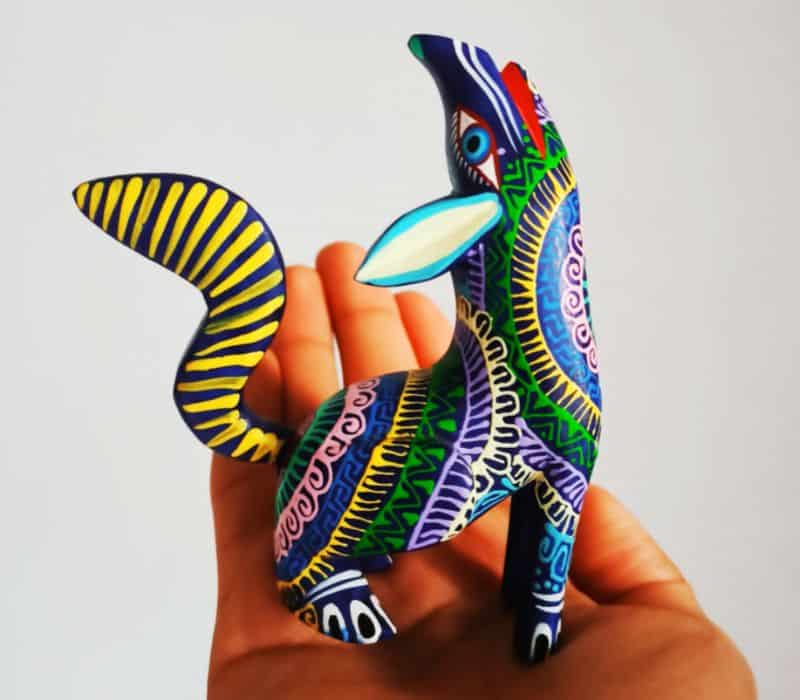
While there’s no evidence that’s what these phantasmagorical Mexico creatures are, you can take this fun quiz to answer the question, What is my alebrijes?
How do you pronounce Alebrije?
The correct pronunciation of alebrije is al-lay-bree-hay.
If you were wondering about the alebrije pronunciation, don’t worry because it’s a common question.
However, we needed to clear it up before we go could any further — but now that everyone’s on the same page, let’s continue!
Is there a translation for alebrijes in English?
No — There is no English translation for alebrije, and in fact, there’s no Spanish translation for alebrije either. Alebrije is a made up word that doesn’t mean anything at all; it’s simply the name of this particular style of Mexican art
Where does the word alebrije come from?
It is attributed to the creator of alebrijes, Pedro Linares. There’s more about Pedro coming up, but in short, he fell ill to the point of having fever dreams, and saw the creatures he named alebrijes in those dreams.
Wondering about the origins of alebrijes?
The first alebrijes were made by artist Pedro Linares in Mexico City in the 1940s.

He was primarily a cartonería artist (a type of traditional papier-mâché art from Mexico), and the first alebrijes were made of papier mache, not wood.
Linares sold his colorful creations at many local markets, including the well-known Mercado la Merced in Downtown Mexico City.
Eventually, alebrijes entered the hands (and hearts) of two other famous Mexican artists, Frida Kahlo, and husband, Diego Rivera.
Pedro Linares Lopez: Creator of Alebrijes

Mexican artist Pedro Linares is the so-called inventor of alebrijes, and the first person to create what we know today as an alebrije.
He was a pretty well-known cartonería (papier-mâché) artist in Mexico City, and the first alebrijes were made of paper.
As alebrijes started gaining popularity in Mexico City, they also caught the attention of Judith Bronowski, a British documentary filmmaker.
She made the 1975 film, Linares: Artesano de Cartón, about his fantastical artform.
In the 1980s, Bronowski organized a Mexican art workshop in the United States with Pedro Linares, Manuel Jiménez Ramírez, and Oaxaca textile artist, Maria Sabina.
She is also a famous shaman from Huautla de Jimenez.
Between the documentary and this Mexican folk craft workshop, alebrijes spread, and took on a new form.
pedro linares alebrijes for sale
You will sometimes see Pedro Linares original alebrijes come up for sale on auction sites, like this one that sold on LiveAuctioneers.
They start at about $1,000 USD for smaller pieces, but the large alebrijes usually go for much more.
Manuel Jimenez: Creator of Oaxaca Alebrijes
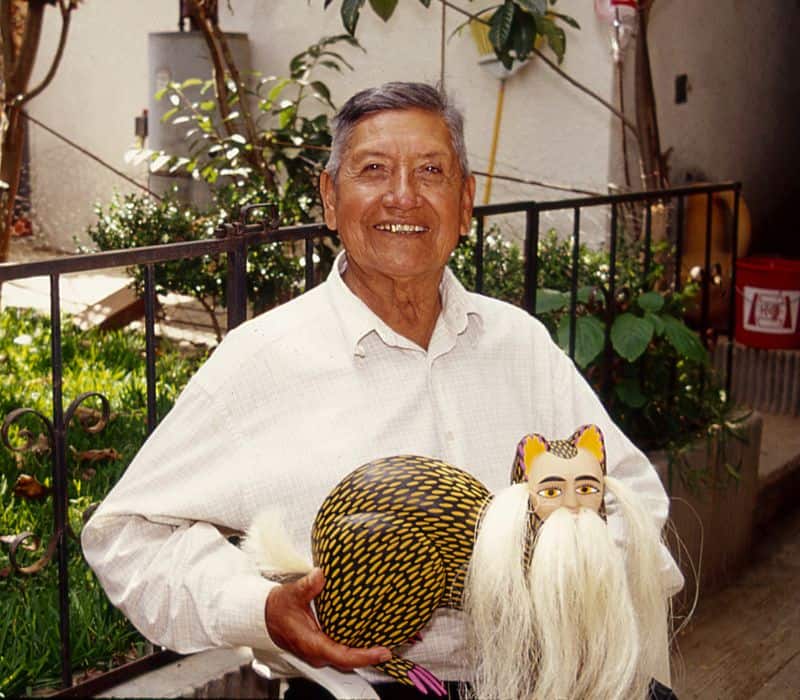
Manuel Jiménez Ramírez was a Mexican woodcarver, sculptor and painter. He is credited with the invention of the Oaxacan alebrijes we know today.
The major changes he made was using wood instead of papier mache, which Linares used.
Jiménez was born in the pueblo of San Antonio Arrazola, Oaxaca, located just six miles (10 m) from Oaxaca City.
As a young artist, he used clay, then wood, as his preferred mediums. Wood art was common in this part of Oaxaca, thanks to the copal tree.
Oaxacan Alebrijes Today
The alebrijes of Oaxaca we know today are made with wood from the copal tree (Protium copal).
This tree is native to Mexico and Central America and is used for everything from carving Oaxacan animals for alebrijes to making copal incense from its resin.
After being carved from the copal wood, alebrijes are hand-painted in their characteristic bright colors.
Since these are fantasy or imaginary creatures, and painted by hand, every authentic Oaxacan alebrije is unique, so no two are alike.
Arturo Caballero: Modern-Day Alebrije Artist

Arturo Caballero is perhaps the most famous of all contemporary alebrije artists today.
He makes both small and large alebrijes (some as tall as 6-feet/2 m), which have an almost Asian aesthetic, reminiscent of Japanese artists like Yayoi Kusama and Takashi Murakami.
Coco Alebrijes: Dante and Pepita

Alebrijes weren’t part of the older Oaxaca Día de Muertos traditions, but they have made their way into modern-day celebrations.
As part of mainstream pop culture today, they have made their way into Day of the Dead-themed films, like Pixar’s Coco.
What do Alebrijes symbolize?
Like all good art, this is something for the viewer or alebrije owner to decide.

If we take them from their original creation point, alebrijes were a spirit guide for Linares, navigating his frightening fever dreams through a terrible illness.
They began as a vision in Pedro Linares’ dreams, crafted out of paper mache in Mexico City.
As their popularity grew, alebrijes evolved, and their meaning may have evolved with them.
However, this was just what they symbolize to him, and they can mean different things to different people.
Alebrijes Animals
At a quick glance, alebrijes look like animal figures. When you inspect closer, you’ll see each alebrije combines characteristics from a few animals that have been merged into a single figure.
This is because alebrijes are made up animals, and it’s why no two are alike.
Alebrijes Patterns

Wondering, What are the characteristics of alebrijes? Two of the most visually-striking are the bright colors and intricate patterns.
While some alebrijes just have dots and stripes on them, some have patterns symbolic to the local Zapotec of Oaxaca, those native to the land.
The 4 Elements of Alebrijes
Pedro Linares’ original alebrijes were hybrid creatures, containing qualities from the four elements — Earth, Air, Water and Fire.
Nowadays, artists have license to make alebrijes as they see fit, and while many do still take the Four Elements into account, there are no rules.
You’ll see all types of alebrijes imaginable, but now you know ones with wings may signify the Air Element.
Alebrijes with fins might represent the Water Element, horns or antlers might represent the Earth, and dragon characteristics may represent Fire.
Where are Alebrijes made?

San Antonio Arrazola, Oaxaca
Until the mid-1960s, San Antonio Arrazola was the only village in Oaxaca producing authentic alebrijes from Mexico.
Manuel Jiménez was the main alebrije artisan, but eventually, the local alebrije vendors selling his art fell out of favor with him.
The copal wood suppliers and alebrije vendors, uhappy with Jiménez, started encouraging other nearby Oaxaca towns to take up the artform.
Eventually, other towns like San Martin Tilcajete and La Unión in the San Felipe Tejalápam Municipality, started to make alebrijes.
Though he seemed to be in disfavor with everyone around him, Jiménez remains one of the most famous people from Oaxaca thanks to his alebrijes.
San Martin Tilcajete, Oaxaca
Hearing just how lucrative alebrijes had been in San Antonio Arrazola, artisans in the nearby pueblo of San Martín Tilcajete took up the craft.
Nowadays, San Martín Tilcajete is even more synonymous with Oaxaca alebrijes than San Antonio Arrazola, where they originated.
Alebrijes in other parts of Mexico
In Mexico, alebrijes are sold at local mercados (Oaxaca markets) and crafts fairs and on display at museums.
Some of them will be authentic Oaxaca alebrijes from San Antonio Arrazola or San Martín Tilcajete, and some won’t be.
It’s difficult (maybe impossible) to know which ones were authentically-produced, and which weren’t.
Especially with smaller alebrije figurines that leave little room for an artist’s signature, there’s really no way to tell — unless you buy them from one of the Oaxaca alebrije towns.
How are Alebrijes made?

Some, though not all, artists start by making sketches or alebrijes drawings of what they want to carve.
Carving the figure comes next, sanding it, and painting the alebrije in their characteristic bright colors and Zapotec patterns.
Some alebrijes are signed, though usually only the large sculptures, not the small alebrije figurines.
As with most art, pieces with an artist’s signature hold a higher value — but just who signs the alebrije is an interesting topic, as it takes several people to make one.
The person who signs the alebrije is usually the person most well known in the family that made it or the workshop where it was made.
While one son may carve the alebrije, and another son may sand it, and the daughter may paint it, if the father is a famous artisan, he will sign it.
Production of Alebrijes in Oaxaca
There’s definitely a division of labor when it comes to making alebrijes. Usually, the men and boys gather the copal wood, and carve it.
Sanding the alebrijes is monotonous and often considered the worst part of the process, so it’s usually relegated to children in the family.
Women will then take over from here, and paint the alebrijes.
As some painters are more skilled and precise than others, the larger sculptures that will sell for more money are given to the best painters, while the small alebrije figures go to those with less artistic ability.
What materials are Alebrijes made of?

Papier Mache
The first iteration of alebrije art was made from papier-mâché.
Alebrije creator Pedro Linares was a cartonería artist, so he mainly worked with paper as a medium, but did eventually make alebrijes out of wood so they would be sturdier.
Copal Wood
Alebrijes are Oaxacan wood carvings, traditionally made with wood from the copal tree.
In his book, Crafting Tradition: The Making and Marketing of Oaxacan Wood Carvings, author Michael Chibnik writes about the different types of copal wood.
“Wood carvers in La Unión Tejalapam refer to two types of copal: male and female. The female (hembras) are better for carving because they are softer and have fewer knots, while the male (machos) are lighter in color…” which makes male copal wood easier to paint.
Crafting Tradition
Final Thoughts on the Mexican Alebrijes of Oaxaca
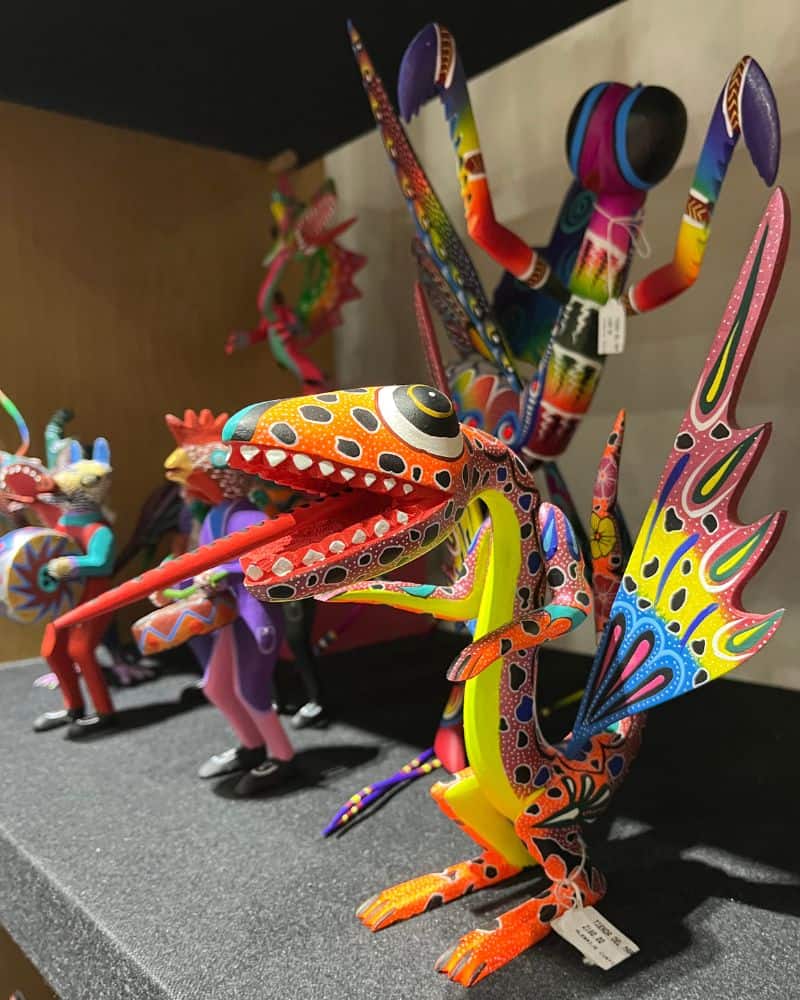
Sometimes called Mexican spirit animals, alebrijes hold a lot of meaning for some, and are nothing more than a colorful Mexican folk art for others.
As with all art, each person an alebrije touches is moved by it in a different way.
When traveling to Oaxaca City, you must visit the Alebrije Towns of San Martín Tilcajete and San Antonio Arrazola to see them being handmade by local artisans.
For now, I hope this article answered all your questions about alebrijes, the famous Oaxacan wood carving art.
Ready to Book Your Mexico Vacation? Here Are Some Resources To Look At:

Mexico is a large country — the 14th largest country on Earth by size — and it’s also the 6th most biodiverse diverse country in the world.
Though it’s mostly known for beaches, there’s a lot more to Mexico than that. Check out these Mexico articles to discover parts of the country you never knew existed.
- The 30 Most Beautiful Cities in Mexico (#7 Will Shock You)
- Mexico Off the Beaten Path Places for Your Bucket List
- 20 Hot Springs in Mexico That are Calling Your Name
- Hidden Beaches in Mexico You’ve Never Heard Of
- Best Waterfalls in Huasteca Potosina Mexico
- The Coolest Mayan Ruins in Mexico’s Yucatan Peninsula
⚠️ Before You Go — Get Your FREE Guide!
Head here and enter your email address to download your FREE Mexico guide (5 Things You Don’t Want to Forget to Pack for Mexico) and get Mexico travel tips, tricks and more sent straight to your inbox.
