
Celebrating Three Kings Day in Mexico: Gifts, Rosca de Reyes & Tamales

In a country that’s overwhelmingly Catholic, Three Kings Day in Mexico (Día de Reyes or Día de Reyes Magos) is an important holiday celebrated every January 6th.
In the Catholic tradition, it marks the day the Three Wise Men (Reyes Magos) reached baby Jesus in Bethlehem and brought gifts to the child.
For this reason, some Mexican kids get gifts from the Reyes Magos that morning instead of on Christmas.
There’s a lot more to celebrating Three Kings Day in Mexico, including the ring-shaped rosca de reyes cake, so let’s do a deeper dive into this festive holiday.
When Is Three Kings Day in Mexico in 2027?

Three Kings Day is on January 6th each year, and in 2027, it’s on Wednesday, January 6th.
The night before, Tuesday, January 5th, is when kids leave out their shoes and letters for the Reyes Magos (Three Wise Men).
Día de Reyes is not one of Mexico’s official public holidays, so government offices, banks, businesses, shops, and restaurants open for business as usual.
It’s also the last day of the Guadalupe-Reyes Marathon, aka the 26-day Mexican Christmas season.
This begins with Día de Guadalupe on December 12th, the holiday for Mexico’s patron saint, and ends with Día de Reyes Magos on January 6th.
What Is Día de Reyes Magos?

Día de Reyes celebrates the Epiphany.
In the Christian story, three kings followed a star to Bethlehem to meet the newborn Jesus. In Mexico, they’re known as Melchor, Gaspar, and Baltasar.
They brought gifts of gold, frankincense, and myrrh. That’s why, in Mexico, the Three Kings are the ones who bring presents to children.
Santa Claus has become popular in Mexico, too, so many kids now get gifts on both December 25th and January 6th. (🎁 Lucky kiddos, huh?!)
How Mexicans Celebrate Three Kings Day
1. Letters to the Three Kings

In the days before January 6th, kids write letters to the Reyes Magos. They list the gifts they’d like and promise they’ve been good all year.
2. Shoes by the Door and Hay for the Camels
On the night of January 5th, children leave their shoes out, often next to the nativity scene or the Christmas tree.
Some kids, particularly those from religious families, put a little hay or grass nearby for the three kings’ camels.
3. Gifts on the Morning of January 6th

When kids wake up on January 6th, their presents are waiting next to their shoes.
On Día de Reyes (January 6th), expect to see children showing off new bikes, balls, and toys in parks and plazas.
4. Photos With the Reyes Magos
In malls and churches throughout the country, large-scale displays are set up — usually with live men portraying the kings — so kids can take photos with them.
This is similar to what you might see at malls in the U.S. with Santa during Christmas and the Easter Bunny during Easter.
Various cities in Mexico have holiday fairs and public festivals like the Romería de Reyes in Mexico City.
Here, families line up to take photos with Melchor, Gaspar, and Baltasar, and kids hand over their letters to the Three Kings in person.
What Is Rosca de Reyes?

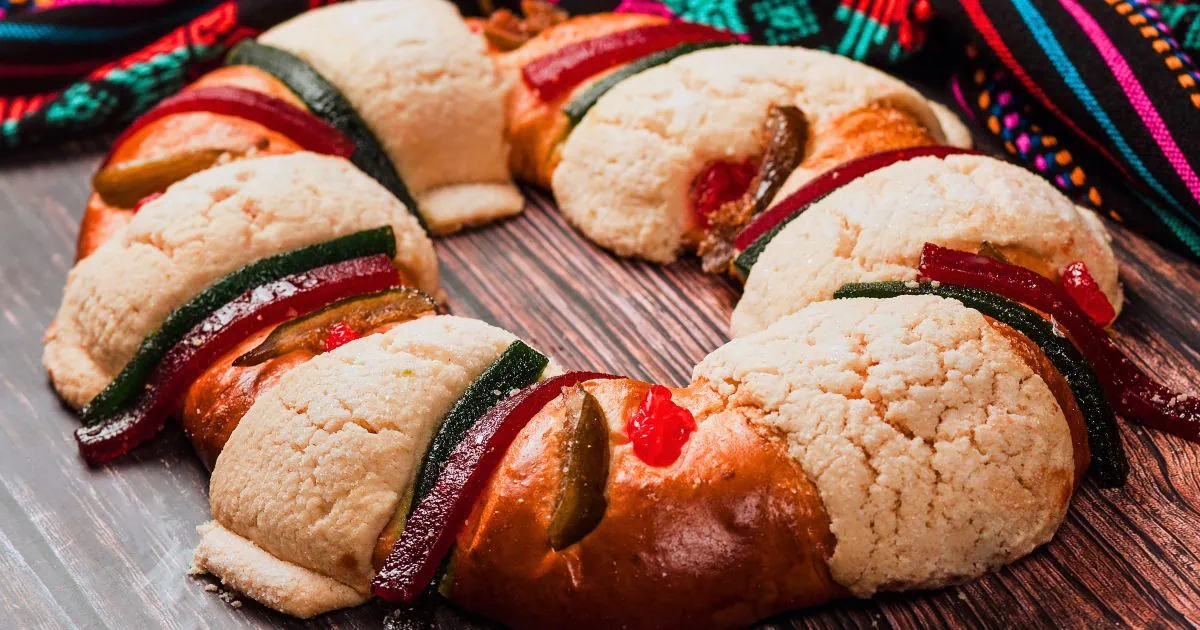
Rosca de reyes (meaning “kings’ ring”) is a large oval or ring-shaped sweet bread, eaten on Three Kings Day.
It’s soft and lightly sweet, often flavored with orange zest and orange blossom water.
The top is decorated with strips of ate (pronounced ah-tay), candied fruit, and sugar.
Ate means “fruit paste” in Spanish.
The traditional rosca has no filling, but many bakeries now also sell roscas filled with nata (sweet cream), chocolate, cream cheese, or fruit jelly.
The tradition of rosca de reyes came to Mexico from Spain, where a similar bread is called roscón de reyes.
France has its own version, the galette or gâteau des rois.
Some historians trace the idea of a hidden token in a cake back to the Roman festival of Saturnalia, held in honor of the god Saturn.
Rosca de Reyes vs King Cake in New Orleans

If you’ve been to New Orleans, the rosca might look familiar. The Louisiana king cake comes from the same tradition, brought by French settlers.
In New Orleans, king cake season starts on January 6th, called Twelfth Night, and runs until Mardi Gras.
King cake is a ring of sweet dough topped with icing and purple, green, and gold sugar, the colors of Mardi Gras.
Similar to Mexican rosca de reyes, king cakes also have a small plastic baby hidden inside.
Whoever finds it buys the next cake or throws the next party, instead of hosting a tamal party.
What the Rosca de Reyes Symbolizes

Besides being one of the most beloved types of Mexican pan dulce (sweet bread), every part of the rosca has a meaning.
- ⭕️ The shape: the ring has no beginning and no end, which stands for God’s endless love. It also looks like a king’s crown.
- 🍒 The candied fruit: the jewels on the Three Kings’ crowns.
- 👼 The baby Jesus figurines: Jesus hidden from King Herod, who ordered the killing of baby boys in Bethlehem.
In Europe, the hidden token used to be a dried bean. In Mexico, it became a small figurine of baby Jesus, called the Niño Dios or muñeco.
A small rosca usually hides a few figurines, while big ones can have up to a dozen.
What Happens If You Find the Baby Jesus in Your Rosca?

With rosca in Mexico, everyone cuts their own slice, one at a time. You can’t see the figurines from the outside, so it’s a gamble.
If you find one, you become the baby Jesus’s godparent (called “padrino” for godfather, or “madrina” for godmother).
As with being an actual godparent, finding the baby Jesus in your rosca de reyes also comes with a job.
On February 2nd, Día de la Candelaria, the person who found it must host a gathering and serve tamales with atole (a pre-Hispanic corn drink).
Traditionally, the godparent also dresses a Niño Dios figure and takes it to church to be blessed that day — that’s why some people cut their slice very carefully.
Why You Won’t Find Acitrón in Your Rosca Anymore
Older roscas were topped with acitrón, a candied cactus made from the biznaga, a barrel cactus 🌵 that grows very slowly and is protected in Mexico.
Under Mexico’s endangered-species rule, selling it is illegal, so today, bakeries use ate, candied figs, papaya, or other fruit instead.
Where to Buy Rosca de Reyes in Mexico

Roscas show up in bakeries right after New Year’s and sell out fast on January 5th and 6 — though there are select places selling them year-round.
During the holidays, you’ll find rosca de reyes cakes at neighborhood panaderías (bakeries), supermarkets, Costco, and all the big national bakery chains.
Expect lines on January 5th and 6th, and know that eventually, roscas will be sold out everywhere if you wait too long to buy yours.
For those who just want a taste, many places also sell mini roscas for one person, in addition to the large (and massive) rosca de reyes cakes.
Día de la Candelaria: The Tamales You Owe on February 2nd

Día de la Candelaria (Candlemas) takes place each year on February 2nd.
An important holiday in the Catholic tradition, it also marks the final chapter of the rosca tradition in Mexico.
It is the day when everyone who found a Jesus figurine in their rosca on January 6th throws a tamal party, called a tamalada. 🫔
Families also bring their Niño Dios figures, dressed in new clothes, to church to be blessed.
Learn more about tamales in my guide to traditional Mexican foods.
Best Place to Experience Three Kings Day in Mexico: Tizimín, Yucatán

The small town of Tizimín, located in eastern Yucatán state about two hours from Mérida, is known as the “City of the Kings.”
Though I’ve driven through Tizimín en route to the beach town of El Cuyo, I haven’t had the chance to attend its impressive Feria de Reyes (Kings Fest).
Tizimín’s main church is dedicated to the Three Holy Kings (Melchor, Gaspar, and Baltasar), the town’s patron saints.
Each December 28th, the kings’ statues are brought down from their niches to start the Feria de Reyes, the town’s biggest festival of the year.
It runs through January, with pilgrims, a cattle fair, folk dancing, concerts, religious plays, and more.
Tips for Visiting Mexico on Three Kings Day
- 📆 It’s a normal workday. Museums, shops, and restaurants keep regular hours, but bakeries get packed.
- 🍰 Buy your rosca early. The best ones from the most popular bakeries sell out by the evening of January 5th.
- ✅ Say yes if you’re offered a slice. Just know the rule if you find the baby Jesus!
- 🔪 Ask before you cut. Some families wait for everyone to arrive, and kids often go first.
- 🤓 Read up on the season. Día de Reyes closes out a whole month of celebrations, which I cover in Mexican Christmas traditions and Mexican Christmas foods.
Three Kings Day in Mexico FAQ
When is Three Kings Day in Mexico in 2027?
Three Kings Day (Día de Reyes) is on Wednesday, January 6th, 2027, though kids leave their shoes out the night before, on January 5th.
Is Three Kings Day a holiday in Mexico?
It’s an important tradition, but it’s not an official day off, so businesses, banks, and offices are open as usual.
What happens if you get the baby in the rosca de reyes?
You become the baby Jesus’s godparent. On February 2nd, Día de la Candelaria, you host a party and serve tamales.
What does the rosca de reyes represent?
The ring/oval shape stands for God’s endless love and the kings’ crowns.
The candied fruit represents the jewels on the crowns, and the hidden figurines represent baby Jesus hiding from King Herod.
How many babies are in a rosca de reyes?
It depends on the size. Small roscas usually have a few figurines, while big ones can hide up to a dozen.
Do Mexicans get gifts on Christmas or Three Kings Day?
Traditionally, Mexican children get gifts from the Three Kings on January 6th. Today, many families also give gifts on Christmas.
Is rosca de reyes the same as king cake?
They come from the same European Epiphany tradition, but they’re not the same.
New Orleans king cakes are topped with purple, green, and gold sugar and eaten until Mardi Gras.
Mexico’s rosca de reyes cakes are topped with candied fruit and (mostly) eaten on or around January 6th.
What do you eat on Día de la Candelaria?
Tamales, with atole or champurrado (Mexican hot chocolate) to drink.
They’re paid for by whoever found the baby Jesus in the rosca on January 6th.
My Final Thoughts on Celebrating Three Kings Day in Mexico

Three Kings Day (Día de Reyes) is the sweet ending to Mexico’s long holiday season — the so-called Guadalupe-Reyes Marathon.
An important religious holiday, it also includes gifts for the kiddos and a family meal with traditional Mexican foods and rosca de reyes (Mexican king cake).
If it’s your first time sampling rosca, try the traditional kind with no filling before opting for the fancier versions.
If you’re in Mexico on January 6th, grab a slice of rosca de reyes and cut carefully, because you don’t want to find the baby Jesus and owe everyone tamales.
