
The 12 Best Oaxaca Art Towns to Buy Direct from Local Artisans

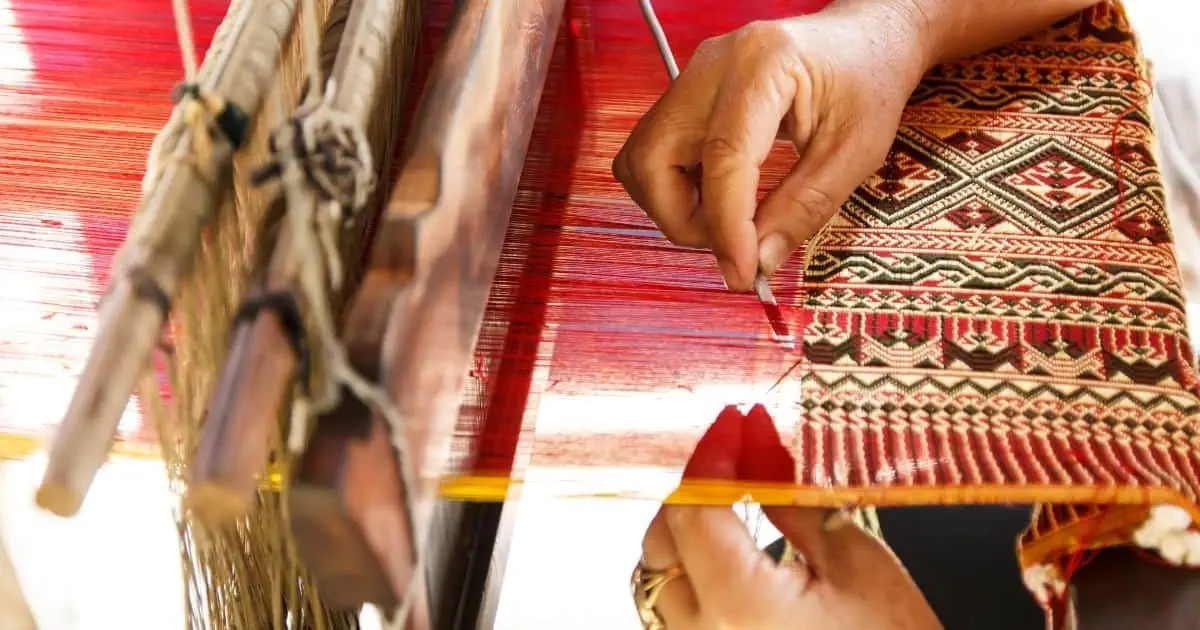

Ready to discover the art towns in Oaxaca Mexico?
You’ve come to the right place because this article highlights the Top 12 best Oaxaca artisan towns in the state.
Discover the most incredible Mexican folk art in Oaxaca, from black pottery and fantastical animal sculptures to artisan cheese and mezcal.
Each of these Mexican art towns is like a unique art gallery.

Want to do a Oaxaca art towns tour? Book this Zapotec Tour, with a near-perfect Five Star rating, which takes you to five towns.
Learn where each type of handicraft is made and a little about the artists and the creative traditions in each town.
You’ll also learn about the top three artisan markets to visit with tips on what to look for and what to eat.
Sometimes called the Oaxaca Ruta de Artesanías (Oaxaca Art Town Route), let’s get to this list of the best Oaxaca artisan towns to visit when you’re traveling to Oaxaca Mexico.
Top 12 Best Oaxaca Artisan Towns
1. San Bartolo Coyotepec, Oaxaca: Black Pottery Town

There are few better places to enjoy Oaxacan art than the small town of San Bartolo Coyotepec (pronounced coy-yo-tah-peck).
👩🎨 Best Way to Go: You can visit this artisan village, and a few more, by booking this full-day Oaxacan tour to see all the top Oaxaca sites and art towns.
Known internationally for its black pottery, the ceramics made here have been found in archaeological digs going back centuries. Why? — you might be asking.
Because “barro negro” (black clay) is extremely strong and impermeable. Known as Oaxacan black pottery, barro negro is the perfect material to make containers for storage or transport.
Until the 1950’s, though, you may have thought black clay was a misnomer. That’s because the fired wares came out of a gray matte color; not black at all.
Fortunately, Doña Rosa Real Mateo, a San Bartolo native, discovered that if she rubbed a stone over the surface, the vessels fired to a deep shiny black.
This technique, called burnishing, makes the clay more fragile and porous, but adds beauty by spades.
Decorative black pottery makes for stunning home decor and is all the rage in San Bartolo now, supporting 95% of the population.
Doña Rosa’s family continues to produce fine black pottery today, as do other notable artists such as Carlomagno Pedro and Abdiel Cardozo Calderón.
This is one Oaxaca artisan town you won’t want to miss!
📍 Location: Find San Bartolo Coyotepec on Google Maps
2. Teotitlán del Valle, Oaxaca: Rug and Textile Town

Art runs deep in the soils and towns of Oaxaca, and in this case, in fibers and fingers. Teotitlán del Valle, AKA the Oaxaca Textile Village, is a Zapotec village founded in about 1465.
👩🎨 Best Way to Go: If you’re planning to do a Oaxaca tour, book this full-day tour that includes Teotitlán del Valle, the Hierve el Agua waterfalls, and more.
Teotitlán del Valle is famous for its massive and intricate “tapete” rugs.
These Oaxaca rugs are made from local sheep wool, which has been dyed in a gorgeous array of reds, blues, yellows, and purples.
Although synthetic dyes are still used by some, the most dedicated artists use all-natural dyes gathered from wildflowers, bark, roots, and cochineal insects.
Demetrio Bautista Lazo, one such artist, has pioneered new green dyes and added his special flare to the traditional Zapotec designs.
Stop in at Demetrio’s studio at La Cupula Restaurant and B&B to admire and purchase rugs made by him and his extended family.
Looking to stay the night in this charming town? Book your stay at La Cupula B&B — one of the best hotels in Teotitlán del Valle, Oaxaca.
While you’re there, you may also get a quick introduction to natural dye production and weaving. From La Cupula, continue into town to explore more beautiful weaving operations.
📍 Location: Find Teotitlán del Valle on Google Maps
3. San Martín Tilcajete, Oaxaca: Alebrije Town
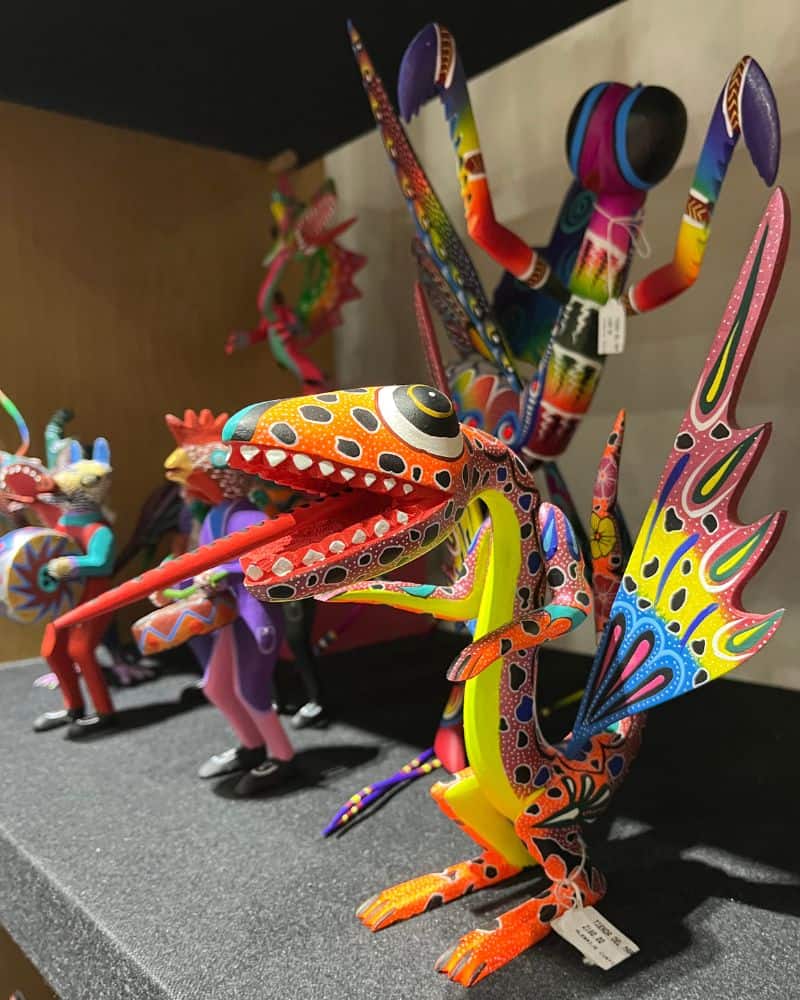
Colorful and fanciful — that’s one way to describe the bright wooden sculptures San Martín Tilcajete, Mexico has.
The town has become famous for its colorful animal figures, known as alebrijes.
👩🎨 Best Way to Go: Visit the Oaxaca alebrije town of San Martín Tilcajete by booking this Oaxaca private tour to the artisan villages, where you’ll watch demonstrations of how these wooden sculptures are made.
The creatures are expertly sculpted in copal, a wood said to hold magical properties. Next, they’re air-dried for six months to two years. Alebrijes can be a couple of inches to several feet tall.
During the drying, some of the pieces may crack. If they do, they are repaired using wooden wedges, pine paste, and resin then sanded until perfectly smooth.
Next, the painting begins. An expert painter will lay down a base layer, often with another color, to add highlights and shadow.
Then, the detailed work begins, requiring a steady hand, stamina, and a lot of patience from these Oaxacan painters.
The results are stunning fantastical creations for sale in shops and homes throughout the city.
Although the Oaxaca artists of San Martin Tilcajete carved wood for generations, they didn’t start making alebrijes until the 1990s.
Original alebrijes were made in papier mâché by Pedro Linares in Mexico City.
However, Oaxaca artisans adapted them to their preferred form using local materials that were easy to come by, like copal wood.
Manuel Jiménez Ramírez, one of the most famous people from Oaxaca, is said to have been among the first people to make alebrijes from Oaxaca Mexico.
He is often called the “father of Oaxacan alebrijes.”
📍 Location: Find San Martín Tilcajete on Google Maps
4. Santa María Atzompa, Oaxaca: Green Pottery Town

Santa María Atzompa is home to one of the best archeological sites in Oaxaca, Monte Alban Ruins.
While this is one of the most popular places to visit in Oaxaca, the town also attracts art lovers with its green pottery.
That’s right; there are two Oaxaca pottery towns — Santa María Atzompa and San Bartolo Coyotepec.
Unlike the black pottery of the Oaxaca in San Bartolo Coyotepec, the pottery here is glazed in a green color.
👩🎨 Best Way to Go: Discover the whole town by booking this Oaxaca private tour of Monte Alban Ruins and Santa María Atzompa.
Pottery has a similarly rich history in this town, where it has been made for generations.
The clay itself is dug from a nearby area and brought back by burro (donkey) on the same paths used by the town’s founding fathers.
Once the villagers collect the clay, the men pulverize it and mix it with water until it’s uniform.
Pieces are thrown on foot-powered potter’s wheels, then dried for about eight days. The pieces are fired, then glazed and fired again.
The pottery of Santa Maria Atzompa was once sold all across Mexico and even in the United States.
Now, however, it is mostly sold locally — but you can find it in a few local Oaxaca markets.
Part of the reason for that is because the original glaze recipe contained lead monoxide, which could leach into food and water.
Some of the town’s potters have made the switch to lead-free glazes that are food safe. But unless you’re sure, buy pieces for decorative use only.
📍 Location: Find Santa María Atzompa on Google Maps
5. San Antonio Arrazola, Oaxaca: Alebrije Town
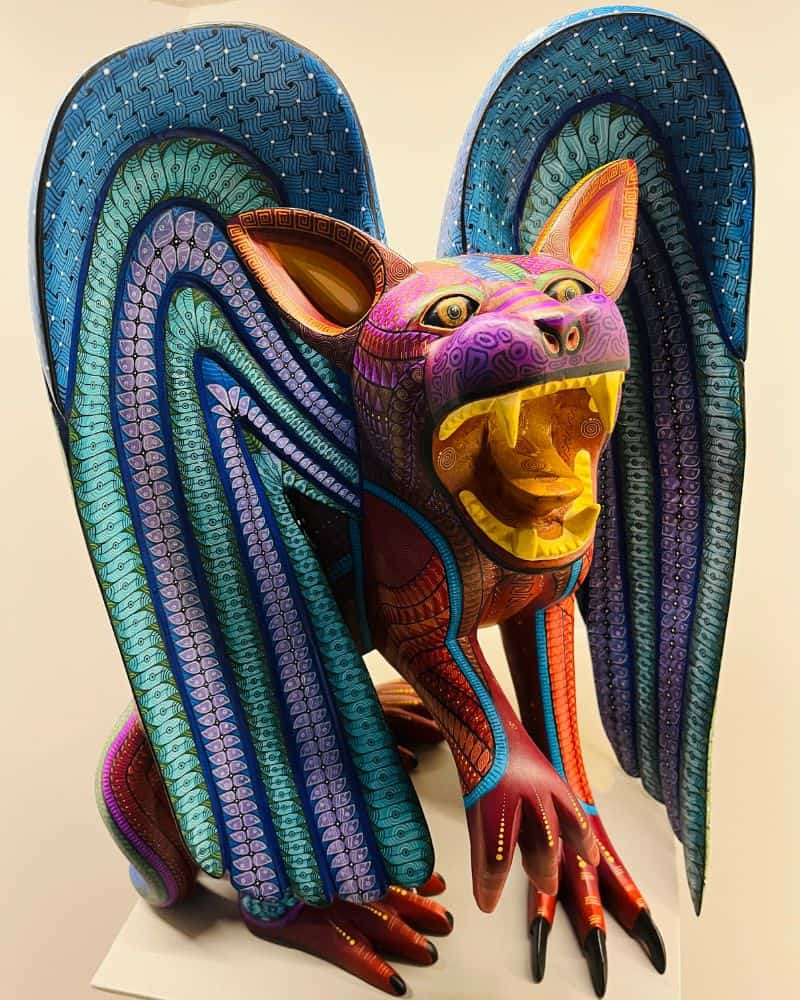
If you love alebrijes, Mexico’s fanciful folk art animals, San Antonio Arrazola is definitely worth a visit!
In fact, the town is so famous for this Oaxaca art that it claimed the title “la cuna de alebrijes” (the birthplace of alebrijes).
👩🎨 Best Way to Go: Book this Oaxaca artisan tour to visit the alebrije town of San Antonio Arrazola, Oaxaca, as well as the Ruins of Monte Alban Oaxaca, and more.
San Antonio Arrazola was the first town in Oaxaca to start making alebrijes from wood. The concept, however, has an interesting background story:
Alebrijes originated from Pedro Linares, a Mexico City artist who suffered a strange dream while ill and feverish.
In his dream, he saw strange fantastical creatures, all of whom shouted nonsense words: “Alebrijes! Alebrijes!”
After recovering, Linares recreated the beasts in papier mâché (paper mache). His alebrijes grew in popularity and were eventually adapted into wood sculptures by artists in San Antonio Arrazola.
Although the art form has spread to a couple of other towns in Oaxaca Mexico, each town and artist produces unique alebrije figures — and no two are alike!
Want to learn more about Oaxaca alebrije art?
You’ll want to Google Pedro Ramirez, Manuel Ramírez, Arsenio Morales and Lauro Ramirez, four of the top alebrije artists associated with this craft.
📍 Location: Find San Antonio Arrazola on Google Maps
6. Santo Tomás Jalieza, Oaxaca: Rug Town
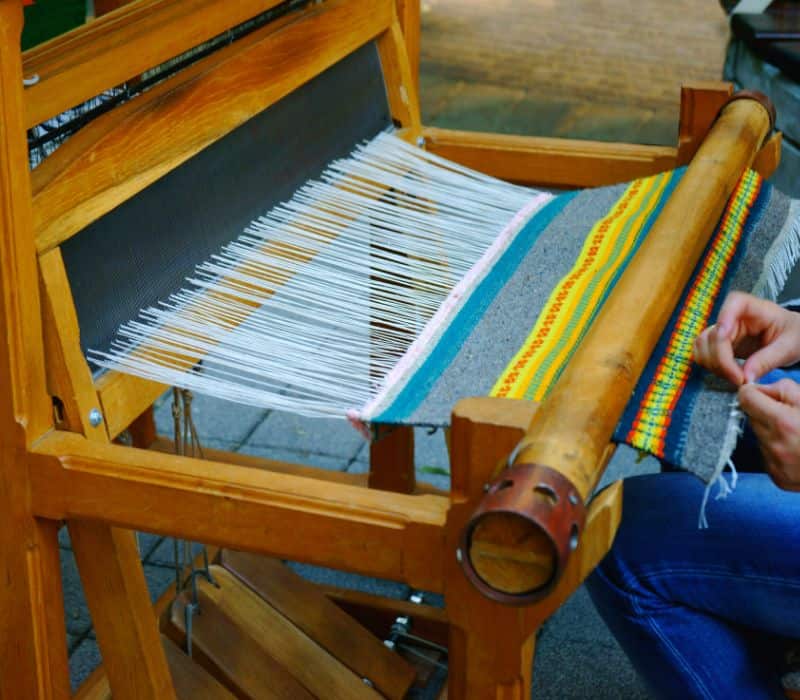
Rugs, belts, handbags, table runners, and placemats abound in the pretty village of Santo Tomás Jalieza.
This town, known as the “town of belts” is well-known for its textiles created on backstrap looms.
👩🎨 Best Way to Go: Enjoy a totally customized Oaxaca itinerary when you book this best Oaxaca private tour. You can include up to 13 stops, like Santo Tomás Jalieza Village, Mitla Ruins and El Tule Tree.
This backstrap loom Oaxaca art form dates back to ancient times, and has been passed down through generations.
The tradition involves using a loom held in place in front of the artisan with straps wrapped around the back.
The artists here tend to make their creations from cotton, combining beautiful colors and designs to make eye-catching placemats, tablecloths, napkins, vests, backpacks, and more.
Many of the artists work at a cooperative, and it’s well worth a stop here. Fridays are the busiest days since many visitors drop by on their way to or from the Ocotlan Market.
Santo Tomás Jalieza is located 15 miles (24 km) from Oaxaca City. You can visit on this tour, or by renting a car in Oaxaca and driving.
📍 Location: Find Santo Tomás Jalieza on Google Maps. While there, also check out the local market and Iglesia de Santo Tomas Jalieza, a beautiful 16th Century church.
7. San Antonino Castillo Velasco, Oaxaca: Embroidery Town

If you love embroidery and/or dried flower arrangements, there’s no better place to visit than San Antonino Castillo Velasco, Mexico.
👩🎨 Best Way to Go: Book this Oaxaca culture tour to see the beautiful the embroidered dresses and floral arrangements in San Antonino Castillo Velasco, as well as other artisan towns in Oaxaca Mexico.
One kind of embroidery practiced in San Antonio is so intricate and hard to pull off that the style is called “hazme si puedes” (make me if you can).
The designs often feature flowers and animals.
Traditionally, they adorned women’s blouses and dresses. However, there are also embroidered shirts for men.
The dresses are sometimes called Oaxacan wedding dresses, and are definitely beautiful enough for the purpose.
Artisans in San Antonio also practice other embroidery styles including “punto de semilla” (seed point), “tejido tradicional,” (traditional fabric), and “pensamientos” (thoughts).
The town’s lesser-known craft involves making flower arrangements from “flor immortal” (immortal flower).
These flowers are special because they maintain their color even when dried.
They are used to make elaborate flower sculptures for religious festivals in Oaxaca, church decorations, and more.
📍 Location: Find San Antonino Castillo Velasco on Google Maps
8. Tlacolula, Oaxaca: Mercado de Tlacolula Sunday Market
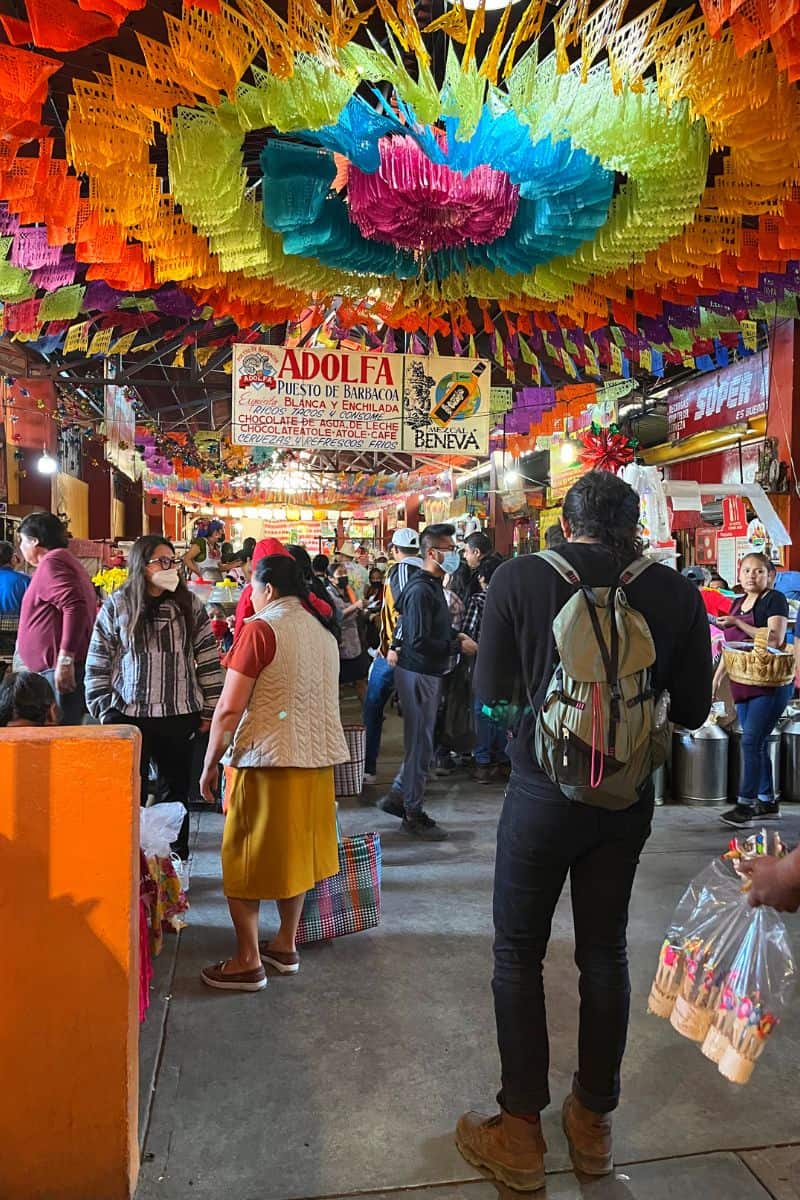
Heading to a market in Mexico is an amazing multi-sensory experience. It’s also a great way to experience local life, buy crafts and eat delicious cuisine, like mole, the most famous food from Oaxaca.
👩🎨 Best Way to Go: Book this Mercado de Tlacolula Tour with a local. It is the perfect way to immerse yourself in Zapotec culture, try delicious local cuisine, and buy unique crafts from Oaxaca.
The Mercado de Tlacolula is one of the best markets to visit in Oaxaca.
It’s the largest market in the Central Valleys region of the state — and the one of the longest-running markets in Mexico.
If you go, you’ll be surrounded by vendors from the highlands wearing colorful garb, and speakers of 16 or more different ethnic languages.
It is truly one of the most unique things to do in Oaxaca City.
🛍️ Oaxaca Sunday Market in Tlacolula
If you can visit on a Sunday, when the market takes place. The market is actually open daily, but the larger section is open Sundays only.
This is the most popular day to go to the Mercado de Tlacolula, so expect large crowds, but a lively, fun experience.
While there, walk, peruse, haggle, and enjoy the colorful chaos.
You can find everything here, from Oaxaca textiles, household wares and utensils, to handicrafts, pottery and “jícaras” (gourd bowls used to drink mezcal or tejate).
If you’re shopping for Oaxaca souvenirs, this is the place.
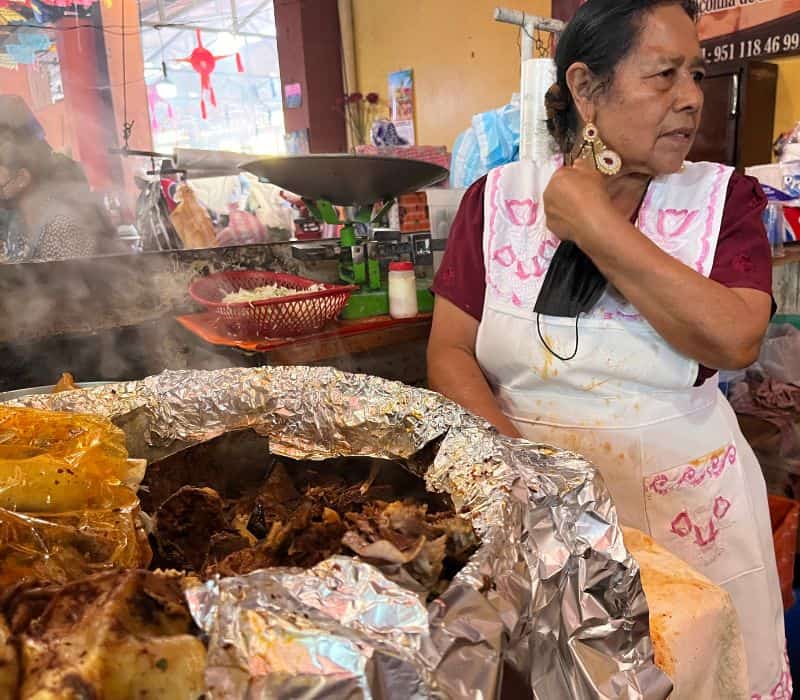
🍖 Pasillo de Humo: Smoke Alley

Once you get hungry, buy veggies, salsas, and tortillas, or venture into the Pasillo de Humo.
A Oaxacan tradition, the famous Pasillos de Humo (smoke alleys) are some of the best restaurants in Oaxaca City.
This “alley of smoke” is lined with vendors selling meat by the kilo. They’ll grill it for you while you wait, enveloped in tantalizing aromas.
Oaxaca Travel Tips: Try the cecina topped with grilled onions 😋
📍 Location: Find Mercado de Tlacolula on Google Maps.
9. Ocotlán de Morelos: Oaxaca Friday Market

Another wonderful market you won’t want to miss is the Ocotlán de Morelos Friday Market.
It only takes place on Fridays, so leave some space on your itinerary for Oaxaca if you’ll be in town on a Friday.
👩🎨 Tour Tip: Pair your market day with this small-group Monte Alban tour, which also stops in the artisan towns of San Antonio Arrazola and San Bartolo Coyotepec.
Here, you can buy Oaxaca art from all across the valley. You’ll even find interesting offerings, like huarache shoes and “sombreros panza de burro,” artisan gaucho-style hats.
You can also buy tepache, mezcals, tejate, and other Oaxacan drinks, as well as Oaxacan textiles, clay figurines, and ceramic vessels.
Once you’ve had your fill shopping for the best bargains, be sure to fill your belly as well! The Ocotlán de Morelos market is a foodie paradise.
🍽️ Frida’s Kitchen in Mercado de Ocotlán Market

Visit the internationally-renowned Frida’s Kitchen for culinary creations made by Beatriz Vasquez, who looks a lot like Frida Kahlo.
Or, try any number of other eateries — you’re sure to find delicious Oaxacan fare at every turn.
Another reason to visit Ocotlán’s market is that it’s a perfect summation of the culture of the municipality. If you want to experience the “real Oaxaca,” you can do that here.
In fact, the market is the subject of a mural painted by artist Rodolfo Morales.
He is famous for capturing and elevating scenes from Ocotlan, Mexico.
📍 Location: Find Ocotlán de Morelos on Google Maps
10. Zaachila, Oaxaca: Oaxaca Thursday Market

One of Oaxaca’s most traditional and authentic markets takes place in Zaachila, Mexico.
The best day to visit this town is on a Thursday, when the market is bustling and you’ll get a fabulous cultural experience.
👩🎨 Best Way to Go: Book this Signature Oaxaca Market Tour with a Oaxaca Native and go on a culinary journey to taste traditional pan dulce (sweet bread), barbacoa (BBQ) consome (soup) and more.
Zaachila is only a 40 minute drive from downtown Oaxaca City.
The easiest way to go is by renting a car in Oaxaca City and driving there. Once in Zaachila, head to the Mercado Municipal market in the center of town.
Here you’ll find all kinds of products, including handicrafts, fruits, veggies, and more. Many of the vendors sit on the ground in their traditional clothing, selling their wares.
You can easily spend two hours wandering amongst them, buying flowers, pottery, hats, baskets, beans, cacao, and sweet bread.
Mezcal, agua miel (honey water), and pulque are also available — served in a traditional jícara gourd bowl. How fun is that?
A food court on the inside is also a must-stop for ice cream. Buy nieves (sorbet) or malteadas (shakes), perfect for taking the edge off the heat.
Enjoy the market, buy products to your heart’s content, or turn them into a photo walk.
📍 Location: Find Zaachila Oaxaca on Google Maps
11. Villa de Etla, Oaxaca: Oaxaca Cheese Town

While in Oaxaca, you’ve probably come across the region’s renowned quesillo, or Oaxaca string cheese.
It’d be hard to spend any time in Oaxaca without eating it since it is commonly served atop appetizers, snacks, and local dishes.
This cheese, known as quesillo (pronounced kay-see-yo), is a tasty, white string cheese that is bouncy, stretchy, and flavorful.
The artisan town of Villa de Etla is known as the birthplace of Oaxacan quesillo.
If you’re a cheese fiend, it is well worth the trip! The best way to visit is by getting a rental car in Oaxaca and driving to the Village of Etla.
It is about 20-40 minutes north of Oaxaca City.
Quesillo is a bit tricky to make because it has to be stretched when the cheese is at a specific pH.
The cheese is made by dropping it in a bath of boiling water, then pulling it out and stretching it into long mozzarella-like threads.
Then the threads are wound up into a ball and packaged in plastic.
The best quesillo is made from fresh milk, but some vendors use milk powder instead to cut costs.
The extra investment pays off in flavor.
📍 Location: Find Villa de Etla on Google Maps. If you can, ask a local if they know of anyone offering a quesillo making class or demo so you can see the traditional way of making this famous Oaxaca cheese.
12. Tlacolula de Matamoros, Oaxaca: The Land of Mezcal

Tlacolula de Matamoros is known best for one thing: Mezcal.
This area is the top Oaxacan mezcal producer, as the majority of mezcal comes from here in “la Tierra de Mezcal,” or the Oaxaca Land of Mezcal.
👩🎨 Best Way to Go: Visiting a mezcal distillery in Tlacolula is an amazing way to learn from and meet local mezcaleros (master mezcal makers), and sample the best Oaxaca mezcal from small producers.
The best mezcal begins with the best agave — and many say that it’s grown here on the mezcal roads of Tlacolula de Matamoros, Mexico.
Depending on the type, the agave plants for mezcal are grown for 7-25 years before getting cut down and processed.
They are left to naturally ferment, then double-distilled in copper stills or “barro” clay pots.
Visit Mezcal Pensamento to try 20 different varieties of mezcal, such as fruit and coffee mezcal.
Alternatively, book a tour and tasting of Salvadores Mezcal at Casa Palacios Distillery.
If you’re in Oaxaca in October, don’t miss Tlacolula’s annual Mezcal, Craft and Gastronomy Festival.
While best known for artisan mezcal, don’t miss the Tlacolula Sunday Market to buy some non-boozy art.
Artists in Tlacolula de Matamoros are known for their intricate ironwork (the doors of the Chapel of the Señor del Tlacolula Church are a great example of this art form) and delicious “pan de yema,” a sweet bread made with egg yolk.
📍 Location: Find Tlacolula de Matamoros on Google Maps
Oaxaca Artisan Towns: Frequently Asked Questions
What crafts are Oaxaca known for?
Oaxaca is known for many different handicrafts, including wool rugs and textiles, black pottery, green-glazed pottery, intricate embroidery and Oaxacan alebrijes. The diversity is stunning!

One of Oaxaca’s most well-known crafts are alebrijes (pronounced al-lay-bree-hays).
These fantastical wooden sculptures are a delightful combination of whimsy and flamboyant colors.
Although alebrijes exist in other parts of Mexico, Oaxaca artists in San Antonio Arrazola were the first to make these creations in wood rather than papier mâché.
Other common handicrafts include “bordado” embroidery, green-glazed pottery, metal work, candles, baskets, flower sculptures, and the graphic Oaxaca art prints.
Some of the Oaxaca art is good enough to eat!
When visiting, don’t miss the Oaxaca culinary delights that are works of art in their own right, namely the artisan mezcal, and artisan foods from Oaxaca, especially Oaxacan cheese.
One unique feature of Oaxaca art is that much of it began before the Spanish arrived.
Of course, the Spanish did bring in some new technologies and techniques, but many of the art forms remain largely unchanged.
Where can I buy crafts in Oaxaca?
Visiting the towns and villages in Oaxaca’s Central Valley is one of the best ways to buy handicrafts in Oaxaca — and probably the most fun too!

By visiting each village and seeing the homes and studios of different artisans, you’ll get a much deeper and richer appreciation for each art form.
It will also add extra layers of meaning to anything you buy. Way beyond the trinkets and prints you might order from Etsy with gift cards.
Of course, it isn’t always practical to visit many different villages and studios.
Shopping in the major markets is a prime way to peruse and purchase lots of different handicrafts all in one place.
Consider visiting the Mercado de Tlacolula market, the Mercado de Ocotlán market, and the Mercado de Zaachila market.
Where can you find the best folk art in Oaxaca?
You can find the best folk art in Oaxaca in the Valles Centrales, or Central Valleys region. This area is brimming with artisan towns, most of which are dedicated to one or two specific crafts.

For the largest variety of handicrafts all in one place, visit the markets, especially the Sunday Market in Tlacolula de Matamoros, Mexico, and the Friday Market in Ocotlán de Morelos, Mexico.
If you’re looking for a specific handicraft, consider going straight to the source!
Nothing beats visiting the studios and homes of incredible Oaxaca artists.
Hearing their stories and learning about their production process adds so much more meaning to the wall art shopping experience.
Plus, you’ll get to understand why true Oaxacan art isn’t about just finding the lowest price.
In short: If you want a true five stars experience you won’t soon forget, you must chat up the artists themselves.
My Final Thoughts on the Best Oaxaca Artisan Towns to Visit

Oaxaca art is rich, varied, and beautiful. You could spend days visiting all of the different artisan towns in Oaxaca.
Located within 1-2 hours of Oaxaca City, they definitely make for some of the best day trips from Oaxaca.
The Oaxacan Art Towns have so much to offer visitors — from naturally dyed red wool rugs, to glossy black pottery, to the flavorful bounce of Oaxaca cheese and the multicolored alebrije figures.
If you can’t make it to every one of the towns, don’t worry!
You can also visit the Santo Domingo Cultural Center in Oaxaca City to see crafts on display from various Oaxaca artisan towns in the region.
🎭 Want to see the best Oaxaca street art? You’ll find that in Oaxaca City on this tour; not the artisan villages nearby.
So what art catches your interest the most? Which of these Oaxaca artisan towns do you want to visit?
Will you book a tour to visit multiple Oaxaca artisan towns in a single day, pick a few favorites to check out with your rental car, or take a colectivo to hit up the markets?
No matter what you decide, you’re sure to have an incredible time while you’re there. Plus, you’ll come home with gorgeous folk art. What could be better?
