
Mexico’s Whale Shark Season Just Opened — Here are 15 Things You Don’t Know About Whale Sharks


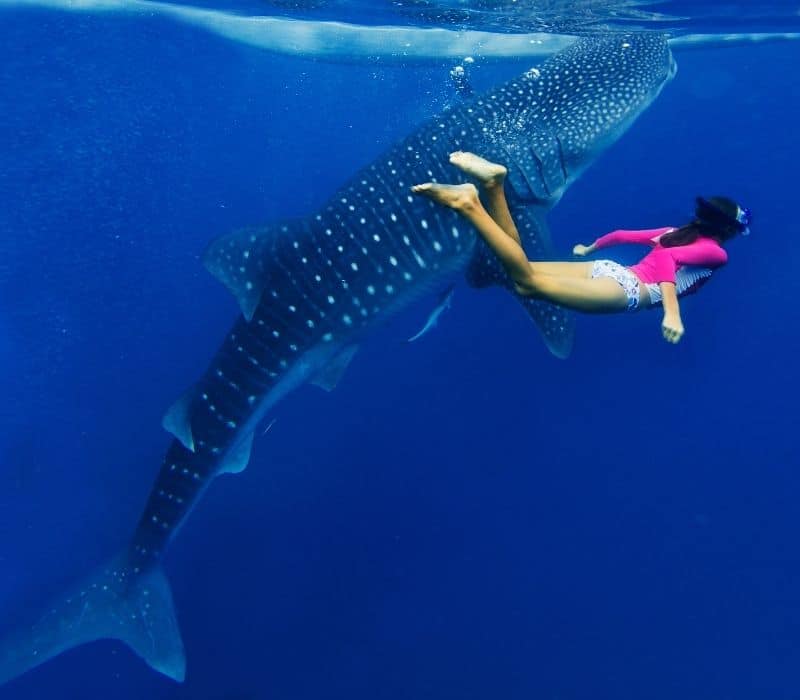
Last year, I finally crossed swimming with the whale sharks off my bucket list on this whale shark swim off the coast of Isla Mujeres, Mexico.
As I live in Mexico, and Mexico is one of the few places to swim with whale sharks in the world, I took full advantage of the opportunity.
Not only was it one of the coolest things I’ve done since moving to Mexico, I became obsessed with whale sharks because as it turns out, they’re fascinating animals (not just giant ones).
If you want to learn about these magnificent creatures too, or you’re planning to go swimming with whale sharks in Mexico (or elsewhere), you’re in for a treat.
Here are 15 enthralling facts about whale sharks that will deepen your appreciation for these majestic beings.
1. Whale Sharks are Sharks; not Whales
Contrary to what their name might suggest, whale sharks are not whales. They belong to the shark family, similar to basking sharks and mako sharks.
These giants of the sea resemble whales due to their massive size and their feeding behavior, which involves filter-feeding like baleen whales.
However, they’re true sharks because their bodies are made of cartilage.
2. Whale Sharks are the Largest Fish in the Sea
Imagine a school bus gliding through the ocean; that’s how enormous whale sharks can be.
Known as the largest fish in the sea, they can reach lengths of up to 40-feet-long (12 meters), dwarfing many marine creatures and even some terrestrial ones.
The species was first documented in 1828 by military doctor Andrew Smith after a specimen was harpooned in Table Bay, South Africa — Can you imagine what he was thinking when he saw this ocean giant?!
3. Whale Sharks Live Up to 130 Years
Whale sharks are not only remarkable for their size, but also for their longevity.
Previously thought to live between 70 to 100 years, recent research suggests they can live up to 130 years, thanks to innovative methods like using lasers and cameras to measure their growth more accurately.
4. Female Whale Sharks Grow Larger than Males
The growth trajectory of whale sharks is intriguing for many reasons — especially because the females are larger than the males, which is uncommon for most animals.
While females do grow larger, they mature at a slower pace compared to males.
While males reach sexual maturity at around 30 years, females take about 50 years, achieving lengths up to 14 meters.
It is because of this slow journey to maturity that whale sharks live so long.
5. Whale Sharks Give Birth to Live Young

Whale sharks have an unusual reproductive method called ovoviviparity, where fertilized eggs are kept inside the mother’s body until they are ready to hatch.
This process results in the birth of live young after a gestation period of about 11 months, with the mother capable of carrying up to 300 pups at a time.
🐋 Bonus Fun Fact: Whale shark babies are called pups!
6. Whale Shark Eggs Larger Than Ostrich Eggs
The eggs of whale sharks are impressive, being twice the size of ostrich eggs — which are the largest bird eggs.
These gigantic eggs are a rare find and offer a glimpse into the early development stages of these ocean giants.
7. Whale Sharks Have a Mouthful of Tiny Teeth

Despite having about 3,000 tiny teeth, whale sharks use their expansive mouths to filter feed, consuming plankton and small fishes rather than biting or chewing.
In fact, as filter feeders, whale sharks can’t bite or chew.
8. Whale Sharks are Harmless to Humans
Wondering, Do whale sharks bite? No, there are no records showing that a whale shark has ever bit a human.
Despite their intimidating size, whale sharks pose no threat to humans at all — in fact, we’re more of a threat to them.
They’re known for their gentle nature, often approaching divers and boats out of curiosity rather than aggression.
However, if you’re booking a whale shark tour in Mexico, you’ll be instructed to keep your distance and never touch a whale shark because this is still a massive wild animal at the end of the day.
9. Whale Sharks Have Spots

The spot patterns on whale sharks are as unique as human fingerprints, offering researchers a way to identify individual sharks and study their life histories.
10. Whale Sharks are Buoyant Thanks to Their Massive Liver
The whale shark’s liver is a marvel of nature, making up about 25% of its body weight and playing a crucial role in buoyancy.
This large organ allows them to effortlessly glide through ocean waters.
11. Whale Sharks Consume 1500 Gallons of Water per Hour
In their quest for plankton, whale sharks can process up to 1,500 gallons of water per hour (5,675 liters), acting like giant filters of the sea.
12. Whale Sharks are Effortless Swimmers
Despite their size, whale sharks are not vigorous swimmers. Rather, they move calmly yet swiftly.
Side Note: As someone who did the whale shark swim in Mexico, let me say that they move MUCH faster than you think they do!
They rely on their massive bodies and tail fins to glide through the water, conserving energy as they feed.
13. Whale Sharks Travel Long-Distance

Whale sharks are widespread, but prefer the warm water near places like the Philippines, Australia, the Maldives, Indonesia, Belize and Mexico.
They frequent areas from the western Atlantic Ocean and Caribbean Sea to the eastern Atlantic near Senegal, Mauritania, and Cape Verde in Africa, and extending to the Indian and Pacific Oceans.
Whale sharks also hold the record for the longest migration distances among fish, traveling up to 12,000 miles (19,300 km) to find food and return to their breeding areas.
14. Whale Sharks Never Truly Sleep
Whale sharks have a unique resting behavior — but they never reach State 4 sleep (AKA REM sleep) like terrestrial animals do.
As obligate ram ventilators, they must keep swimming to breathe, allowing only parts of their brain to rest at a time, likely entering a state akin to slow-wave sleep.
15. Whale Sharks Have Eye Protection Like No Others
Whale sharks have dermal denticles around their eyes, similar in structure to teeth, which protect their eyes from parasites and aid in reducing drag while swimming.
I hope these 15 facts about whale sharks highlighted awe-inspiring aspects about one of the ocean’s most magnificent creatures.
Whether you’re fortunate enough to swim alongside them like I did, or you’re simply fascinated by their biology, whale sharks continue to inspire and intrigue marine enthusiasts around the world.